
Every trap. Every time. Decoded.
Newcastle Dog Results — Race Data, Trap Stats & Track Guide
 Available in US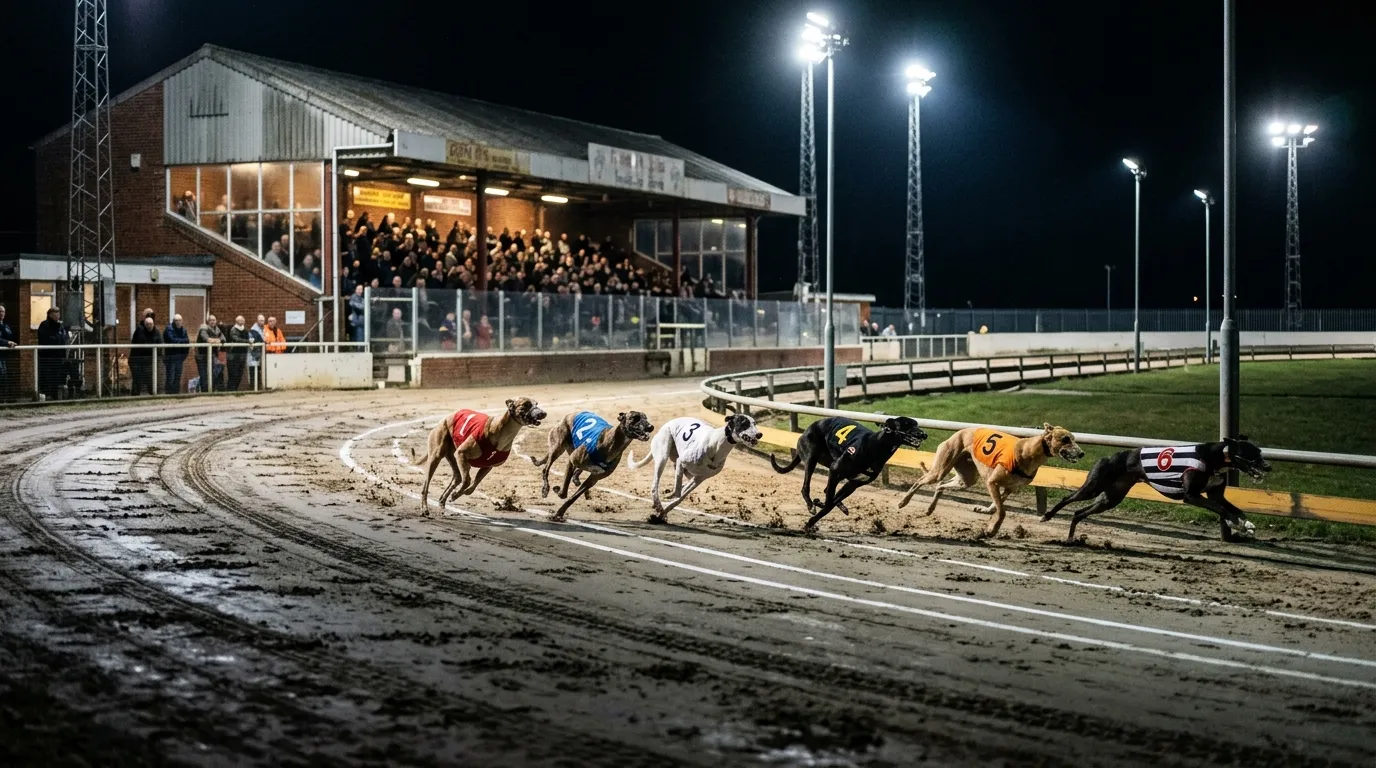
Newcastle Dog Results: What This Guide Covers
Newcastle dog results tell a story that goes well beyond finishing positions. Every racecard printed at the Fossway stadium carries sectional splits, trap draws, trainer codes and grading data — information that separates a casual punter from someone who actually understands what happened in a race and, more importantly, why it happened.
This guide breaks down every layer of Newcastle greyhound results so you can read them properly, spot patterns the odds miss, and make sharper decisions on race night. We cover the stadium's six racing distances, how the track's 415-metre circumference and Swaffham hare system shape the action, and why certain traps consistently outperform others. You will also find sections on betting markets, the history of the All England Cup, the welfare framework behind the sport, and practical advice for visiting the stadium itself.
The scale of the sport behind those results is worth noting. In 2024, GBGB-licensed tracks across Britain recorded 355,682 individual starts — a figure generated by an ecosystem of roughly 500 licensed trainers, 15,000 registered owners and around 6,000 greyhounds entering racing each year. Newcastle is one of the busiest venues in that network, running four meetings a week and attracting a growing audience year on year.
Whether you are checking Newcastle greyhound results for tonight's card, researching form before placing a forecast, or simply trying to make sense of what "EPace, Crd, RnIn" means on a result line, this is the reference you need. Every section links outward to deeper cluster guides where the detail goes further, but this pillar is designed to stand on its own as the most complete single resource on Newcastle dog results available anywhere online. Start wherever the question is — distances, traps, betting markets, welfare — and work through at whatever depth the situation demands.
The Fast Track Summary
- Newcastle runs six distances from 290m to 895m on a 415-metre sand oval with a Swaffham hare — one of the most varied programmes in British greyhound racing.
- Trap 2 is the historically dominant box at Newcastle, outperforming the UK-wide trend where Trap 1 typically leads at around 18–19% win rate.
- The stadium races four days a week — Tuesday morning, Wednesday and Friday daytime, Thursday evening — making it one of the highest-frequency tracks in the country.
- GBGB's 2024 data shows a 94% rehoming rate for retired greyhounds, up from 88% in 2018, with economic euthanasia down 98% over the same period.
- The All England Cup, a Category One event staged at Newcastle since 1938, drew an 85% year-on-year attendance increase at its 2025 final night.
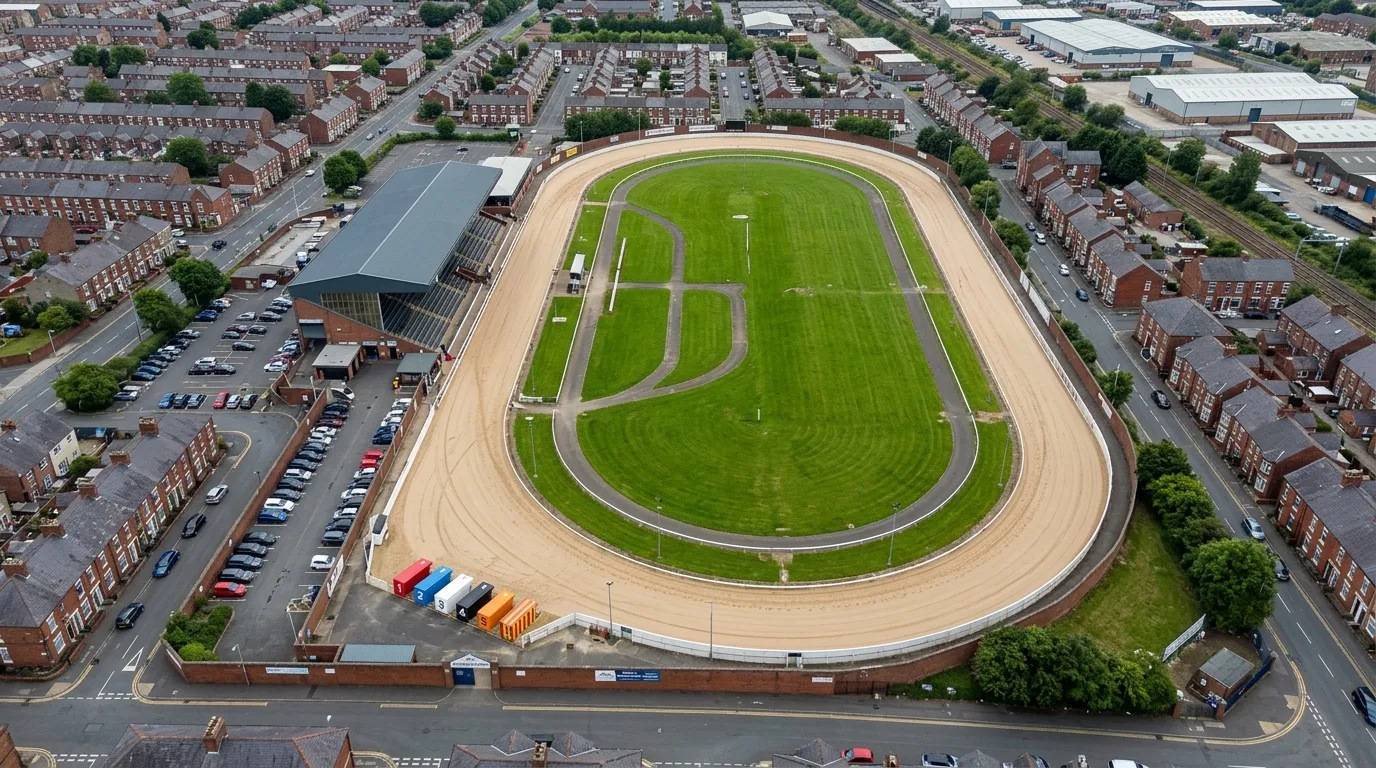
Newcastle Greyhound Stadium at a Glance
Location
Fossway, Byker, Newcastle upon Tyne, NE6 2XJ
Operator
Arena Racing Company
Circumference
415 metres
Hare System
Swaffham inside-rail
Racing Days
Tue, Wed, Thu, Fri
Distances
290m to 895m
Paragraph about the stadium location and operator.
Paragraph about track specifications and hare system.
Paragraph about the racing schedule and frequency.
Paragraph about footfall trends and attendance data.
Paragraph about the volume of data Newcastle produces.
Race Distances and Track Surface Explained
Newcastle offers six standard race distances: 290m, 480m, 500m, 640m, 706m and 895m. That range is unusually broad for a single track — most GBGB venues card races over three or four distances — and it means Newcastle dog results reflect a wider variety of racing styles than you will find at many rival stadiums.
Sprint Distances: 290m
The 290-metre dash is effectively a bend-and-straight race. Dogs break from the traps, negotiate a single turn and power down the home straight. At this distance, early pace is everything. A greyhound that traps slowly or loses ground at the first bend has almost no time to recover. When you read Newcastle dog results at 290m, the sectional time to the first bend is the single most important data point — it usually dictates the finishing order.
Standard Distances: 480m and 500m
The 480m and 500m trips are the bread and butter of the Newcastle programme. These are the distances you will see most often on a racecard, and they cover approximately one full lap of the 415-metre circuit plus a run to the finish line. The 480m is the more common of the two and provides the largest sample of results for statistical analysis. It is also the distance at which trap bias patterns tend to be most reliable because grading-race fields at this trip are the most competitive and consistent.
The 20-metre difference between 480m and 500m is small on paper but significant in practice. The extra distance extends the second bend, giving wide runners marginally more time to improve position before the final straight. If you are studying Newcastle greyhound results and notice a dog consistently finishing stronger at 500m than 480m, that 20-metre difference is often the explanation.
Middle Distance: 640m
At 640m, the emphasis shifts from raw early pace to stamina and tactical positioning. These races cover roughly one and a half laps, meaning dogs face three bends rather than two. The run-in after the final turn is shorter relative to the overall distance, which punishes greyhounds that rely purely on a late burst. What matters here is consistency through the bends — dogs that hold their position without checking or losing ground tend to dominate the 640m results at Newcastle.
Staying Distances: 706m and 895m
The 706m and 895m races are the domain of stayers — dogs bred and trained for endurance rather than explosive speed. These trips appear less frequently on the Newcastle racecard, typically once or twice per meeting, which means the sample of results is smaller and trap bias data for these distances should be interpreted with more caution. The 895m race is almost two full laps and is one of the longest standard distances in British greyhound racing. The early pace matters less here; what matters is whether a dog can sustain its speed through four or five bends without fading.
The Sand Surface
Newcastle runs on a sand surface, which is the standard across all GBGB-licensed tracks. Sand provides a consistent running surface that can be graded and maintained between meetings, but it reacts to weather. Rain makes it heavier and slower; dry spells allow it to firm up and run faster. These conditions are reflected in the "going" information published before each meeting and they directly affect race times. A 29.50-second 480m run on firm sand might translate to 29.80 or slower on a rain-softened track, so when comparing Newcastle dog results across different dates, always check the going report first.
Newcastle's six-distance programme creates a deeper, more varied dataset than most British tracks. Sprint, standard, middle and staying results each reward different running styles, and reading them accurately starts with understanding what each distance demands.
How to Read Newcastle Greyhound Results
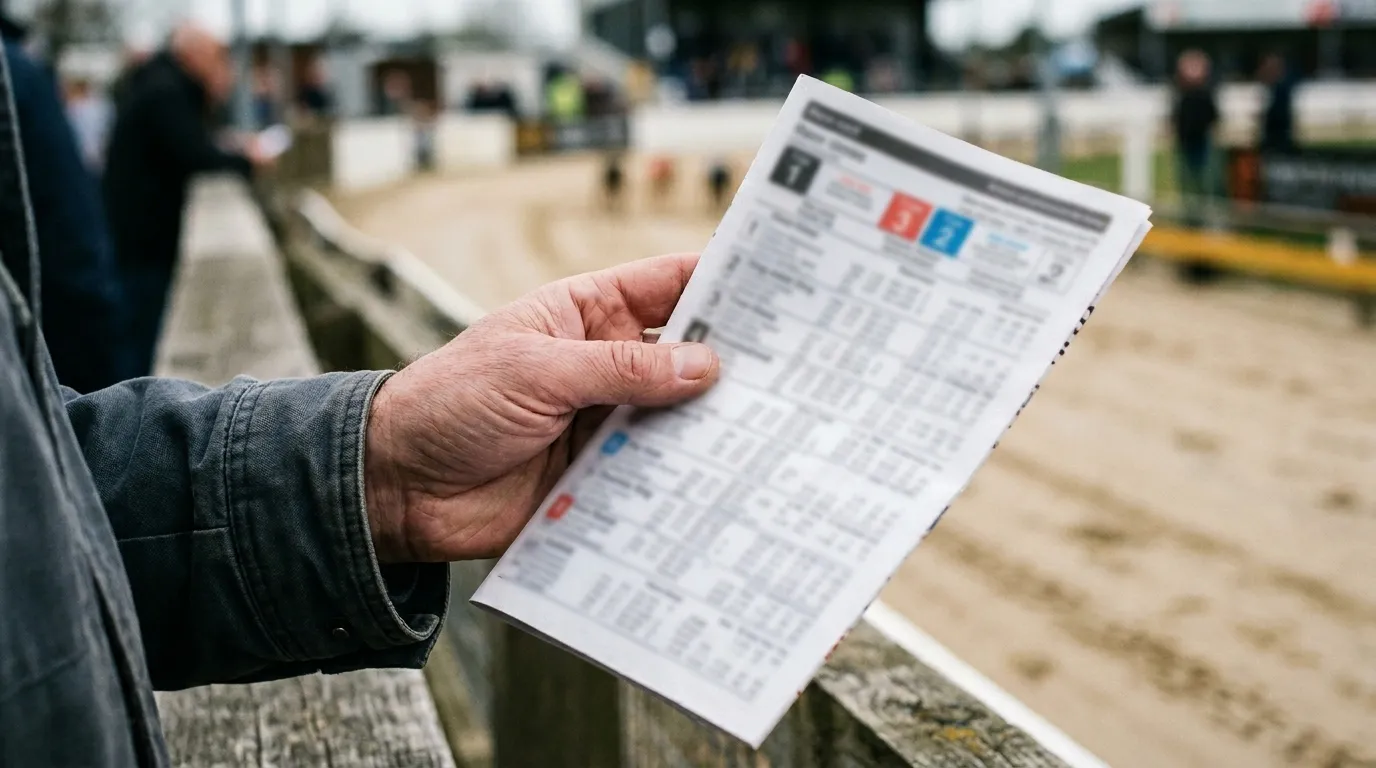
A Newcastle greyhound result line is a compressed data record. Every element — from the trap number to the closing comment — carries information that experienced bettors use to assess a dog's true ability. If you have ever stared at a column of abbreviations and numbers wondering what half of it means, this section is for you.
The Result Line Structure
A typical Newcastle result entry reads left to right and contains these elements: finishing position, trap number, dog name, sectional split to the first bend, bend positions through the race, finishing time, distance beaten or winning margin, and running comments. Some platforms also display the starting price, the trainer name and the weight carried. When you look at Newcastle dog results online or in a printed racecard, the exact layout varies between providers, but the underlying data is always the same.
Here is what a standard 480m result might look like in compressed form:
1st — Trap 2 — Ballymac Doris — 4.72 — 1-1-1 — 29.48 — 2L — EPace, ALd, RnIn
That tells you: the winner ran from Trap 2, reached the first bend in 4.72 seconds, led at every checkpoint, finished in 29.48 seconds, won by two lengths, and the running comments confirm she showed early pace, led all the way, and ran in close to the rail.
Sectional Times and What They Reveal
The split time to the first bend — 4.72 in the example above — is arguably the most valuable number in any result line. At Newcastle, the run from the 480m traps to the first timing point is approximately 130 metres. A time of 4.60 to 4.70 indicates a genuinely fast breaker; 4.80 and above suggests a dog that needs time to find stride.
Why does this matter? Because early pace determines whether a dog races in clean air or gets caught in traffic. A greyhound that clocks 4.65 to the first bend and secures the rail is running its own race. A dog clocking 4.85 from the same trap is already fighting for position and may encounter interference on the bends. When you scan a sequence of Newcastle dog results for a particular greyhound, the trend in its sectional splits tells you more about its true form than the finishing position alone.
Bend Positions Decoded
The "1-1-1" in the example above is the positional call — where the dog was placed at each checkpoint. Most Newcastle races at 480m have three positional calls: first bend, second bend and entering the home straight. A sequence like 3-2-1 tells you the dog was third at the first bend, improved to second by the next checkpoint, and led into the straight. That is a classic closing pattern, and it tells a very different story from a dog that runs 1-1-3 — fast away but fading.
These positional records become powerful tools when you stack them. If a dog has run 5-4-3, 4-3-2 and 3-2-1 across its last three outings at Newcastle, the improving pattern is unmistakable, regardless of whether it won any of those races. Conversely, a consistent frontrunner that suddenly records 1-1-3 in its last run is flagging a problem — fatigue, a step up in class, or possibly an injury issue. The results page does not spell these things out; you have to extract them.
Running Comments: The Abbreviated Story
The running comments at the end of each result line are written by the race judge and condensed into standard abbreviations. These are worth learning because they describe what happened during the race in a way that finishing times alone cannot. The most common abbreviations you will encounter in Newcastle dog results include:
EPace — showed early pace from the traps.
SAw — slow away from the trap.
Crd — crowded during the race.
ALd — all led, trap to line.
Paragraph on interpreting comment combinations.
Finishing Margins and Adjusted Times
Paragraph on margin conversion and adjusted time calculation.
Key takeaway on the five layers of result data.
Newcastle Trap Bias: Which Box Wins Most?
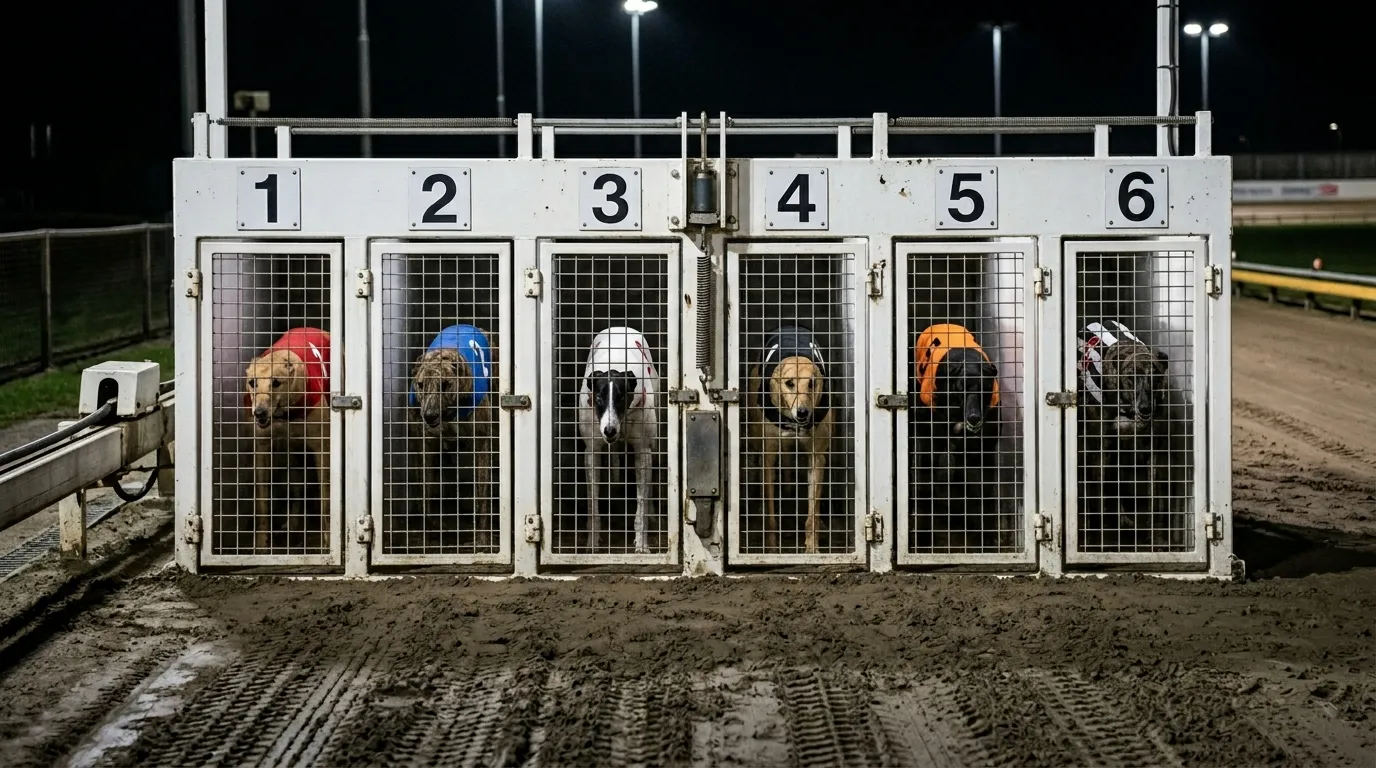
If every trap at every greyhound track had an equal chance of producing the winner, each of the six boxes would win roughly 16.6% of races. They do not. Track geometry, hare type, circumference and the run to the first bend all create biases that persist over time, and Newcastle is no exception.
The UK-Wide Baseline
Across British greyhound racing as a whole, Trap 1 — the red jacket, closest to the inside rail — wins at approximately 18 to 19% of all races, a significant edge over the theoretical average. The explanation is straightforward: the inside box gives a dog a protected inside flank against the rail. When the hare runs on the inside, a Trap 1 dog that breaks level with the field has the shortest path to the first bend and the most sheltered racing line. This advantage is strongest at sprint and standard distances where the first bend arrives quickly.
Newcastle's Trap 2 Anomaly
Newcastle breaks the national pattern. Historical data from the stadium shows that Trap 2 — the blue jacket — has produced more winners than any other box over extended sample periods. This is unusual. While Trap 1 still performs above average at Newcastle, it is the blue box that holds the statistical edge.
There are plausible explanations for this. Newcastle's 415-metre circumference means the bends are relatively tight. A Trap 1 dog that breaks slowly risks being squeezed against the rail by a faster Trap 2 runner on its immediate outside. The Trap 2 dog, meanwhile, has one layer of protection on its inside (from Trap 1) but also has a fractionally wider angle into the first bend, allowing it to position itself for the racing line without being forced into the rail. On a Swaffham inside-hare track where tight bending is the norm, that positional advantage appears to compound over hundreds of races.
None of this means you should blindly back Trap 2 at Newcastle in every race. What the data suggests is that when all other form factors are roughly equal — similar grades, comparable sectional times, no strong early-pace standout — Trap 2 has a slight edge that is worth incorporating into your assessment. The bias is also distance-dependent. At 290m, where the first bend arrives almost immediately, the inside traps hold a more pronounced advantage. At 640m and above, the extra bends dilute the opening draw, and trap bias becomes less predictive. The most reliable application of this data is over the standard 480m trip, where sample sizes are largest and grading tends to produce the most evenly matched fields.
How Favourites Perform
It is also worth placing trap data in the context of market expectation. Industry analysis indicates that the market favourite wins roughly 30% of greyhound races, with the top three in the betting accounting for approximately 73% of winners. That means the favourite loses more often than it wins, and even the top three in the market fail to provide the winner in about one race in four. Trap bias does not override ability, but in the roughly 27% of races where an outsider prevails, a favourable draw is often part of the explanation.
At Newcastle, Trap 2 carries a historically proven statistical advantage. Nationally, Trap 1 leads at 18–19%. In both cases, bias is a tiebreaker in competitive fields — not a standalone betting system. Combine it with sectional data and grading context before using it to adjust selections.
Transition from trap analysis to betting markets.
Betting Markets at Newcastle Dogs
Greyhound racing and betting are structurally inseparable in Britain. The sport is largely funded through media rights agreements with bookmakers and pool contributions from on-course and off-course wagering. Understanding the available markets at Newcastle is not just about placing bets — it is about understanding the economic engine that keeps the results coming.
Win and Each-Way
The simplest market is a win bet: pick the dog you think will finish first. Each-way extends that to cover a place finish, typically first or second in a six-runner race. The each-way terms at Newcastle greyhounds are usually one-quarter the win odds for a place, though this can vary between bookmakers. If your selection is returned at 8/1 and you bet each-way, a second-place finish pays 2/1 on the place portion. Win betting is where most beginners start, and for good reason — it is the easiest market to understand and the most directly connected to the form analysis covered earlier in this guide.
Forecast and Tricast
A forecast bet requires you to predict the first and second finisher in the correct order. A tricast demands the first three in exact sequence. These markets are where greyhound betting becomes genuinely challenging — and where the payouts reflect that difficulty.
Forecast Example
You fancy Trap 2 to win and Trap 5 to finish second in a 480m A3 race. If you place a £1 straight forecast and both dogs finish in the predicted positions, the payout is determined by the Computer Straight Forecast calculation, which uses the starting prices of the runners. A typical CSF return might be £15 to £40 for a mid-priced combination, but it can run much higher if either selection is at long odds.
A reverse forecast covers both possible orders — Trap 2 first/Trap 5 second, or Trap 5 first/Trap 2 second — but costs £2 for a £1 unit stake because it is effectively two bets.
Paragraph on tricast mechanics and combination bets.
Tote and Pool Betting
Paragraph on tote pool mechanics at Newcastle.
Starting Price vs Exchange Odds
Paragraph comparing SP and exchange pricing.
Transition to the All England Cup section.
The All England Cup and Category One Racing
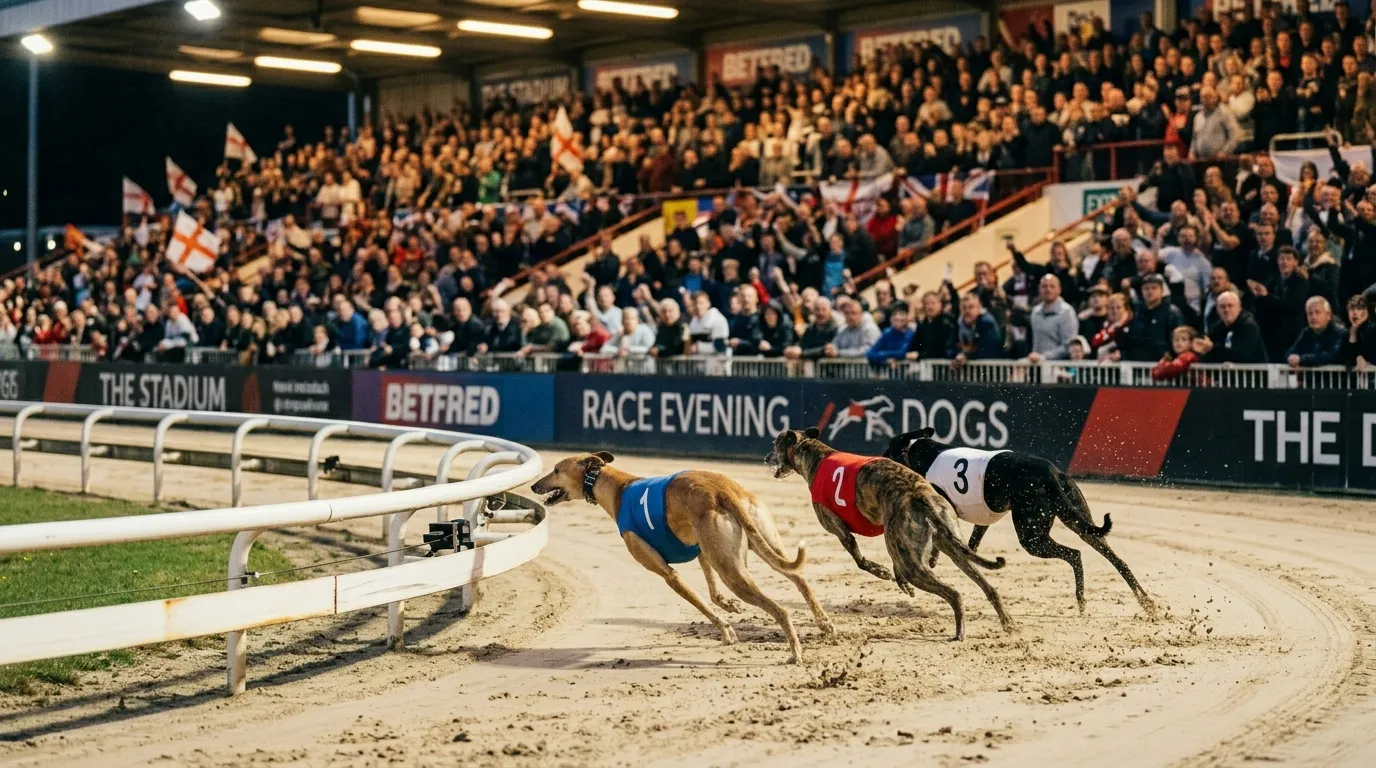
Newcastle's position in the greyhound racing calendar is defined by one event above all others: the All England Cup. First staged at Brough Park in 1938, it is one of the longest-running Category One competitions in the sport — and it has never left its home track. That kind of continuity is rare. The English Greyhound Derby has moved between venues repeatedly over the decades; the All England Cup has stayed put in Byker for nearly ninety years.
Category One is the highest classification in British greyhound racing, reserved for the sport's premier events. To qualify as Category One, a race must meet minimum prize money thresholds — currently at least £12,500 for the winner — and attract open-class fields drawn from the top tier of the greyhound population. The total prize money pool for all greyhound racing in Britain stands at £15,737,122, with the English Greyhound Derby alone offering £175,000 to the winner. The All England Cup does not match the Derby's prize fund, but its standing and its audience continue to grow.
The evidence for that growth is concrete. At the 2025 All England Cup final night, Newcastle Stadium recorded an 85% increase in attendance compared to the previous year's final. For a single evening event at a sport not exactly drowning in media coverage, that is a remarkable number. The All England Cup has become the kind of occasion that draws people who might attend greyhound racing only once or twice a year — a flagship night that functions as both a sporting event and a social evening.
The competition format is built around heats, semi-finals and a final, typically run at 480m. Entries come from trainers across the country, meaning the Newcastle regulars face visiting dogs from kennels with national reputations. That inter-track dimension is what lifts the racing quality above the standard BAGS meeting: the fields are faster, the margins tighter, and the result lines generate data that is worth studying long after the cup has been awarded. For bettors, the All England Cup heats are valuable because they pit Newcastle specialists — dogs whose sectional splits and bend-position patterns you may already know — against visitors whose form has been built at tracks with different circumferences, hare types and going characteristics.
In 2026, the All England Cup season carries additional weight. This is the centenary year for greyhound racing in Britain — the first modern oval-track meeting was held at Belle Vue, Manchester in 1926 — and flagship events like the All England Cup will inevitably attract heightened interest. Arena Racing Company has signalled its intention to build on the record-breaking 2025 attendance figures, and the centenary framing gives the 2026 edition a promotional hook that extends well beyond the core racing audience. For anyone tracking Newcastle dog results through the spring and summer, the cup heats are among the most analytically rich races on the calendar.
The All England Cup has been held at Newcastle (then Brough Park) since 1938, making it one of only a handful of Category One greyhound events that has remained at its original venue for its entire history.
From Brough Park 1928 to Newcastle Stadium
The track on Fossway has seen racing for nearly a century. What opened as Brough Park in the late 1920s has become, under successive owners, the sole surviving greyhound stadium in the North East — and one of the most active in Britain.
The first race at the venue took place on 23 June 1928. The winner was a dog called Marvin, returned at 3/1. It is a detail that survives mainly in local histories, but it places Newcastle's track in the sport's early expansion phase. Modern oval-track greyhound racing had begun just two years earlier at Belle Vue in Manchester, and stadiums were opening rapidly across the country. At its peak, Britain had more than 77 licensed greyhound venues. Newcastle was among the first wave outside London and the industrial Midlands.
Brough Park staged its inaugural greyhound meeting on 23 June 1928 — nearly four months before King George V officially opened the Tyne Bridge on 10 October the same year. The dogs got there first.
Paragraph on Newcastle's lost greyhound stadiums.
Paragraph on ownership history through the decades.
Paragraph on the ARC era and Entain media deal.
Paragraph on the centenary and the venue's endurance.
Greyhound Welfare and Retired Racer Adoption
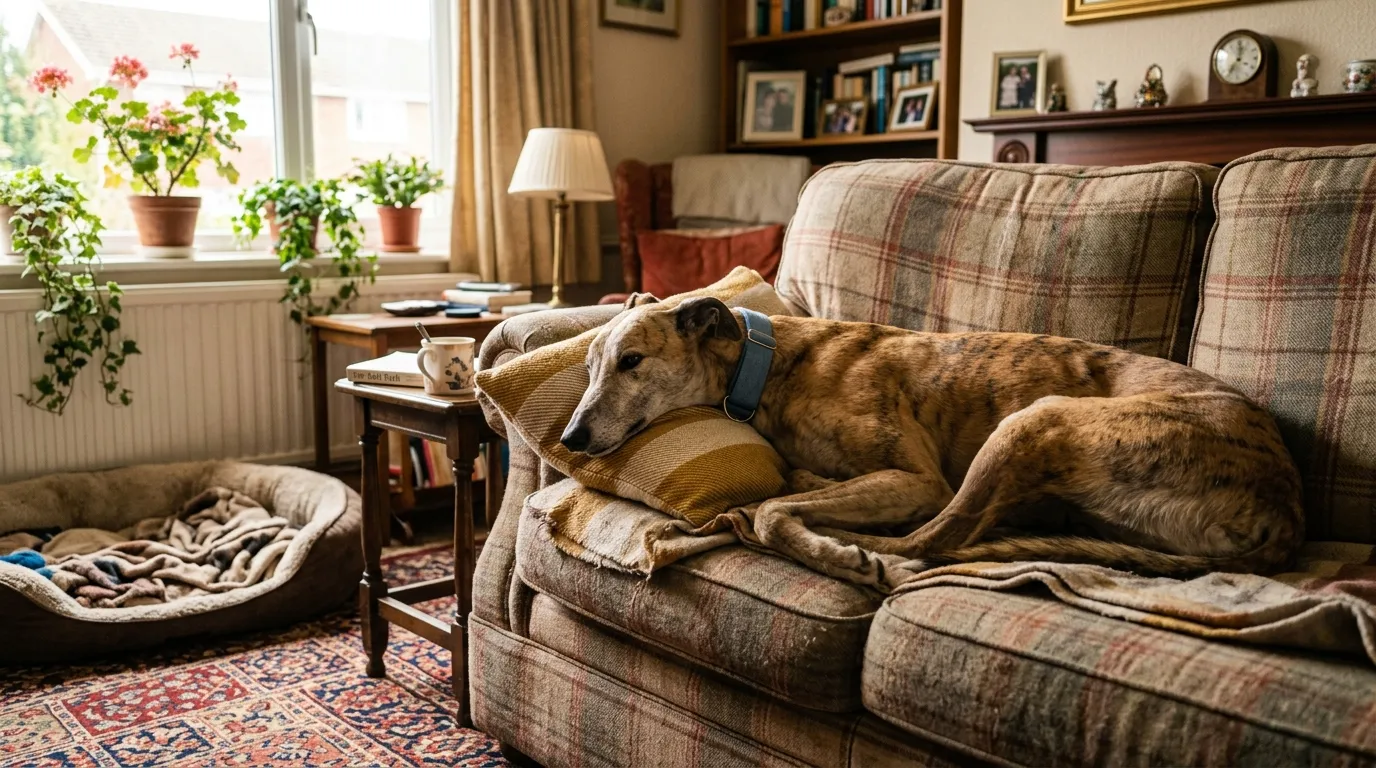
No serious guide to greyhound racing can avoid the welfare question, and it should not try to. The sport has a complicated history on this front, and the data paints a picture of genuine progress alongside persistent concerns. If you follow Newcastle dog results with any regularity, you owe it to the dogs generating those results to understand what happens to them during and after their racing careers.
The GBGB Data: Injuries and Deaths
The Greyhound Board of Great Britain publishes annual injury and retirement data for all licensed tracks, including Newcastle. The 2024 figures show a track injury rate of 1.07% of all starts — the lowest since records began. That translates to 3,809 injuries from 355,682 individual starts across all GBGB venues. On-track fatalities fell to 0.03%, down from 0.06% in 2020.
Those numbers represent real improvement, but they benefit from context. Between 2017 and 2024, GBGB tracks collectively recorded 35,168 injuries and 1,353 on-track deaths. The trend line is falling, but the absolute numbers remain significant. Critics of the sport — including organisations like Dogs Trust and the League Against Cruel Sports — argue that any death toll linked to a commercial entertainment activity is difficult to justify.
Interactive Tool
Fatality Rate Reduction, and Runner-Up Contribution Calculator
Calculate the exact drop in on-track fatalities since 2020, and see what the 2nd and 3rd favourites contribute to the top-3 win share.
Percentage Reduction
-
-
Rate 2020
-
Rate 2024
-
Absolute Drop
-
What this guide states as a raw before/after figure: "On-track fatalities fell to 0.03%, down from 0.06% in 2020." The percentage reduction itself is never calculated — it's exactly 50%, the rate halved in four years.
Combined 2nd + 3rd Share
-
-
Top-3 Total
-
Favourite Alone
-
Average Each
-
What this guide gives as two separate figures: "the market favourite wins roughly 30% of greyhound races, with the top three in the betting accounting for approximately 73% of winners." What the 2nd and 3rd favourites contribute combined is never stated — it's 43%, more than the favourite's own share.
Rehoming and Retirement
The rehoming rate is where the data shift is most dramatic. In 2024, 94% of retired greyhounds were successfully rehomed — up from 88% in 2018. That six-percentage-point improvement represents hundreds of dogs per year finding homes rather than facing uncertain outcomes. The number of greyhounds euthanised for economic reasons — the most uncomfortable statistic in the sport — dropped from 175 in 2018 to just three in 2024, a reduction of 98%.
"There is much to be pleased and encouraged by in this year's data. The initiatives we have introduced in recent years are now embedded and are helping to consolidate the significant progress we have made since 2018 across all measures." — Mark Bird, Chief Executive, GBGB
The Greyhound Trust, the sport's primary rehoming charity, operates centres across the country and works alongside individual track homing coordinators. Newcastle Stadium has its own welfare protocols overseen by GBGB-appointed veterinary officers, and every dog racing at the track is covered by the GBGB Injury Recovery Scheme, which funds treatment for racing injuries up to a specified threshold.
The Legislative Pressure
The welfare debate has moved beyond advocacy and into legislation. The Prohibition of Greyhound Racing (Wales) Bill was introduced to the Senedd in September 2025, and in December the general principles were approved by 36 votes to 11. In January 2026, the Scottish Parliament passed Stage 1 of the Greyhound Racing (Offences) (Scotland) Bill. If both pieces of legislation complete their passage, Wales and Scotland will join the growing list of jurisdictions worldwide that have banned commercial greyhound racing.
"Each year, hundreds of dogs die or are seriously injured in the name of entertainment, which is unacceptable. With both Scotland and Wales moving closer to ending greyhound racing, it's time for the rest of the UK to follow suit." — Owen Sharp, Chief Executive, Dogs Trust
England, where all 18 of the current GBGB-licensed tracks are located, has not proposed equivalent legislation. Newcastle Stadium, as an English venue, is not directly affected by the Welsh or Scottish bills. But the direction of travel is clear, and the sport's long-term survival depends on whether the welfare improvements demonstrated in the GBGB data can convince the public — and eventually Parliament — that regulated racing is compatible with acceptable animal welfare standards.
GBGB welfare metrics have improved markedly since 2018: injuries at their lowest recorded rate, rehoming above 90%, and economic euthanasia virtually eliminated. Legislative challenges in Wales and Scotland signal that the sport must continue demonstrating this progress to maintain its social licence in England.
Visiting Newcastle Greyhound Stadium
Checking Newcastle dog results online is one thing. Being at the track when those results are generated is a different experience entirely — the sound of the traps, the acceleration of the dogs off the first bend, the crowd reaction when a 10/1 shot leads into the home straight. If you have never been to a greyhound meeting, Newcastle is one of the better places to start.
Getting There
The stadium is on the Fossway in Byker, about 15 minutes by car from the city centre. The nearest Metro station is Byker, roughly a 10-minute walk from the ground, with Chillingham Road as an alternative. Bus routes serving the A187 corridor stop within walking distance. Parking is available on site, though it fills up quickly on popular nights — the Thursday evening meeting and any special event card will test the capacity. If you are coming for the All England Cup or a Saturday night event, arriving early or using public transport is sensible advice.
Tickets and Packages
General admission to a standard meeting starts from around £5, making it one of the cheapest live sporting events you can attend in the North East. The stadium also offers trackside dining packages and restaurant bookings for groups, corporate events and celebrations. Arena Racing Company's "Back On Track" promotion in late 2025 — offering 25% off hospitality packages — drove a 33% increase in online bookings and a 28% uplift in restaurant reservations across ARC's venues, Newcastle included. It is a clear sign that the hospitality side of the operation is performing.
"Competition for the leisure pound has never been higher, so to grow our footfall in 2025 is a great achievement. We know greyhound racing is a fantastic and cost-effective night out for people of all ages, families, groups of friends and colleagues." — Sarah Newman, Marketing and Communications Manager, Arena Racing Company
What to Expect on the Night
A typical meeting at Newcastle comprises 12 to 14 races, spaced at roughly 15-minute intervals. That gives you time between races to study the racecard for the next event, place bets at the tote windows or with on-course bookmakers, and — importantly — eat. The stadium has a bar, food kiosks and a restaurant with views over the track. The atmosphere is informal compared to horse racing: no dress code, no pretension, and a crowd that ranges from serious punters with form books to families on a night out.
If you are attending a daytime meeting — Tuesday, Wednesday or Friday — expect a quieter crowd and a faster pace. BAGS meetings run to a tighter schedule because they are broadcast into betting shops nationwide, and the intervals between races can be shorter. Evening and Saturday meetings tend to have a more social atmosphere, with larger crowds and a more relaxed tempo.
Practical Tips
Bring cash as well as a card — some on-course bookmakers still prefer it. Download the Newcastle Greyhound Stadium app or bookmark the track's website before you arrive so you can access live racecards and results on your phone. If you are new to the sport, the tote windows are the simplest place to start betting because the minimum stake is low and the process is straightforward: pick a race, pick a dog, hand over your money. And if you are coming specifically to study form rather than to socialise, the daytime meetings offer the best combination of full race programmes and uncluttered sightlines.
Frequently Asked Questions
How do I read Newcastle greyhound results?
A Newcastle result line runs left to right and contains several distinct data fields: finishing position, trap number, dog name, sectional split to the first bend, positional calls at each checkpoint through the race, finishing time, winning margin expressed in lengths, and a string of running comment abbreviations. The sectional split is the most analytically valuable number in the line — it tells you how fast the dog broke from the traps and reached the first timing beam, which at 480m is approximately 130 metres from the starting boxes. A fast split, say 4.65 seconds, usually indicates a dog that secured a forward position early and raced in clean air. A split of 4.85 or above suggests the dog needed time to find stride and likely encountered traffic through the bends. Running comments like EPace (early pace), SAw (slow away), Crd (crowded) and Bmp (bumped) describe in-race incidents that the finishing position alone cannot capture. Combining all five data layers — splits, positional calls, finishing time, margin and running comments — gives you a complete picture of what happened in a race and, crucially, why the dog finished where it did. One length is roughly 0.08 seconds, so you can also use the margin to estimate adjusted times for beaten dogs and compare performances across different races.
Which trap wins most at Newcastle?
Historical data from Newcastle Greyhound Stadium shows that Trap 2, the blue jacket, has produced more winners over extended sample periods than any other box at the track. This is unusual because Trap 1, the red jacket, is the leading box at most British greyhound tracks, winning at approximately 18–19% of all races nationally versus a theoretical expectation of 16.6%. Newcastle's 415-metre circumference and Swaffham inside-rail hare create relatively tight bends that slightly favour the Trap 2 position. A dog drawn in Trap 2 has one layer of protection on its inside from the Trap 1 runner but also a fractionally wider angle into the first bend, giving it room to position itself for the racing line without being forced against the rail. The advantage is statistical rather than absolute — it will not override poor form, a clear class gap or a markedly slow trapper — but it is a meaningful tiebreaker in evenly graded fields. It is worth combining trap bias data with sectional times and running comments from recent Newcastle dog results to build a more complete selection picture, rather than relying on draw alone.
What distances are raced at Newcastle dogs?
Newcastle offers six standard race distances: 290m, 480m, 500m, 640m, 706m and 895m. The 290m is a sprint — essentially one bend and a straight — where early pace from the traps is the dominant factor. The 480m and 500m are the most commonly carded distances and produce the deepest pool of result data for form analysis; most BAGS meetings feature several races at these trips. The 640m is a middle-distance test where stamina and tactical positioning through three bends become more important than raw speed. The 706m and 895m are staying trips that appear less frequently on the racecard but offer a distinct challenge: the 895m race is nearly two full laps of the 415-metre circuit and rewards dogs bred and trained for endurance over those built purely for acceleration. This six-distance programme is broader than most British greyhound tracks, which typically race over three or four distances, and it creates a wider variety of result patterns for form students to study.
