
A Stadium That Predates the Tyne Bridge
The Tyne Bridge opened in October 1928. Newcastle greyhound racing history predates it — by four months. The first official race meeting at Brough Park, as the stadium was then known, took place in June of that year, making the track older than the city’s most iconic landmark. That fact alone tells you something about the sport’s roots in the north-east: greyhound racing did not arrive as an afterthought or a novelty. It arrived with the same industrial momentum that was building bridges, laying tramlines, and putting Tyneside on the map.
This is the story of Newcastle greyhound racing history from its founding in the late 1920s through decades of boom and decline, ownership changes, lost stadiums, and a twenty-first-century revival that brings the sport to its centenary year. It is a story about a single venue — Brough Park, now Newcastle Stadium — but it is also a story about a sport that has been declared dead so many times that it has stopped taking obituaries seriously.
The dates, names and results in this article are drawn from publicly available records, including newcastle-racing.co.uk, the Greyhound Racing History archive, and official GBGB data. Where specific race results or attendance figures are cited, they are attributed to the source. Newcastle greyhound racing history is well documented because the people who made it cared enough to write it down.
1927–1938: Building Brough Park and the First Races
Greyhound racing arrived in Britain in 1926 when the first oval-track meeting, using a mechanical hare, was held at Belle Vue in Manchester. The sport spread rapidly. Within two years, tracks were opening across the country, driven by a combination of working-class demand, entrepreneurial investment, and the simple fact that six dogs chasing a fake rabbit around a sand track was extraordinarily exciting to watch.
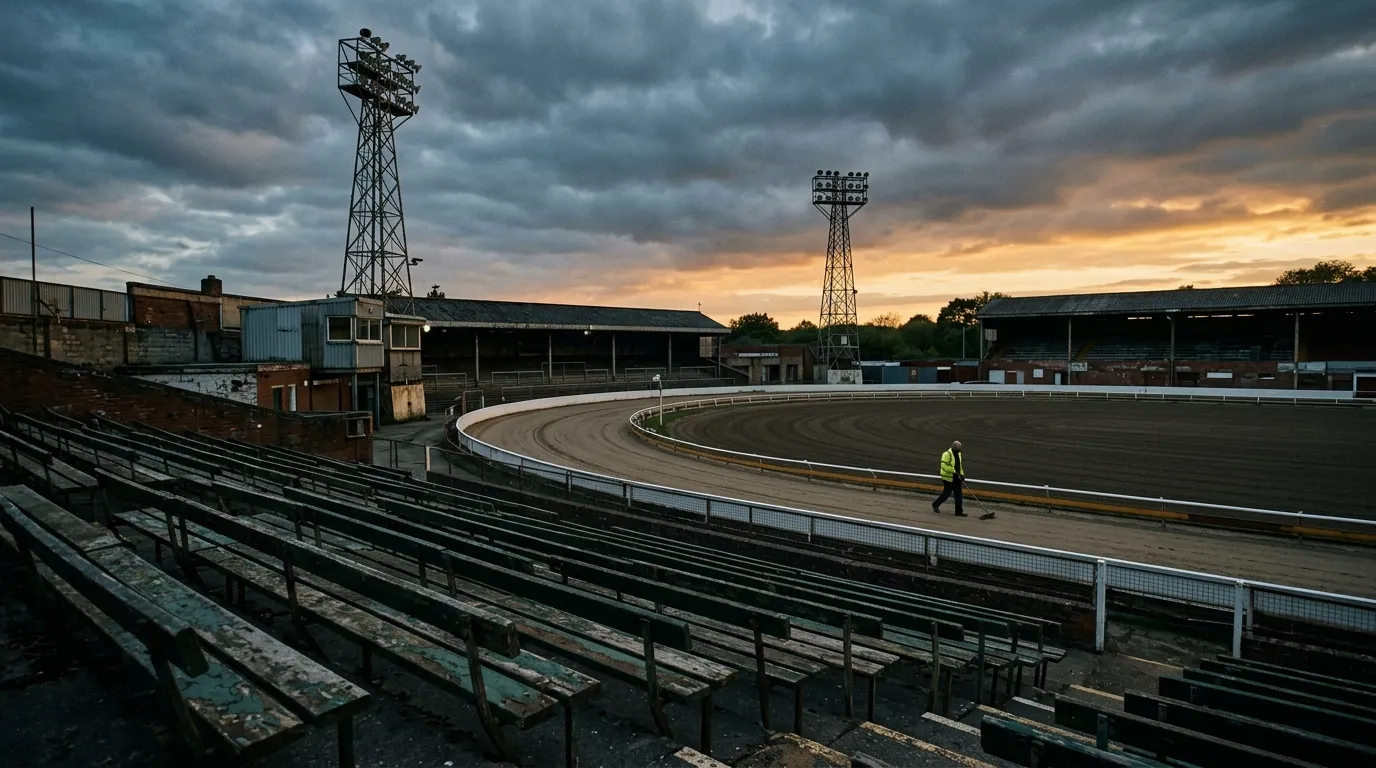
Newcastle was not far behind Manchester. The stadium at Brough Park was constructed in 1927 on a site in the Byker area, east of the city centre. The location was industrial and accessible — close to the terraced streets where its core audience lived and worked. The track was built as a purpose-designed greyhound venue with an oval circuit, covered stands, and the infrastructure to handle large crowds.
The first official race meeting at Brough Park took place on 23 June 1928. The winner of the inaugural race was a greyhound named Marvin, returning at odds of 3/1. It was not a headline event. No dignitaries cut a ribbon, no newspaper devoted its front page to the occasion. But it was the beginning. From that June evening onward, Brough Park would stage greyhound racing continuously — through economic depression, world war, social upheaval, and multiple changes of ownership — for nearly a century.
The early years of the stadium coincided with the first great boom in British greyhound racing. By the 1930s, the sport was drawing enormous crowds across the country. In London, stadiums like White City and Wembley were attracting tens of thousands of spectators per meeting. In the north-east, Brough Park and its rival venues tapped into the same appetite. The working week was long, money was tight, and an evening at the dogs offered affordable entertainment, social contact, and the possibility — however slim — of going home with more in your pocket than you arrived with.
The first decade of racing at Brough Park established the patterns that would define the venue for generations: regular evening meetings, a loyal local crowd, a small number of prominent trainers who supplied the majority of runners, and a betting market that was as much about social ritual as it was about financial calculation. The stadium was not glamorous, but it was alive, and by the late 1930s it had become a permanent fixture in the life of Byker and the broader north-east.
The Second World War interrupted but did not end racing at Brough Park. Greyhound tracks across Britain continued to operate during the conflict, albeit under restrictions: meetings were limited in frequency, blackout regulations affected evening racing, and many of the men who had filled the terraces were away fighting. Yet the tracks that stayed open served a purpose beyond entertainment. They offered a semblance of normality, a place where people could gather, and a modest release valve for wartime stress. Brough Park emerged from the war with its infrastructure intact and its audience waiting to return.
The Golden Era: All England Cup and National Derby Champions
The All England Cup was first staged at Newcastle in 1938, a decade after the stadium opened, and it would become the venue’s signature event — the one race that put Brough Park on the national greyhound-racing calendar. The competition, a Category One event, attracted the best dogs from across the country and gave Newcastle a prestige that many northern tracks never achieved.
The mid-twentieth century was the golden era of British greyhound racing by any measure. Attendances peaked in the late 1940s, when post-war austerity combined with limited entertainment options to create captive audiences of remarkable size. Greyhound racing was, briefly, the most attended spectator sport in Britain — ahead of football in terms of cumulative gate numbers, though behind it in cultural prestige. Newcastle shared in this boom. The stands at Brough Park filled regularly, the betting turnover was substantial, and the local trainers who supplied runners for the All England Cup became minor celebrities in the Byker community.
The All England Cup itself produced memorable finals over the decades. The competition format — heats, semi-finals, and a showpiece final held under floodlights on a feature evening — gave the event a narrative arc that individual race meetings lacked. Local dogs that reached the final became the talk of the pubs along Shields Road. Dogs that won it were remembered for years. The cup gave Newcastle a reason to matter in a sport that was increasingly dominated by the bigger, wealthier tracks in London and the Midlands.
Beyond the All England Cup, Brough Park produced dogs that competed at the very highest level of the sport. Newcastle-trained runners appeared in the English Greyhound Derby, the Scottish Derby, and other Category One events. Some of them reached finals. A few won. The achievements were never routine — Newcastle was not a factory of champions in the way that the big London kennels were — but when a Brough Park dog performed on the national stage, the sense of civic pride in Byker was tangible. Greyhound racing was, for a significant section of the north-east working class, not just entertainment but identity.
Through the 1950s and 1960s, the golden era gradually dimmed. Television arrived and changed the economics of leisure. Football clubs invested in floodlights and midweek fixtures, competing directly for the same evening audience. The introduction of betting shops in 1961 allowed punters to wager on greyhound racing without attending the track, which was convenient for bettors but catastrophic for stadium attendance. Why stand in the cold at Brough Park when you could watch the results on a screen in a warm shop on the high street? Greyhound tracks began to close — first the marginal ones, then some of the established names. Newcastle survived because it had the All England Cup, a reliable local crowd, and an absence of immediate competition within the city after its rival stadiums faded. But the trajectory of the sport nationally was downward, and Brough Park could not escape the gravity entirely.
Changing Hands: TGH, Ladbrokes, William Hill and ARC
The ownership history of Newcastle Stadium reads like a compressed history of the British greyhound industry itself — a succession of corporate parents, each reflecting the economic realities of its era.
For much of its early life, Brough Park was operated by independent promoters connected to the local greyhound-racing community. The track changed hands several times in the post-war decades as the economics of the sport shifted. By the 1970s and 1980s, greyhound stadiums were increasingly attractive to bookmaking firms, which saw track ownership as a way to control the supply of content for their betting businesses. Ladbrokes, one of the largest bookmakers in the UK, acquired a portfolio of greyhound tracks during this period, and Newcastle was among them.
The Ladbrokes era brought corporate stability but also corporate priorities. Decisions about investment, race scheduling, and prize money were made in London rather than Byker, and the interests of a national bookmaking chain did not always align with the interests of a local track. When Ladbrokes eventually divested its greyhound portfolio, the stadiums passed through several further hands.
William Hill, another major bookmaker, held the stadium for a period, continuing the pattern of betting-industry ownership. The bookmakers’ interest in track ownership was always primarily about securing media rights — the right to broadcast races into betting shops and later onto online platforms — rather than about the stadium as a venue or the sport as an experience. This created a tension that persists to this day: the commercial value of greyhound racing lies mainly in its content, not in its crowds.
The most significant ownership change in Newcastle’s recent history was the acquisition by Arena Racing Company, which took control of the stadium as part of a wider acquisition of the William Hill greyhound-stadium portfolio. ARC brought a different philosophy: rather than treating the stadiums as content factories for betting shops, the company invested in the venue experience, promoting greyhound racing as a leisure product alongside its core media-rights business. Under ARC, Newcastle Stadium saw improvements to its facilities, a refreshed marketing approach, and a renewed emphasis on attracting spectators through the turnstiles rather than relying solely on remote betting revenue.
The transition to ARC ownership also brought structural changes to how the stadium operated. Race schedules were optimised to serve both the BAGS betting-shop market and the live-event audience. The Thursday evening meetings were positioned as the venue’s weekly showcase, with restaurant packages and group-booking options designed to attract a broader audience beyond the traditional betting crowd. Simultaneously, the morning and afternoon BAGS fixtures continued to serve their primary purpose: generating content for the bookmakers who funded the majority of the industry’s prize money.
By the time ARC had bedded in, Newcastle Stadium occupied an unusual position in British greyhound racing. It was the sole surviving licensed track in the north-east — a distinction that had less to do with Newcastle’s success than with the disappearance of its neighbours.
Newcastle’s Lost Greyhound Stadiums: White City and Gosforth
Brough Park was not Newcastle’s only greyhound track. For decades, it shared the city with at least two other significant venues: White City Stadium and Gosforth Greyhound Stadium. Both are gone now, their sites redeveloped, their racing histories preserved only in archive records and the memories of those who attended.
White City Stadium in Scotswood was one of Newcastle’s early greyhound venues. Like many of the “White City” stadiums across Britain — named after the famous London venue built for the 1908 Olympics — it was a multi-purpose sports ground that hosted greyhound racing alongside other events. The stadium served a different catchment area to Brough Park, drawing its crowd from the west end of the city rather than the east. Competition between the two venues was real but not destructive; the city was large enough and the appetite for the sport strong enough to support both, at least through the peak years.
Gosforth Greyhound Stadium operated further north, closer to the Town Moor. It was a smaller, less prominent venue than either Brough Park or White City, and it closed earlier than both. The story of its closure mirrors the broader pattern across British greyhound racing: declining attendances, rising maintenance costs, and the escalating land value of the site relative to the revenue generated by racing. When a greyhound stadium sits on developable urban land, the financial logic eventually points in one direction. The Gosforth site was redeveloped for housing, and today there is nothing at the location to indicate that greyhounds once raced there. The same fate befell White City. Both stadiums exist now only in local memory and in the occasional photograph that surfaces in north-east history groups.
Newcastle’s experience was not unique. The UK once had more than 77 licensed greyhound tracks; today, just 18 remain. That decline is national, but its effects are local. Every closed track meant a community that lost a social venue, a set of trainers who lost their home track, and a group of racegoers who had to travel further or stop going altogether. The survival of Brough Park through this long contraction is not accidental — it reflects the track’s location, its loyal audience, the All England Cup, and a sequence of owners who, for various reasons, chose to keep the lights on rather than sell the land.
Today, Newcastle Stadium is the only licensed greyhound track in the north-east of England. It carries the legacy of its lost neighbours as well as its own.
2017–2026: The Arena Racing Era and the Centenary
Arena Racing Company’s stewardship of Newcastle Stadium, beginning in the late 2010s, marked a shift in how the venue positioned itself. ARC’s model combined media-rights revenue — broadcasting races to betting shops, online bookmakers, and platforms like Sky Sports Racing and RPGTV — with a renewed push to bring people through the gates. The “Back On Track” promotional campaigns, restaurant refurbishments, and investment in the All England Cup as a flagship event were all part of a strategy to make the stadium relevant as a live-entertainment venue, not merely as a content source for remote betting.
The results, particularly from 2024 onward, suggest that the strategy is working. ARC reported a five per cent year-on-year increase in greyhound stadium footfall across its venues in 2025, the All England Cup nights grew in profile, and the stadium attracted a broader demographic — younger visitors, social groups, families — alongside the traditional betting crowd. The media-rights deal with Entain, signed in 2022 and operational from January 2024, secured the stadium’s broadcasting future and brought additional commercial stability.
The racing itself remained competitive. Newcastle’s trainers continued to produce runners capable of competing at the highest level, and the All England Cup attracted quality entries from across the country. Jimmy Fenwick, a Newcastle-based trainer, captured the mood when discussing his dog Wicky Ned ahead of the All England Cup: “It was an exceptional trial. His debut at Cork in February blew us away,” Fenwick told the Newcastle Greyhound Stadium news page. That combination of local pride and national ambition — a Newcastle kennel buying a promising dog from Ireland and preparing it for the stadium’s biggest race — is the thread that has run through the venue’s history from the beginning.
The Arena Racing era also brought Newcastle greyhound racing history closer to the digital age. Live streaming, social-media promotion, online booking for restaurant packages, and data services that make race results and form guides available within minutes of the final race all contributed to a modernisation that the stadium needed. The physical venue is still the same Byker site it has occupied since the 1920s, but the way it connects to its audience has changed fundamentally.
By 2025, the transformation was visible enough to attract positive press coverage and a growing sense that greyhound racing at Newcastle was not just surviving but developing. ARC introduced its Racing Club membership scheme, offering regular visitors a package of benefits including discounted entry, priority booking, and exclusive event access — a loyalty model borrowed from horse racing that signalled confidence in the stadium’s ability to retain and grow its audience. The initiative was a small but telling indicator of the direction: Newcastle was no longer a track that simply existed between owners. It was a venue with a plan.
The stadium entered 2026 — the sport’s centenary year in Britain — with more optimism than it had carried in decades.
Greyhound Racing at 100: What 2026 Means for the Sport
In 2026, greyhound racing in the United Kingdom marks its centenary — one hundred years since that first oval-track meeting at Belle Vue in Manchester. It is a milestone that arrives with complicated baggage. The sport is smaller than it was, facing legislative challenges in Wales and Scotland, and operating in a media landscape that gives it a fraction of the attention it once commanded. But it is also a sport that has outlasted repeated predictions of its death, and Newcastle Stadium is one of the reasons why.
For Newcastle, the centenary is both a national moment and a local one. The stadium is not quite 100 years old itself — that milestone falls in 2028 — but it is close enough that the national centenary and the stadium’s own history overlap meaningfully. The All England Cup, first run in 1938, is approaching its ninetieth year. The trainers, owners and supporters who keep the sport alive in the north-east are part of a lineage that stretches back to a June evening in 1928 when a dog called Marvin crossed the line first at Brough Park.
What does the next chapter look like? The honest answer is that nobody knows with certainty. The legislative landscape is shifting — Wales is moving towards a ban, Scotland has taken the first parliamentary steps towards one, and animal-welfare pressure on the sport is more organised and more effective than at any point in its history. At the same time, the venues that remain are investing, the audiences are growing, and the media-rights model has given the sport a commercial foundation that is less dependent on gate money than at any time in the past.
Newcastle greyhound racing history is a story of survival, adaptation and stubborn persistence. The stadium has outlived its original owners, its rival tracks, its corporate parents, and several generations of critics who declared the sport finished. If the next hundred years look anything like the first, Brough Park will still be staging races long after the latest round of obituaries has been forgotten.
The full picture is in our Newcastle dog results guide.
Its showpiece race is the All England Cup.
