

What a Newcastle Greyhound Racecard Actually Tells You
Open any greyhound racecard for the first time and you will probably feel like someone handed you a cockpit instrument panel with no flight manual. Numbers, abbreviations, cryptic form lines, split times — it looks as though it was designed to keep outsiders out. It was not, but nobody said the learning curve was gentle.
A greyhound racecard explained properly is the single most useful tool a punter can own. Every piece of data on that card exists to answer one question: what is this dog likely to do in the next thirty seconds? The card tells you where it prefers to run, how quickly it leaves the boxes, whether it handles bends cleanly or gets bumped wide, and what kind of trip it needs to produce its best. Across GBGB-licensed tracks in 2024 alone, there were 355,682 individual starts — every single one of them summarised, compressed and filed into the form lines you see on the racecard.
This guide breaks the Newcastle greyhound racecard into its component parts, explains what each column and abbreviation means, and shows you how to turn raw data into usable information. No shortcuts, no jargon left unexplained, no assumption that you already know the difference between a calculated time and an actual time. By the end you will read a Newcastle card the way a trainer reads one — quickly, critically, and with a clear idea of which dog fits the race.
The Anatomy of a Racecard: Header to Form Lines
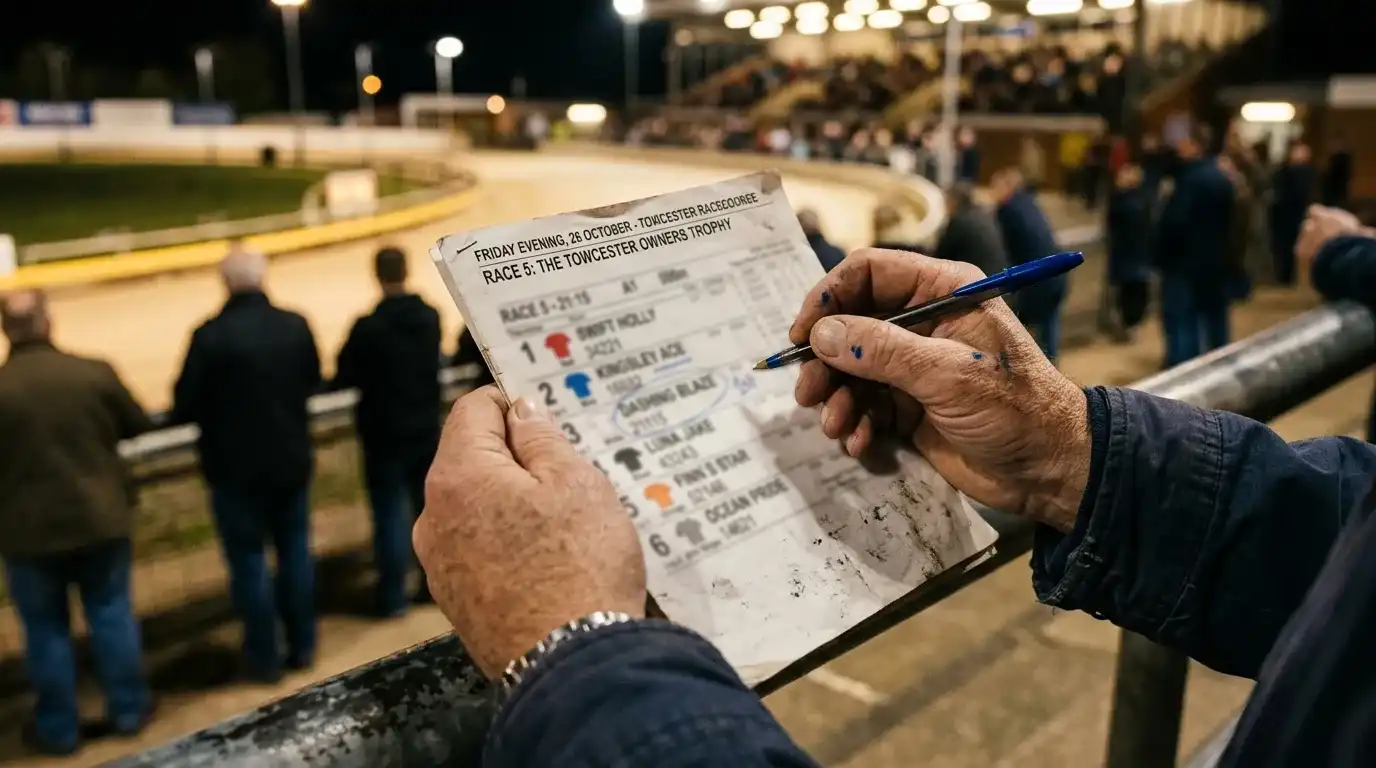
Every racecard follows the same top-to-bottom hierarchy, whether you are reading it in the Racing Post, on a screen at Newcastle Stadium, or inside a bookmaker app. Understanding the layout is half the battle because once you know where to look, you stop scanning and start reading.
The Header Block
At the top of each race entry you will find the race time, the race number, the distance, the grade, and the prize money. At Newcastle, a typical midweek BAGS fixture might read something like “14:22 — Race 4 — 480m — A5 — £100 to winner”. The grade (A5, in this case) tells you the class of dogs competing. A1 is the highest open-race standard at the track; higher numbers mean lower ability bands. The prize figure may look modest, but remember that greyhound racing is a volume sport — trainers run dogs multiple times per week, and consistency beats one-off paydays.
The distance is critical because it determines the running configuration. Newcastle’s 480-metre trip, for instance, starts on the back straight and involves negotiating four bends. The 290-metre sprint, by contrast, is a dash from the home-straight boxes to the line with just two bends. These are not interchangeable races — a dog built for 480 metres may struggle at 290 if it lacks early pace, and a 290-metre specialist will often fade over longer trips.
The Runner Rows
Below the header, each greyhound gets its own row. Reading left to right, you will typically see: trap number, dog name, trainer, weight, form figures, sectional times from recent runs, and race comments or running positions. Some cards also show the sire and dam of the dog, which is useful for handicapping pups or recent arrivals with thin form lines.
The trainer column is more revealing than many punters realise. At Newcastle, a handful of kennels dominate the local grading programme, and their runners tend to arrive race-fit and well-trialled. If you see a dog from a prolific local kennel stepping up in grade or switching distance, pay attention — trainers rarely make those moves without reason.
Weight
Greyhound weight is listed in kilograms. A dog carrying 32 kg running against a 28 kg rival is not automatically at a disadvantage — size affects running style rather than outright speed. Heavier dogs tend to hold their line better through bends, while lighter runners can be sharper out of the boxes and more agile at the first turn. What matters more than absolute weight is weight change. If a dog has dropped a full kilogram since its last run, it may be off its feed, not fully recovered from a knock, or at the tail end of a racing cycle. A stable weight across three or four runs usually signals a dog in routine.
Form Figures
The form line is a string of digits, usually six, read from left to right with the most recent result on the right. The number represents the finishing position: 1 means a win, 6 means last. The letters matter too — a dash (–) typically indicates a break between runs, and certain cards include the trap number in brackets before the position figure. A form line of 321211 tells you a dog that has been in the first three in five of its last six starts, with its most recent run being a winner. A line that reads 664435 says something very different — a dog that has been struggling but whose most recent two runs show slight improvement. Direction of form is as valuable as headline figures.
Comments and Run Descriptions
At the foot of each runner’s row you will often find a one-line comment from the race analyst or a compressed running description from the previous outing. These are packed with abbreviations — we will decode them in a later section — but even at a glance they reveal the trip a dog had. “Led 1st to run-in, headed close home” tells you the dog was competitive and may have won with a cleaner finish. “Slow away, crowded 2nd” tells you it never got into the race. Learn to read these and you will spot patterns that form figures alone cannot show.
Trap Numbers, Colours and Seeding Logic
Every greyhound in a race is assigned a trap — a starting box on the inside or outside of the track — and each trap has a fixed jacket colour. Trap 1 is red, trap 2 is blue, trap 3 is white, trap 4 is black, trap 5 is orange, and trap 6 is black and white stripes. These colours are not decorative. When six dogs are hurtling towards the first bend at 40 mph, the jacket is the only way trackside spectators and commentators can tell them apart. Knowing the colour scheme by heart is basic literacy for anyone following live racing.
Trap assignment is not random. The racing manager at each track seeds greyhounds based on their known running style. Dogs classified as “railers” — those that naturally hug the inside rail — will typically be drawn in traps 1 or 2. “Wide runners”, dogs that prefer to race on the outside, tend to appear in traps 5 or 6. Middle-seed dogs get the central traps. The logic is straightforward: if a rail runner draws trap 6, it has to cut across five other dogs to reach the rail, causing crowding and increasing the risk of collisions. Seeding exists to reduce interference and produce fairer races.
This is also where trap bias begins. Across UK tracks, trap 1 shows a win rate of roughly 18 to 19 per cent — meaningfully higher than the theoretical 16.6 per cent you would expect if all six boxes were equal. The advantage comes from geometry: the trap 1 runner has the inside rail as a protective wall, a shorter path to the first bend, and no dog to its inner flank. At Newcastle, the picture shifts slightly — trap 2 rather than trap 1 has historically produced more winners — but the underlying principle is the same. Inside traps carry a structural edge, and the racecard tells you exactly where each dog is drawn.
When reading the card, check whether the dog has been drawn in its preferred position. A railer in trap 1 is a comfortable fit. A railer squeezed into trap 4 has a problem. Some bettors build entire strategies around dogs drawn out of their comfort zone, backing them when they return to their ideal box. The racecard gives you this information for free — the question is whether you use it.
Split Times and Sectional Speed Explained
If form figures give you a dog’s results, split times give you the film of how those results happened. They are the most underused column on any greyhound racecard explained in depth, and the most valuable for anyone trying to separate genuine ability from circumstance.
A split time — sometimes called a sectional time — is the clock reading at a specific point during the race. At most tracks, the first timing point is the run to the first bend, often measured from the boxes. At Newcastle, with a 415-metre circumference and approximately 130 metres from the boxes to the first bend on the standard 480-metre trip, the first split captures the dog’s early pace and trapping speed. A fast first split means the dog cleared the lids quickly and reached the bend in front or near the front. A slow first split does not always mean the dog is slow — it may have been impeded at the boxes or crowded through the first stride.
The value of sectional times lies in comparison, not absolutes. A first-bend split of 8.50 seconds tells you nothing on its own. But when you compare that 8.50 against the same dog’s previous splits — 8.47, 8.62, 8.51 — you get a picture of its consistency. A dog that consistently hits the first bend in 8.48 to 8.52 is predictable and reliable. A dog whose splits swing from 8.30 to 8.75 is erratic, and erratic dogs cause chaos at the first turn.
Second-half splits, where available, reveal stamina and bend-running ability. A dog that posts a fast first split but a slow second half is a “front-runner” or “pace dog” — it leads early and tires. Conversely, a dog with a moderate first split and a strong finishing section is a closer, the kind that picks up tiring rivals in the home straight. Neither style is inherently better, but they suit different race shapes. If a card is loaded with front-runners, the closer in trap 6 has a sneaky chance — the pace dogs will cut each other’s throats through the first two bends while the closer waits for the carnage.
Some racecard formats include a “time” column showing the overall race time for the dog’s last run. This is useful but incomplete. Two dogs might both clock 29.50 over 480 metres, but if one ran 8.45 early and 21.05 late while the other ran 8.70 early and 20.80 late, they are fundamentally different types. The split times reveal what the headline figure hides.
Bend Positions: What 1-1-1-1 Really Means
On many racecards, especially those published by Timeform or in the Racing Post, you will see a string of numbers separated by hyphens after each dog’s name or in a dedicated column. These are bend positions, and they record where the dog was running at each bend of the track. A sequence of 1-1-1-1 means the dog led at every bend and won from the front. A sequence of 6-5-3-2 means it started near the back, improved through the middle, and finished strongly — a textbook closer.
Bend positions answer a question that finishing positions alone cannot: how did the dog get there? A dog that finishes second with positions of 1-1-1-2 had a completely different race to a dog that finishes second with positions of 5-4-3-2. The first one led nearly the whole way and was caught late. The second one came from off the pace and ran on well. Both finished second. Only one of them is improving.
At Newcastle, with its 415-metre oval and relatively tight bends, the first and second bend positions are especially telling. A dog that holds first or second position through the first two bends has a clear passage and avoids the bunching that happens on the turns. Dogs that are fourth, fifth, or sixth at the first bend have to navigate traffic, and at a track of Newcastle’s dimensions, making up ground around the bends without running extra distance is genuinely difficult. The geometry works against you.
When reading a racecard, compare bend positions across a dog’s last three or four runs. Consistency is the signal. A dog that is routinely 1-1 at the first two bends and then finishes 1st or 2nd has a clear, predictable running style. A dog whose positions jump between 1-2-4-5 and 3-1-1-2 is more unpredictable — its races depend heavily on the break and on which dogs it faces. Neither profile is bad, but the consistent dog is easier to handicap and easier to trust in a forecast.
One subtle point: bend positions also reveal crowding incidents. If a dog was 2nd at the first bend, 2nd at the second bend, and then suddenly 5th at the third bend, something happened. Maybe it checked off the heels of the leader, or got squeezed between two dogs. Cross-reference the bend positions with the race comment to find out. If the drop in position was caused by interference rather than lack of ability, you have found a dog whose form figure flatters to deceive — and its next run might be much better than the bare result suggests.
Decoding Six-Run Form: Patterns That Matter
The form line is the racecard’s headline — it compresses a dog’s recent history into half a dozen digits. Reading it properly means looking beyond the numbers and asking what caused each result.
The most common beginner mistake is treating form as a league table. A dog with a form of 111211 looks unbeatable. But if those wins came in A7 grade and the dog has just been promoted to A5, it is running against better animals for the first time, and its form is about to be tested. Conversely, a dog showing 433322 in A3 might be a solid proposition if it drops back to A4, where it can compete comfortably. The grade context around each digit matters as much as the digit itself.
Look for patterns across the six runs. A sequence that reads right to left as 6-5-4-3-2-1 is an improving dog. Each run is better than the last. It may be coming back from injury, settling into a new trap, or simply peaking at the right time. This is the kind of form line that catches graders off guard — the dog is still rising and the official assessment may not have caught up. On the flip side, 1-2-3-4-5-6 is a dog in freefall. Something has changed — fitness, enthusiasm, a niggling injury — and backing it because it won five starts ago is a trap that punters fall into constantly.
Interrupted form is another signal worth tracking. A dash or a gap in the sequence means the dog missed time. Greyhounds are creatures of routine, and a break of more than three or four weeks usually means an injury, a season (for bitches), or a kennel transfer. The first run back after a break is unreliable almost by definition. The dog is ring-rusty, it may not be fully fit, and the trainer may be using the run as a fitness exercise rather than a genuine attempt to win. Treat the first form figure after a break as partial evidence at best.
Distance switches deserve attention, too. If the last three runs show form of 211 at 480 metres and then the dog appears on a racecard for a 290-metre sprint, you are not looking at a continuous form line — you are looking at a change of plan. The 480-metre form does not directly transfer. The dog might lack the raw early pace for a sprint, or it might love the shorter trip and improve sharply. Check whether the trainer has run the dog at 290 before by scanning earlier form or the archive. If the distance switch has no precedent, treat it as a question mark.
Finally, factor in the trap draw for each historic run. A form figure of 5 from trap 6 at Newcastle might reflect a wide draw that cost the dog three or four lengths at the first bend. The same dog from trap 2 next time out starts with a structural advantage it did not have before. Smart racecard reading connects form, trap, split times and race comments into a single narrative rather than treating each column in isolation.
Racecard Abbreviations: SAw, Crd, EPace and Beyond
Race comments on the greyhound racecard are written in compressed shorthand. Once you learn the vocabulary — there are perhaps thirty to forty abbreviations in common use — you can read an entire race in about five seconds. Until you do, the comments might as well be in another language. Here are the essentials.
SAw — Slow Away. The dog was slow out of the traps. This is one of the most frequent comments you will see, and its significance depends on severity. A dog that is slow away by half a length in a 480-metre race can usually recover. A dog that is slow away by two lengths in a 290-metre sprint is almost certainly beaten before the first bend. Chronic slow beginners are liabilities in short-distance races and unreliable in forecasts.
EPace — Early Pace. The opposite of SAw. The dog showed strong speed from the boxes and was prominent at the first bend. EPace runners are gold dust at Newcastle, where early position often dictates the outcome. If a racecard comment reads “EP, led 1st”, you know the dog broke sharply and reached the first bend in front. That is both a style indicator and a positive sign of fitness.
Crd — Crowded. The dog was impeded by other runners, usually at a bend. “Crd 2nd” means crowding occurred at the second bend. This is a legitimate excuse for a poor finishing position, though you should ask how often it happens. A dog that gets crowded once is unlucky. A dog that gets crowded in three of its last five runs might be poorly drawn or habitually running into trouble because of its style.
Bmp — Bumped. Similar to crowded but usually a single contact event rather than sustained interference. “Bmp 1st” means the dog took a knock at the first bend. Like crowding, it affects the run but the severity varies.
Blk — Baulked. Stronger than bumped. The dog was stopped in its stride by another runner — a significant incident that probably cost several lengths. When you see Blk in a comment, the finishing position that follows is essentially meaningless as an indicator of ability.
RnUp — Ran Up. The dog finished well and closed ground on the leaders in the closing stages. A positive comment that suggests the trip may be on the short side — the dog wanted further.
W — Wide. The dog raced wide, usually through the bends. Running wide costs time because the dog covers more ground than the rail runner. “W 1st & 2nd” means the dog was wide at the first two bends, which at a tight track like Newcastle could easily account for a couple of lengths.
Rls — Rails. The dog stuck to the inside rail through the race. A positive comment for dogs drawn in traps 1 or 2, confirming they are genuine rail runners.
MsdBrk — Missed Break. More emphatic than SAw. The dog had a seriously poor start, possibly turning sideways in the box or failing to engage with the lure immediately. MsdBrk runs should be treated almost as non-runners for form-assessment purposes.
There are many more — Led, EvCh (every chance), Fin (finished), Chl (challenged), HldOn (held on) — but these core terms cover the majority of race comments you will encounter on a Newcastle card. The GBGB mandates that all licensed tracks record racing incidents and injuries through standardised reports, which is why the shorthand is consistent across tracks. Written evidence submitted by the GBGB to the Senedd in 2025 confirmed that the governing body operates a statutory requirement to document every racing incident, and these records feed directly into the form lines and comments that appear on the racecard.
The trick is not to memorise every abbreviation — you will learn them through repetition — but to read the comment as a story. “SAw, Crd 1st, RnUp” tells you a dog that was slow out, got bumped at the first bend, and still ran on. That is a better race than the finishing position suggests. “EP, Led to 3rd, W & Fdd” tells you a dog that blazed from the traps, led until the third bend, ran wide, and faded. That dog might not stay the distance. Each abbreviation is a plot point, and together they give you the narrative behind the number.
Calculated Time vs Actual Time: Adjusting for Going
The final column that trips up newcomers is the distinction between actual time and calculated time. Actual time is straightforward — it is the clock reading from trap lift to the dog crossing the finish line. Calculated time, or “calc time”, is the same performance adjusted for the going on the day.
Track conditions affect race times the way a headwind affects a sprinter. A wet, holding surface slows dogs down; a dry, fast track lets them run closer to their potential. Two dogs might clock identical actual times but on different days in different conditions, and those performances are not equivalent. Calculated time strips out the going variable and gives you a theoretical time that the dog would have recorded on a “standard” surface. It is the closest thing to a level playing field that greyhound analysis offers.
How is it calculated? The adjustment is based on the going allowance published for each meeting. If the going is described as “slow” with an allowance of +0.30, it means every dog is running roughly 0.30 seconds slower than they would on a standard surface. The calculated time subtracts that allowance from the actual time, producing a normalised figure. A dog that clocked 29.80 on a slow going (allowance +0.30) has a calculated time of 29.50, which gives you a truer picture of its raw ability.
At Newcastle, going reports are influenced by weather conditions in the Byker area — rain, temperature, and wind all play a part. The track surface is sand-based, and while it drains reasonably well, sustained rain can add anything from 0.10 to 0.50 seconds to actual times depending on severity. Punters who ignore the going and compare raw times from different meetings are comparing apples with oranges.
One practical application: when two dogs from different tracks meet for the first time — say, a Newcastle regular drawn against a runner that has been racing at Sunderland or Kinsley — their actual times at their respective home tracks are not directly comparable. Track circumferences, bends, surfaces and going vary. Calculated time provides a more meaningful comparison, though it is still imperfect because it cannot account for differences in track geometry. A dog with a calculated 480-metre time of 29.20 at Newcastle has demonstrated a specific level of ability. A dog with the same calculated time at a wider, galloping track may produce it in a different way — earlier pace, longer stride — and the two dogs would race each other differently to how the numbers suggest.
There is one more adjustment worth knowing: the body-length conversion. In greyhound racing, distances between runners are often expressed in lengths. One greyhound body length is conventionally equivalent to about 0.08 seconds. So if a dog was beaten three lengths in its last run with a time of 29.60, and it finds a way to avoid the crowding that cost those lengths, its theoretical time drops to roughly 29.36. This small-scale arithmetic is the foundation of greyhound handicapping, and it all starts with reading the racecard properly.
That is the full anatomy of a Newcastle greyhound racecard explained from top to bottom. The card is not trying to confuse you — it is trying to compress an enormous amount of information into a very small space. Your job as a reader is to decompress it. Start with the header for context, check the trap draw and seeding, read the form figures for trajectory, cross-reference with split times and bend positions, decode the abbreviations for the story behind the numbers, and adjust for going. Do that consistently and you will stop guessing and start reading.
The full picture is in our Newcastle dog results guide.
