

Newcastle Trap Bias: Separating Signal from Noise
Ask ten greyhound punters which trap wins most at Newcastle and you will get ten answers — most of them wrong, a few of them right for the wrong reasons. Newcastle greyhound trap bias is one of those topics that everyone has an opinion on but few people have actually measured. The good news is that it can be measured. The bad news is that the data tells a more complicated story than “always back trap 1”.
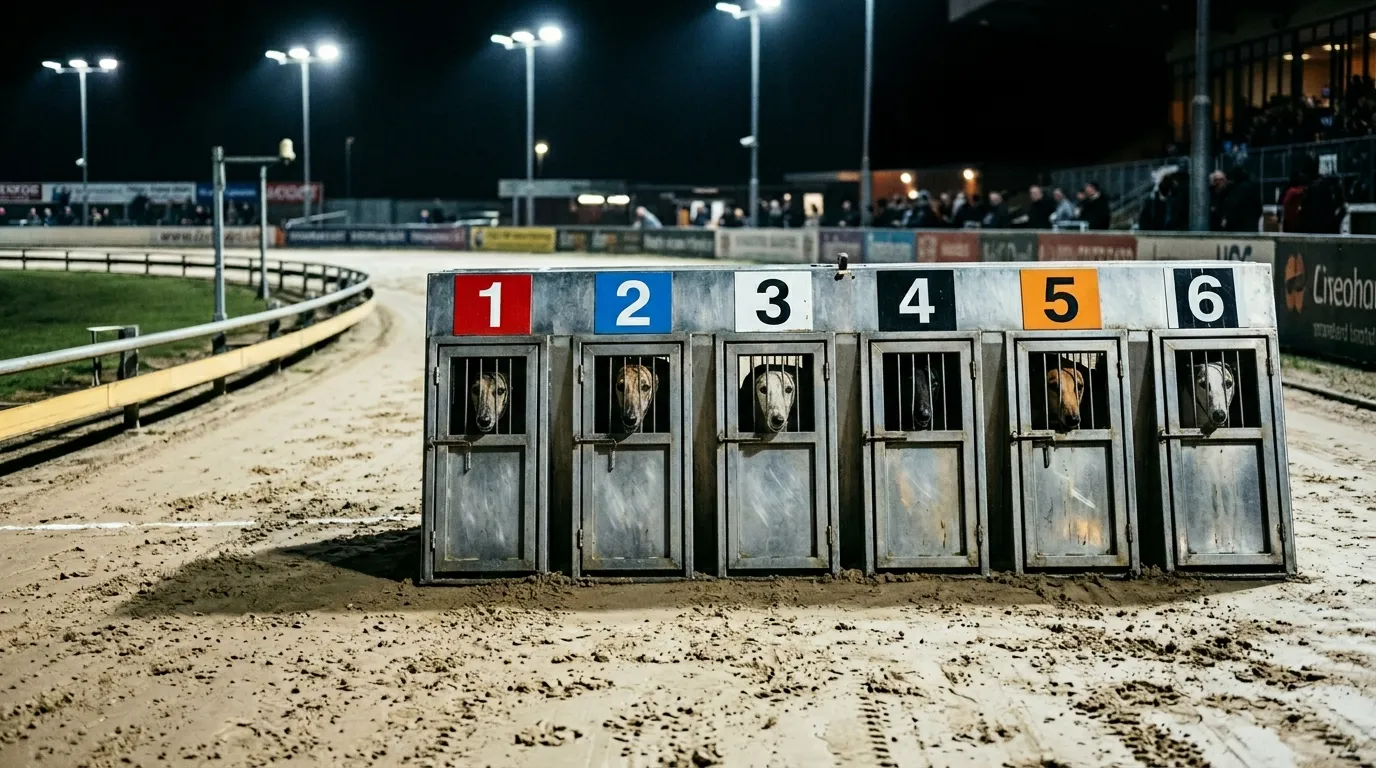
Trap bias is the statistical tendency of certain starting boxes to produce more winners than probability alone would predict. In a six-dog race, each trap should theoretically win 16.6 per cent of the time if all else were equal. All else is never equal. The shape of the track, the position of the first bend, the type of mechanical lure, the running styles seeded into each box, and even the weather on the night — all of these warp the baseline in predictable ways. The question is not whether bias exists at Newcastle. It does. The question is how large it is, which distances amplify it, and whether it is stable enough to be useful.
This article breaks down Newcastle greyhound trap bias using publicly available race data, explains the mechanical and geometrical reasons behind the numbers, and gives you a framework for incorporating trap statistics into your selection process without falling into the trap of treating correlation as causation. Because that, more than anything, is what separates punters who use data from punters who are used by it.
What Causes Track Bias in Greyhound Racing
Before looking at Newcastle’s specific numbers, it helps to understand why trap bias exists at all. The answer is geometry, physics, and a mechanical hare.
Every greyhound track in the United Kingdom is an oval. The dogs start from numbered boxes on one part of the track and race in the same direction around the bends, chasing a lure — at Newcastle, a Swaffham-type hare that runs on a rail along the inside of the track. The lure’s position creates a gravitational pull: every dog wants to be close to the rail because the hare is there, and because the shortest route around a bend is the inside line. This means that from the moment the traps open, there is a natural convergence towards the rail at the first bend. Dogs drawn on the inside — traps 1 and 2 — are already there. Dogs drawn on the outside — traps 5 and 6 — have to cross other runners to get there, or else race wide and cover extra ground.
Nationwide data shows that trap 1 wins roughly 18 to 19 per cent of all races across UK tracks, against a theoretical expectation of 16.6 per cent. That two to three percentage-point edge does not sound dramatic until you realise what it means in volume. Over a thousand races, trap 1 produces around 20 to 30 more winners than a neutral trap. For a systematic bettor, that asymmetry is significant.
The second factor is the run to the first bend. Every track has a different distance from the starting boxes to the first turn, and that distance determines how much time the dogs have to sort themselves out before they hit the curve. A long run-up — 150 metres or more — gives outside dogs time to find a clear lane and reduces the inside bias. A short run-up — under 100 metres — compresses the field and punishes wide runners because they arrive at the bend still tangled in traffic. Newcastle’s 480-metre trip has a run of approximately 130 metres to the first bend, which falls in the middle range. The bias exists, but it is not as extreme as it would be on a track with a very short run.
The third element is the lure type. Different mechanical lures travel at different speeds and hold different lines around the bends. A lure that swings wide through the turn can pull dogs off the rail momentarily, giving outside runners a gap. A lure that hugs the rail tightly reinforces the inside advantage. Newcastle uses a Swaffham hare, which generally maintains a consistent rail line and does not flare wide. This tends to sustain inside bias rather than neutralise it.
Finally, the track surface and camber play a role. Some tracks have a slight banking through the bends that helps outside runners hold their line without losing speed. Others are flat, which makes it harder to race wide without scrubbing off momentum. These are engineering details that most punters never think about, but they contribute to the persistent, track-specific patterns that show up in the long-term data.
Newcastle Trap Win Rates by Distance
Here is where theory meets track. At Newcastle, trap 2 — the blue jacket — has historically shown a higher win rate than any other box. This is a slight departure from the UK-wide pattern where trap 1 leads, and it is the kind of local detail that separates someone who reads generic advice from someone who reads the actual data.
Why trap 2 rather than trap 1? The most likely explanation lies in the combination of Newcastle’s bend geometry and its seeding policy. Trap 1 at Newcastle receives the most committed railers — dogs that cling to the inside rail from start to finish. Trap 2 receives dogs that are also rail-inclined but with slightly more flexibility in their running style. When the traps open, the trap 1 dog takes the shortest path to the bend and hugs the rail. The trap 2 dog, starting one box width further out, has a marginally better angle to carry speed into the bend without being squeezed against the rail by the dog on its inside. In effect, the trap 2 runner gets the benefit of an inside draw without the constriction of being against the fence.
The outside traps tell a different story. Traps 5 and 6 at Newcastle tend to underperform relative to the inside four, particularly over the standard 480-metre trip. Wide runners face a double penalty: they cover extra ground on every bend, and they are more exposed to crowding when the field converges. Over 290 metres, where there are only two bends and the pace is flat-out from start to finish, the outside disadvantage is smaller because there is less time for the bias to compound. Over 640 metres and beyond, the bias becomes more variable because the additional bends and longer race duration introduce more randomness.
Market data adds another dimension. The favourite in a greyhound race wins approximately 30 per cent of the time, with the top three in the betting accounting for roughly 73 per cent of all winners. That means the market is right far more often than it is wrong — but it also means that nearly three races in ten are won by a dog trading outside the top three in the betting. Trap bias, used properly, can help you identify situations where the market has not fully priced in the positional advantage of a well-drawn dog or the positional disadvantage of a poorly drawn favourite.
Distance-by-Distance Benchmarks: 290m to 895m
Newcastle operates on a 415-metre circumference and stages races over six distances: 290, 480, 500, 640, 706, and 895 metres. Each distance has a distinct character, and trap bias behaves differently across them.
290 Metres
The sprint. Two bends, a short run to the first turn, and maximum emphasis on trapping speed. At 290 metres, the dog that leads at the first bend wins the majority of the time because there simply is not enough track for a closer to make up ground. Inside traps carry a meaningful edge here. A dog drawn in trap 1 or 2 with a history of fast first-bend splits is a textbook sprint contender. Outside traps can win, but they need a genuinely superior early pace to overcome the extra ground they cover around the bends.
Benchmark times at 290 metres depend heavily on going, but on a standard surface, open-class dogs will break 17.00 seconds. A-grade BAGS runners typically land in the 17.10 to 17.50 range. Anything above 17.80 suggests either a slow track or a dog out of its depth.
480 Metres
The bread-and-butter distance at Newcastle and the trip you will see on the majority of race cards. Four bends, roughly 130 metres to the first turn, and a long enough race for tactical running styles to have an impact. Trap 2 shows its strongest advantage at this distance. The combination of a decent run-up and four bends gives the blue jacket enough opportunities to establish position without being crowded. Front-runners dominate, but strong finishers drawn in traps 3 or 4 can produce competitive results if the early pace dogs cut each other up.
Standard going times for A-grade 480-metre races fall between 29.00 and 29.80 seconds. Open-class runners will go faster. Anything under 28.80 on a standard surface is a high-quality performance.
500 Metres
A slight step up from 480. The extra 20 metres seems negligible but it changes the starting position on the track, which alters the run to the first bend and can shift the bias pattern marginally. Dogs that stay 480 metres strongly tend to handle 500 without difficulty, but the starting box configuration means the first-bend dynamics are not identical. Treat 500-metre form as closely related to 480-metre form but not interchangeable.
640 Metres
The middle-distance trip. Six bends, which means more opportunities for interference but also more opportunities for a strong-running dog to work through the field. Trap bias at 640 metres is less pronounced than at 480 because the additional bends dilute the first-turn advantage. Stamina and bend-running ability matter more. A dog that clips every bend cleanly will save lengths over a dog that runs wide repeatedly, regardless of trap draw.
Benchmark times at 640 metres on a standard surface range from about 39.50 for open class to the low 41s for A-grade. The time range is wider than at shorter distances because stamina variation between dogs is more pronounced over six bends.
706 and 895 Metres
The staying trips. Races over these distances are less common — you will see them on selected cards rather than every meeting — and they attract a smaller pool of specialists. At 895 metres, the dogs complete over two full laps of the track. Trap bias at these distances is essentially noise. The race is long enough that early position means little; what matters is stamina, tactical sense, and the ability to maintain speed through eight or more bends. If you are betting on staying races at Newcastle, focus on form over distance, recent race times, and whether the dog has proven stamina credentials. The trap draw is a footnote.
How Weather Shifts the Bias at Newcastle
Trap bias is not a fixed number carved into the track. It shifts with conditions, and the most powerful condition variable at Newcastle is the weather.
Rain is the obvious factor. When the track surface absorbs water, it becomes heavier and slower. Dogs have to work harder to maintain speed through the bends, and wider runners — who already cover more ground — lose more time per bend than rail runners. The result is that wet conditions tend to amplify the inside bias. Traps 1 and 2 benefit not just from their positional advantage but from the fact that every extra metre covered in heavy going costs more energy than it would on a dry surface.
Temperature matters too, though less directly. Cold, firm surfaces in winter are typically faster than warm, loose surfaces in summer. The speed difference between traps becomes more pronounced on fast going because the margins are compressed — a tenth of a second is worth more when the overall time is quicker. On a slow, wet night, the field tends to spread out and positional luck matters more. On a fast, dry night, early speed and trap advantage become decisive.
Wind is the underrated variable. Newcastle Stadium sits in Byker, and the track’s orientation means that certain bends are more exposed to prevailing wind than others. A strong headwind on the back straight slows the leaders and gives dogs racing in the slipstream a marginal recovery advantage. A tailwind on the home straight benefits front-runners who can extend their lead in the final furlong. These effects are small — measured in hundredths of seconds — but in a sport where photo finishes are common, hundredths of seconds decide outcomes.
The practical lesson is this: do not treat trap statistics as a static table. If you are studying Newcastle greyhound trap bias, check the going report before the meeting. If the going is heavy and the forecast is for more rain, lean harder on inside traps than the long-term averages suggest. If the going is fast and the wind is light, the averages are a reasonable guide. The data is a compass, not a map — it points you in the right direction but it does not tell you exactly where you are on the night. As the analysts at The Game Hunter put it, greyhound racing is a sport of fine margins, and bias is a real but short-term variable rather than a permanent rule.
Grading, Seeding and Their Effect on Trap Data
One of the most common errors when interpreting trap bias data is ignoring the grading and seeding system that determines which dog ends up in which box. Trap statistics do not exist in a vacuum — they are the product of deliberate decisions made by the racing manager before each meeting.
At Newcastle, greyhounds are graded into performance bands (A1 through to A10 and beyond, plus open races for the highest class). Within each race, the six runners are seeded into traps based on their running style. Rail-preferring dogs go to traps 1 and 2. Wide runners go to 5 and 6. Middle runners fill the centre. This is not optional — it is part of the GBGB rules of racing, designed to reduce interference and produce safer, fairer contests.
The seeding system has a direct statistical consequence. Because the best railers are consistently placed in traps 1 and 2, those traps receive dogs whose natural style already favours an inside draw. Some of the trap 2 advantage at Newcastle is genuine geometry — the box position helps the dog. But some of it is selection bias — trap 2 gets dogs that are suited to running from that position in the first place. Disentangling the two effects is difficult, and anyone who claims to have done it perfectly is overstating their case.
The practical implication is that you should not blindly back every trap 2 runner at Newcastle. Instead, ask a more targeted question: does this particular dog in trap 2 have the running style to exploit the draw? A confirmed railer with fast early pace in trap 2 at 480 metres is a strong positional play. A dog that usually runs wide but has been seeded into trap 2 because of limited availability — perhaps it was the only dog left to fill the box — is a poor positional play despite the favourable statistics.
Grade level also matters. In lower grades, where the speed differential between dogs is greater, trap bias has a larger influence because the best dog can overcome a bad draw through sheer superiority. In higher grades, where the dogs are closely matched, the draw becomes more important because there is less ability margin to compensate for positional disadvantage. If you are studying Newcastle greyhound trap bias for practical betting use, weight your analysis towards the grade and distance you are actually betting on rather than relying on aggregate figures across all races.
Using Trap Bias in Your Selection Process
Trap bias is a tool. Like any tool, it is useful when applied correctly and dangerous when used as a shortcut. Here is a framework for incorporating it into your Newcastle selections without oversimplifying.
Start by identifying the distance. As we have seen, the bias is strongest at 290 and 480 metres and weakest over staying trips. If you are looking at a 290-metre sprint, the trap draw should be a significant factor in your assessment. If you are looking at an 895-metre marathon, it barely registers.
Next, check the going report. If conditions are wet and heavy, add weight to inside draws. If conditions are fast and standard, use the long-term averages as your baseline.
Then look at the individual dog. Does its running style match the trap? A railer in trap 2 on a wet night over 480 metres is the best-case scenario for a bias play. A wide runner in trap 2 — even though the trap statistics are favourable — is a mismatch. The statistics reflect the average outcome for all dogs drawn in a trap, but averages include mismatches. Your job is to find the races where the dog, the draw, and the conditions all align.
One approach that works well is to use trap bias as a filter rather than a selection method. Begin with your standard form analysis — check the six-run form, split times, bend positions, and race comments. Identify two or three dogs that look competitive on ability. Then overlay the trap draw. If one of your shortlisted dogs has a clear positional advantage and another has a clear disadvantage, that is a useful tiebreaker. It should not be the first question you ask, but it is a good last question.
Forecasts and tricasts are where trap bias can add the most value. In a straight win bet, you are simply trying to find the winner, and ability usually trumps position. In a forecast, you need the first and second in the correct order, and positional advantage at the first bend strongly correlates with finishing order. If you build forecasts around dogs that are well drawn at the distance, you will hit them more often than if you ignore the draw entirely.
A final caution: do not fall in love with the data. Trap bias is a tendency, not a law. Trap 2 at Newcastle does not win every race. It does not even win most races — it just wins a slightly higher proportion than the other traps over a large sample. Over ten races, the difference between trap 2 and trap 5 might be one extra winner. Over a thousand races, it is statistically meaningful. Over ten, it is noise. If you are betting casually on a single evening, the trap draw is one variable among many. If you are betting systematically over hundreds of races, it becomes a genuine edge — provided you combine it with form analysis, going assessment, and proper staking discipline.
Newcastle greyhound trap bias is real, measurable, and useful. It is not magical, and it is not a substitute for doing the work. Treat it as one part of a larger analytical process and it will improve your results. Treat it as the whole process and it will cost you money.
The full picture is in our Newcastle dog results guide.
The going shifts the bias: track conditions.
