

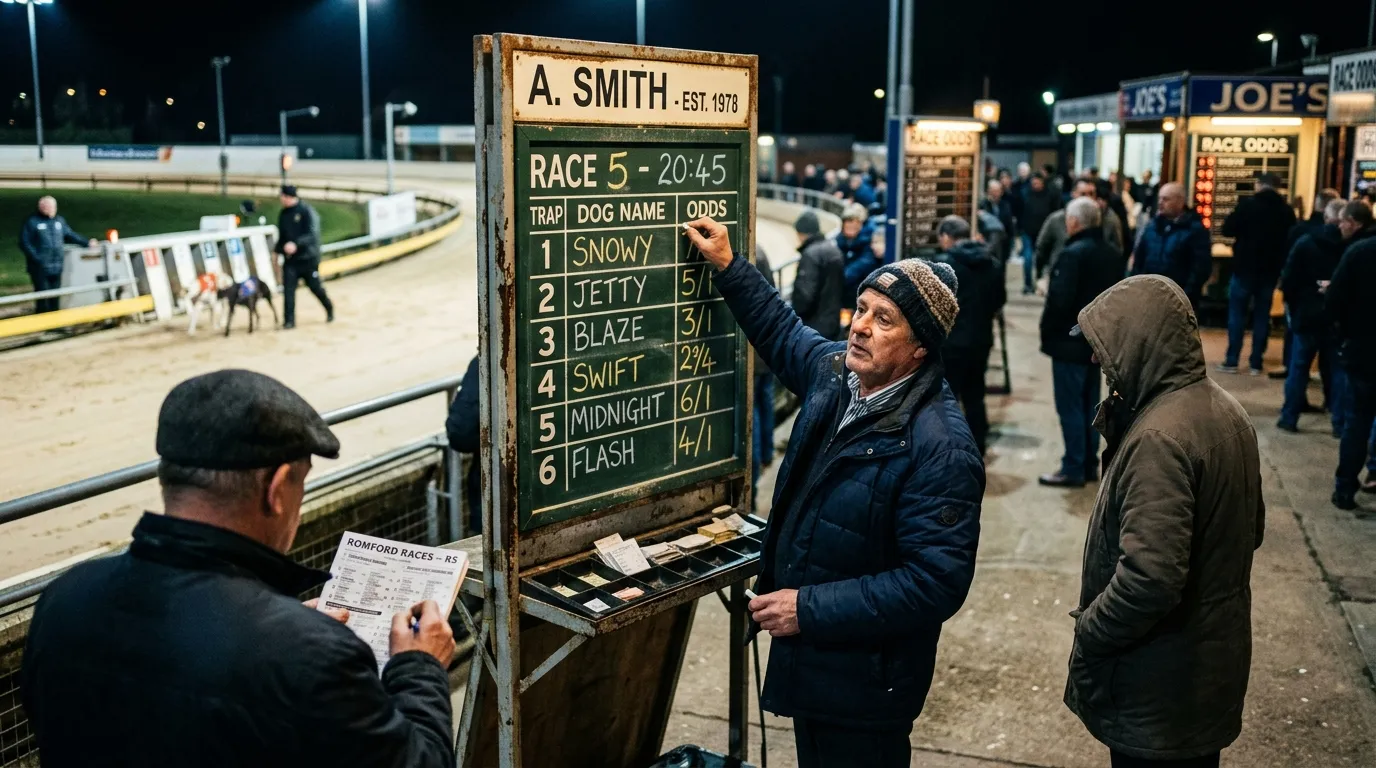
Newcastle Greyhound Odds: Markets, Mechanics and Edge
Greyhound betting in the United Kingdom is a quieter industry than most people assume — and a larger one. Between April 2022 and March 2023, total wagering turnover on greyhound racing across off-course, on-course pool and remote channels was estimated at £1.5 billion, according to Gambling Commission data. That is not horse-racing money, but it is not pocket change either. The sport moves real volume, and Newcastle is one of its busiest venues, staging races five days a week across morning, afternoon and evening cards.
Yet the market is contracting. Gambling Commission figures published by the Racing Post show that greyhound betting turnover fell 12.9 per cent in nominal terms — and roughly 23 per cent in real terms once inflation is accounted for — over the three years to March 2024. That decline is not unique to greyhounds, but it does mean that the money flowing through the market is thinner, the liquidity on some exchanges is lower, and the pricing inefficiencies that punters used to exploit are harder to find. Understanding how Newcastle greyhound betting actually works — which markets exist, how prices are formed, and where value hides — is no longer optional knowledge for anyone who bets regularly. It is the starting line.
This guide covers every major betting market available at Newcastle, explains the mechanics behind each one, and gives you a framework for approaching selections without relying on luck or tips columns.
Win and Each-Way Bets at Newcastle
The win bet is the simplest wager in greyhound racing: pick the dog you think will cross the line first, and if it does, you collect. Your return is your stake multiplied by the odds at the time the bet is settled — either the price you took when you placed the bet (a fixed-odds bet) or the starting price (SP) returned just before the traps open. We will cover SP in detail later.
Each-way betting adds a safety net. An each-way bet is two bets in one: a win bet and a place bet. If your dog wins, both parts pay out. If your dog finishes in a place position — typically first or second in a six-runner race — the place part pays at a fraction of the win odds, usually one quarter. So if you back a dog at 8/1 each-way for £5, you are staking £10 total (£5 win, £5 place). If the dog wins, you collect £45 win plus £15 place, for a total return of £60. If it finishes second, you lose the £5 win stake but collect the £15 place return, netting £5 profit.
Each-way betting suits greyhound racing well because the fields are small — six runners — and the price of each-way insurance is relatively low. The downside is that backing short-priced dogs each-way is a guaranteed way to erode your bank. A 2/1 favourite each-way returns just £7.50 on the place part for a £5 stake, which barely covers the combined outlay. Each-way value lives at bigger prices: the 6/1 or 8/1 shot that you believe has a strong chance of hitting the first two even if it does not win.
At Newcastle, the each-way market is straightforward. Six runners, two places, quarter the odds. Some bookmakers occasionally offer enhanced each-way terms — three places instead of two, or a third of the odds — as promotional incentives, but these are exceptions. The standard terms apply to the vast majority of races.
One tactical note: the win market and the each-way market attract different money, and the balance between them can distort prices. A dog that receives heavy each-way money from punters who fancy it for a place but not a win will see its odds shorten, even though the strength of opinion is for the place rather than the win. If you are watching the market move, keep this in mind. A price shortening from 6/1 to 4/1 does not necessarily mean the smart money thinks it will win — it might mean the each-way money thinks it will place.
Forecast and Tricast: How They Work and What They Pay
If win betting is the foundation of Newcastle greyhound betting, forecasts and tricasts are where the architecture gets interesting — and where the returns get serious.
A forecast requires you to predict the first and second dogs in the correct order. A reverse forecast covers both possible finishing orders between your two selections (first/second or second/first) but costs twice the unit stake. A combination forecast, or “combo”, lets you select three or more dogs and covers every possible first-and-second permutation among them. With three dogs, that is six permutations, so a £1 combination forecast costs £6.
Forecast dividends are declared after the race based on one of two methods: the Computer Straight Forecast (CSF) or the bookmaker’s own fixed-odds forecast price. The CSF is calculated using an algorithm that factors in the starting prices of the first two finishers and the number of runners. It is designed to produce a fair payout that reflects the difficulty of the prediction. A forecast involving two short-priced dogs — say the 2/1 favourite and the 3/1 second favourite — will pay modestly, perhaps £8 to £12 for a £1 stake. A forecast involving a 10/1 outsider finishing ahead of the favourite can pay £40, £60 or more, depending on the field.
The tricast works on the same principle but extends to three dogs: you must predict the first, second and third in the correct order. The permutations multiply and so do the potential returns. A straight tricast — one exact combination — costs a single unit stake, but the odds of getting all three correct in order are long. A combination tricast with four selections covers 24 permutations (4 x 3 x 2) and costs £24 for a £1 unit. The payouts can be dramatic. A tricast involving three outsiders has been known to return several hundred pounds for a single pound staked, though these are exceptional rather than routine.
The Computer Tricast Forecast (CT) dividend is calculated in a similar way to the CSF but accounts for three finishing positions rather than two. Like the CSF, the return scales with the difficulty of the result. Three favourites filling the first three places pays far less than three longshots doing so.
Practical advice for forecast and tricast betting at Newcastle: start by identifying two or three dogs that you believe are the most likely to fill the top places. Consider their trap draws, early pace, and recent form at the distance. Then decide how many permutations you want to cover and price that against the likely dividend. A six-permutation combo forecast on three fancied dogs at £1 per line costs £6. If the CSF dividend pays £15, your net profit is £9. If it pays £8, your net is only £2. The skill lies in identifying races where the likely forecast dividend justifies the staking outlay — and in having the discipline to skip races where it does not.
One common mistake is playing forecasts in races with a dominant favourite. If the favourite is 1/2 or shorter, the CSF involving that dog will be compressed, and your forecast return may not cover a combination stake. Forecasts offer the best value in competitive races where the top three in the market are separated by a few points and the exact finishing order is genuinely open.
Tote Pools at Newcastle: Jackpot, Placepot and Scoop6
Tote pool betting works on a fundamentally different model to fixed-odds bookmaking. Instead of taking a price from a bookmaker, your stake goes into a collective pool with every other punter’s money. After the operator takes a deduction (typically between 13 and 28 per cent depending on the pool type), the remaining pot is divided among winning tickets. The payout is not known until the race is over and all bets are settled — which means pool dividends can sometimes exceed fixed-odds returns by a wide margin, and sometimes fall well below them.
The Tote Win pool is the simplest: pick the winner, and if you are correct, you share the pool with all other winning ticket holders. The Tote Place pool works the same way but for place finishers. In a six-runner greyhound race, the place pool pays on first and second. These pools are most useful when you believe a dog is underestimated by the fixed-odds market. If the bookmakers price a dog at 5/1 but the Tote Win pool returns a dividend equivalent to 8/1, you have found extra value — provided you do not mind discovering the exact return after the race rather than before it.
The Placepot is the pool bet with the widest appeal at greyhound meetings. To win a Placepot, you need to select a placed dog in each of the first six races on the card. With six-runner fields and two places per race, the probability of a single selection going through each leg is roughly one in three. Over six legs, that compounds to long odds, but the Placepot allows multiple selections per leg. Covering two dogs in each of the six races costs 64 lines (2 to the power of 6), so a 10p unit stake costs £6.40. The returns depend on the pool size and the number of winning tickets. On a day when a few surprises thin the field of surviving tickets, Placepot dividends at Newcastle can reach into the hundreds for modest stakes.
The Jackpot pool requires you to pick the winner — not just a placed dog — of every race on the card. It is significantly harder than the Placepot but the dividends reflect that difficulty. Multi-leg pools like the Jackpot and the Scoop6 (which spans six nominated races, often across multiple meetings) are lottery-style bets. They should be approached as occasional gambles with small stakes rather than systematic strategies.
Pool betting is available both trackside and through the Tote app and website. At Newcastle Stadium, the Tote windows operate alongside the main bookmaker ring, and you can switch freely between fixed-odds and pool bets across different races. There is no rule that says you must commit to one or the other for the entire meeting.
SP vs Betfair SP: Which Price Matters?
Starting Price, or SP, is the official price returned on a dog at the moment the traps open. It is determined by on-course bookmakers: a panel of officials reads the prices being offered in the ring and sets a consensus figure. If you place a bet at SP, you accept whatever price is declared after the race starts. It is the default settlement method for most bets placed without taking a fixed price.
Betfair SP is a different animal. It is the starting price generated by the Betfair exchange at the off, calculated from the weight of money on the exchange market. Because the exchange is a peer-to-peer platform — punters bet against each other rather than against a bookmaker — the Betfair SP reflects the wisdom (or folly) of the crowd rather than the commercial position of a bookmaker. In theory, the Betfair SP is a more efficient price because it incorporates more information. In practice, greyhound markets on the exchange are thinner than horse-racing markets, particularly for midweek BAGS meetings at Newcastle, which means the Betfair SP can sometimes be volatile or out of line with on-course prices.
Which should you use? The answer depends on how you bet. If you take early prices — placing your bet hours before the race at a fixed price offered by an online bookmaker — SP is irrelevant because your return is locked in. Early prices can offer value when you spot a dog before the market does, but they can also trap you into backing a dog at 4/1 that drifts to 8/1 by the off, which usually means the market has found a reason to oppose it.
If you bet at the track or close to the off, the on-course market remains significant — Gambling Commission data for the year to March 2024 showed betting shop turnover on greyhounds at £794 million, confirming that the traditional retail channel still handles serious volume. On-course SP tends to be a fair reflection of the market when there is a healthy ring, though at smaller BAGS meetings the number of bookmakers may be limited, which can make SP less reliable.
A useful habit is to compare the SP and the Betfair SP after the race. If they are broadly aligned, the market was efficient. If the Betfair SP is consistently higher than the on-course SP on winners, it suggests the exchange was offering better value — and you might want to direct more of your bets through the exchange. If the reverse is true, the on-course market was more generous. Track these over fifty or a hundred races and you will develop a data-driven sense of where your money works hardest.
Building a Selection Process for Newcastle Dogs
Tips columns and social-media tipsters are not a betting strategy. They are someone else’s opinion with no accountability and no track record you can verify. If you want to bet on Newcastle greyhounds with any consistency, you need a repeatable process — a sequence of questions you ask before every race that filters the field and identifies where you have an edge, if you have one at all.
The process does not need to be complicated, but it does need to be disciplined. Here is a workable framework.
Step one: read the racecard. Check the grade, the distance, the trap draws, and the form of every runner. You are not looking for the winner yet — you are eliminating dogs that are unlikely to win. A dog that has finished last in three of its last four runs, is drawn in an unfavourable trap, and is stepping up in grade can usually be dismissed early. Narrowing the field from six to three or four credible contenders is the first productive move.
Step two: compare sectional times. Among your shortlisted dogs, which one has the fastest first-bend splits? Which one has the best finishing speed? If two dogs are closely matched on form, the sectional times can reveal which one has the running style better suited to this particular race. A front-runner with fast splits drawn in trap 2 over 480 metres at Newcastle has a different profile to a closer with moderate splits drawn in trap 5. Both might be talented, but the front-runner has the structural advantage at this track.
Step three: check the going and weather. If the going is heavy, lean towards dogs with proven form on slower surfaces and dogs drawn inside. If the going is fast, rely more heavily on raw times and sectional comparisons.
Step four: assess the market. Once you have identified your preferred dog, compare your assessment with the bookmaker’s price. If you believe a dog has a 30 per cent chance of winning and the bookmaker offers 4/1 (implied probability 20 per cent), you have found a potential value bet. If the bookmaker offers 2/1 (implied probability 33 per cent), the market agrees with you and there is less room for value. Betting at value prices is the only way to produce a long-term profit, and it requires you to have an independent opinion before you look at the odds — not after.
Step five: choose the market. Win bets for strong convictions, each-way for dogs you rate for a place finish at bigger prices, forecasts for competitive races where you have a view on the first two. Match the bet type to your confidence level and to the race type. Not every race deserves a bet. The most profitable habit in greyhound betting is knowing when to sit one out.
Responsible Gambling: Limits, Tools and Support
No betting guide is complete without this section, and no, it is not a formality. Greyhound racing is fast — a meeting at Newcastle can stage twelve races in under two hours — and the speed of the product is part of its appeal. It is also part of its risk. The interval between bet, result and next opportunity is measured in minutes, not hours, and that cadence makes it easy to chase losses, raise stakes and lose track of spend if you are not paying attention.
The Gambling Commission requires all licensed UK operators to offer self-management tools: deposit limits (daily, weekly, monthly), loss limits, session time alerts, cool-off periods and self-exclusion options. Every major bookmaker operating at Newcastle — whether in the on-course ring, online or through an app — provides these tools. They are not difficult to set up, and they are significantly easier to activate before a losing streak than in the middle of one.
Deposit limits are the most practical starting point. Decide on a weekly amount you can afford to lose entirely — not the amount you expect to win, but the amount that, if it vanished, would not affect your bills, your savings or your mood. Set that as your deposit limit. Once you have hit it, the platform locks you out for the rest of the period. This is not a sign of weakness. It is a structural guardrail, and professional bettors use them routinely.
Session time alerts are underrated. A two-hour evening at Newcastle dogs can feel like thirty minutes when the races are flowing and the picks are coming in. Setting a one-hour or ninety-minute alert gives you a natural pause to check your bank balance, review your bets and decide whether continuing is a decision or a reflex.
If you find that betting is causing stress, financial pressure, or conflict in your relationships, the following organisations offer free, confidential support: GamCare (0808 8020 133), the National Gambling Helpline, and GamStop for self-exclusion from all licensed UK gambling sites. These services exist because the industry knows that a proportion of its customers will develop problems, and because addressing that honestly is better than pretending it does not happen.
One final data point worth remembering: the favourite in a greyhound race wins approximately 30 per cent of the time. That means the dog that the market considers most likely to win loses seven times out of ten. If the most probable outcome in any single race is still a losing bet, long-term profitability depends entirely on price discipline, bank management and emotional control — not on picking more winners. Newcastle greyhound betting rewards process over impulse. Build the habit of treating your betting bank as a limited resource, not a renewable one, and the rest of your strategy has a foundation to stand on.
The full picture is in our Newcastle dog results guide.
