

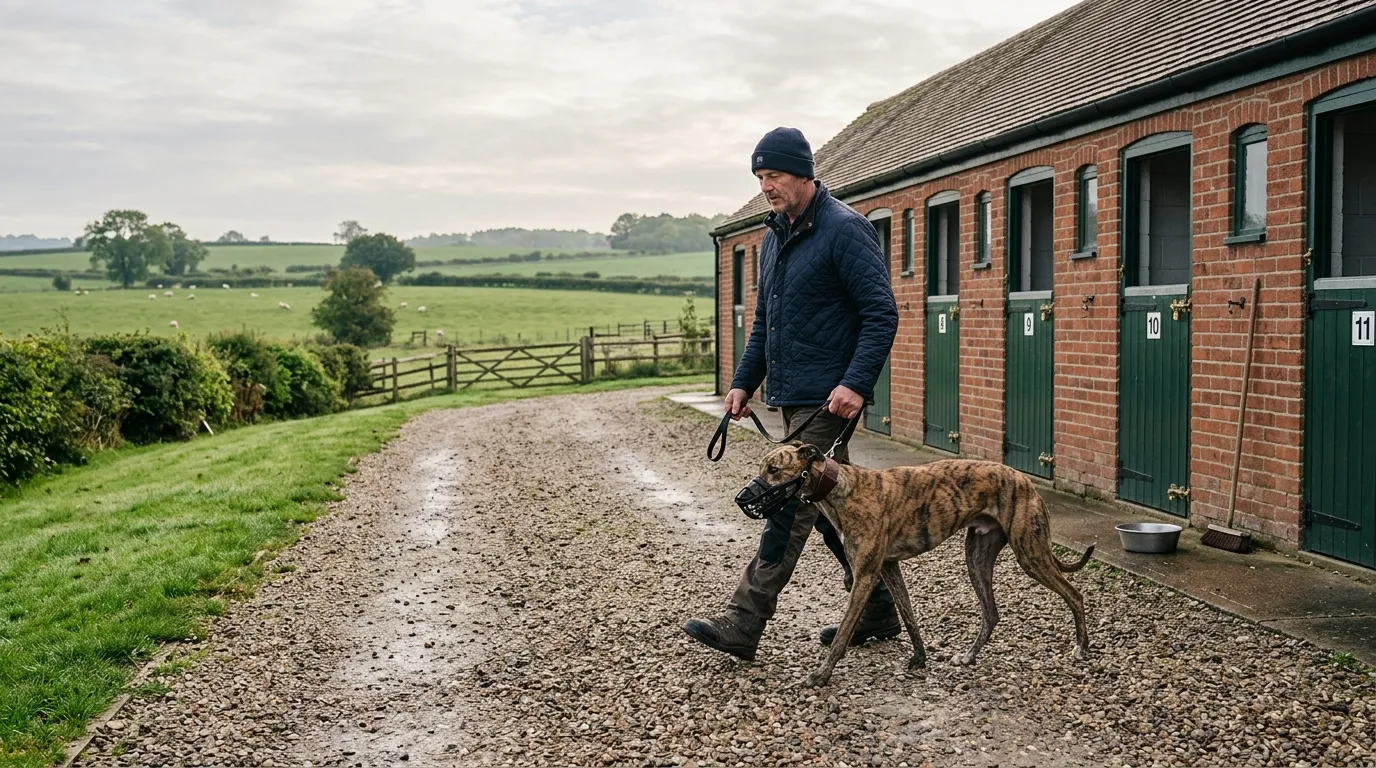
The Names Behind the Numbers on a Newcastle Racecard
Newcastle greyhound trainers do not get headline treatment. The racecard shows their name in small type next to the dog’s details, and most punters scroll past it to check the form figures, the trap draw and the price. That is a mistake. The trainer’s name is not decorative — it is the single most reliable indicator of how a dog has been prepared, what condition it is in, and how it is likely to perform on a given surface in a given week.
Across Britain, approximately 500 licensed trainers operate under GBGB regulations, managing the preparation, welfare and racing programmes of around 6,000 registered greyhounds each year. At Newcastle, the picture is more concentrated. A core group of contract trainers supplies the bulk of runners for graded meetings, while visiting trainers from other regions appear for open races and category one events. The interplay between these two groups — the locals who know every contour of the 415-metre sand circuit and the visitors who bring class from further afield — defines the competitive texture of Newcastle racing.
Understanding who trains what, and how their dogs tend to perform at Newcastle, adds a dimension to form analysis that raw data alone cannot provide. The dog’s time is what happened. The trainer’s record is why it happened.
Contract Trainers at Newcastle Stadium
Contract trainers are the backbone of Newcastle’s weekly fixture list. They hold formal agreements with the stadium to supply a certain number of runners per meeting, ensuring that every card has a full complement of competitive fields. In return, they receive kennel facilities, access to the track for trials, and a guaranteed racing programme for their dogs. The arrangement is common across GBGB stadiums and reflects the practical reality that graded racing depends on a steady supply of locally based greyhounds.
Newcastle’s contract trainers typically kennel their dogs within driving distance of the stadium, which means the dogs race on their home track more often than not. That familiarity breeds a measurable advantage. A dog that has run twenty times over 480 metres at Newcastle has adapted to the track’s specific characteristics — the Swaffham hare, the sand surface, the bend geometry, the run to the first timing point — in ways that a visitor from Romford or Nottingham simply has not. This home advantage shows up in the statistics: contract-trainer runners at Newcastle tend to outperform visitors in graded racing, where the quality gap between dogs is narrow and track knowledge becomes a differentiator.
The names change over time. Angela Harrison made a significant mark at Newcastle in the late 2010s, sending out runners that competed at the highest level — her Droopys Verve finished runner-up in the 2018 English Greyhound Derby, and Droopys Expert reached the 2019 Derby final. The training licence at Newcastle has passed through various hands over the years, and the current roster reflects the latest generation of kennel operators working with the stadium under Arena Racing Company’s ownership. Checking the Newcastle Greyhound Stadium news section provides the most current information on which trainers hold the contract and how their kennels are performing.
For form analysis, the practical approach is simple: when two dogs in the same graded race have similar recent form, the one trained by a Newcastle contract trainer with a strong track record at the venue deserves a marginal edge. That edge is not decisive on its own, but compounded across dozens of selections over a season, it adds up.
Open-Race Visitors and Their Form
Open races change the dynamic entirely. When Newcastle hosts a category one event like the All England Cup or a sponsored open stake, the field includes dogs from kennels across Britain. These are often the best greyhounds in the country — animals that race at Nottingham, Towcester, Romford and other tracks, with form lines that are difficult to compare directly with Newcastle regulars because the track dimensions, surfaces and hare types all differ.
Visiting trainers bring different methods, different feeding regimes and different approaches to race preparation. A southern trainer whose dogs are accustomed to the larger Nottingham circuit (430-metre circumference, 160-metre run to the first bend on 500-metre races) is sending a dog to a tighter track at Newcastle where the bends come sooner and the margins for error are smaller. Some dogs adapt immediately. Others need a run or two to find their feet, which is why many visiting trainers request trials at Newcastle before entering their runners in competition.
The All England Cup is the clearest showcase for this dynamic. With total prize money reaching levels that attract national-calibre entries, the competition draws dogs from leading kennels nationwide. The visiting entries frequently boast faster times from their home tracks, but converting those times into a Newcastle performance is not automatic. The trial data — published on the racecard as a separate line from competitive form — is the first indicator of how a visiting dog has handled the Newcastle track. A trial that produces a competitive time and clean running through the bends is encouraging. A trial with a slow split and wide running suggests the dog is still adjusting.
For bettors, open races at Newcastle present both opportunity and risk. The opportunity is that the market may underrate local knowledge — a home-trained dog that knows the track may outperform a classier visitor that is racing on unfamiliar ground. The risk is the reverse: a genuinely superior dog from a top southern kennel may win comfortably regardless of track adjustment, and ignoring its form because the times were set elsewhere would be a costly error. The best approach is to weigh both datasets — the visitor’s national form and the trial data — without defaulting to either home bias or reputation bias.
How to Research Trainer Performance
Trainer statistics are not prominently displayed on most racecard platforms, but they are available if you know where to look. Two sources stand out for depth and reliability.
Greyhound Stats UK maintains a comprehensive database of trainer performance across all GBGB-licensed tracks. The site lets you filter by track, distance, grade and time period, producing strike rates and profit-loss figures that quantify a trainer’s effectiveness at Newcastle specifically. A trainer who sends out fifteen runners a month at Newcastle with a twenty-two per cent strike rate is measurably more effective than one with a fourteen per cent rate over the same period — and if the first trainer also shows a positive profit to starting price, the signal is stronger still.
The Greyhound Recorder provides a trainer search function that links directly to the race results of individual dogs, letting you trace how a trainer’s runners have performed over time. This is particularly useful for identifying patterns: does the trainer’s dogs tend to improve on their second start after a break? Do they perform better on Thursday evenings than Wednesday afternoons? Do their sprinters outperform their stayers, or vice versa? These patterns are not guaranteed to repeat, but they reflect tendencies in training method and race selection that carry forward season to season.
A less systematic but sometimes more revealing source is the Newcastle Greyhound Stadium’s own news section. Feature articles on trainers and their dogs occasionally appear ahead of major events, and they can provide context — a trainer’s assessment of a dog’s fitness, a kennel change, a new training method — that pure statistics do not capture. The prize pool across British greyhound racing totals £15.7 million, and for trainers competing at Category One level, the financial stakes make these interviews more than promotional fluff. When a trainer talks publicly about a dog’s preparation, the information has market-moving potential.
The most efficient research workflow combines Greyhound Stats UK for quantitative data — strike rate, profit-loss, distance breakdowns — with the Greyhound Recorder for individual dog histories and the Newcastle news section for qualitative context. None of these sources is complete on its own. Together, they build a picture of the trainer landscape at Newcastle that the racecard’s single-line name credit barely hints at.
The wider context is set out in our Newcastle dog results guide.
