

What the Numbers Say About Greyhound Safety and Life After Racing
Greyhound welfare in UK racing is no longer a subject that the industry can discuss in generalities. Since 2018, the Greyhound Board of Great Britain has published independently verified injury and retirement data for every licensed stadium in the country, and those numbers have become the battleground on which the sport’s future is being debated — in parliamentary committees, in the press and in the court of public opinion.
The headline figures for 2024 tell a story of measurable improvement. The track injury rate fell to 1.07 per cent of total starts, the lowest ever recorded. The track fatality rate halved from 0.06 per cent in 2020 to 0.03 per cent. The successful retirement rate reached 94 per cent, up from 88 per cent in 2018. And the number of greyhounds put to sleep for economic reasons collapsed from 175 in 2018 to three in 2024 — a 98 per cent reduction that the regulator considers one of the sport’s most significant welfare achievements.
Those numbers are real, they are audited, and they document genuine progress. They are also, depending on who is reading them, either proof that regulation works or evidence that the underlying risks of racing dogs at forty miles per hour around a sand oval remain unacceptable. Both readings are grounded in the same data. What follows is the data itself, the systems that produce it, and the regulatory framework that sits behind it.
GBGB Injury Data 2018–2024
The GBGB began publishing aggregate injury and retirement data in 2018, following a recommendation from the House of Commons Environment, Food and Rural Affairs Committee, which had criticised the industry’s reluctance to release figures that were already being collected. The data covers all registered greyhounds racing at GBGB-licensed tracks — eighteen stadiums as of January 2025 — and is independently verified before publication.
In 2024, 3,809 injuries were recorded from 355,682 starts, producing the 1.07 per cent injury rate. The GBGB classifies injuries by type and severity, with the majority falling into the category of minor muscular strains and small cuts — conditions that in a pet dog might not prompt a veterinary visit but which racing regulations require to be documented because even minor injuries can affect competitive performance. More serious injuries, including fractures, are a subset of the total and are tracked separately.
The cumulative picture across the seven years of published data is stark in absolute terms. Between 2017 and 2024, 35,168 injuries were recorded on licensed tracks, alongside 1,353 track fatalities. Those numbers fuel the arguments of organisations campaigning for a ban — and they are numbers the industry cannot dismiss, only contextualise. The GBGB’s contextualisation centres on the per-start rate rather than the absolute count, arguing that a 1.07 per cent injury rate across hundreds of thousands of starts represents a sport that is statistically safer than many comparable animal activities. Critics counter that expressing risk per start — rather than per individual dog — dilutes the figure by counting the same animal multiple times across its career.
Track fatalities — deaths occurring at the stadium during or immediately after a race — numbered 123 in 2024. An additional 223 greyhounds died from racing-related causes away from the track, bringing the total to 346 for the year. Each death is investigated, and the causes range from catastrophic injury during a race to medical conditions that manifest post-race. The 0.03 per cent fatality rate per start is the lowest recorded, but the absolute number — 346 dogs in a single year — remains the focal point for welfare campaigners.
Retirement Pathways and the Bond Scheme
The retirement of racing greyhounds is governed by the GBGB’s Greyhound Retirement Scheme, introduced in 2020. Under this scheme, every greyhound registered for racing must be covered by a retirement bond — a financial deposit that ensures the cost of rehoming the dog at the end of its racing career is met. The bond is lodged before the dog is permitted to race and is used to fund the dog’s placement with an approved homing centre once it retires.
The 94 per cent successful retirement rate for 2024 means that the vast majority of greyhounds leaving the racing population are either rehomed through a homing centre, retained by their owner or trainer, or placed with a new owner privately. The remaining six per cent includes dogs that died during their racing career, dogs euthanised on veterinary advice due to injury or illness, and a small number — three in 2024 — put to sleep for economic reasons.
That final category has been the most politically sensitive. Economic euthanasia — putting a healthy or treatable dog to sleep because the cost of veterinary treatment or rehoming is considered too high — dropped from 175 cases in 2018 to three in 2024. GBGB Chief Executive Mark Bird addressed this directly in the 2024 data release: “As a Board, we have been clear that putting a greyhound to sleep for economic reasons is unacceptable and I am pleased that we have reduced this by 98 per cent since 2018.”
The practical infrastructure behind rehoming depends heavily on charitable organisations. The Greyhound Trust is the largest, handling close to seventy per cent of all greyhounds passed to homing organisations. Smaller regional charities and breed-specific rescues account for the remainder. Capacity constraints at homing centres — exacerbated by the cost-of-living crisis affecting charitable funding — have led to an increase in trainers retaining retired greyhounds in their own kennels until a centre place becomes available. In 2023, 1,499 greyhounds were retained by owners or trainers post-retirement, compared to 715 in 2022. The GBGB has commended these trainers for absorbing the cost of care, but the trend underlines a structural pressure point in the system.
GBGB, UKAS and DEFRA Oversight
The regulatory framework for greyhound welfare in Britain operates across three tiers. The GBGB sets and enforces the Rules of Racing, which cover everything from track standards and kennel conditions to veterinary provision and retirement obligations. UKAS — the United Kingdom Accreditation Service, a government body — accredits the GBGB’s regulatory processes, providing external validation that the standards are being applied consistently. DEFRA, the Department for Environment, Food and Rural Affairs, oversees the Welfare of Racing Greyhounds Regulations 2010, the statutory instrument that underpins the legal obligations of the industry.
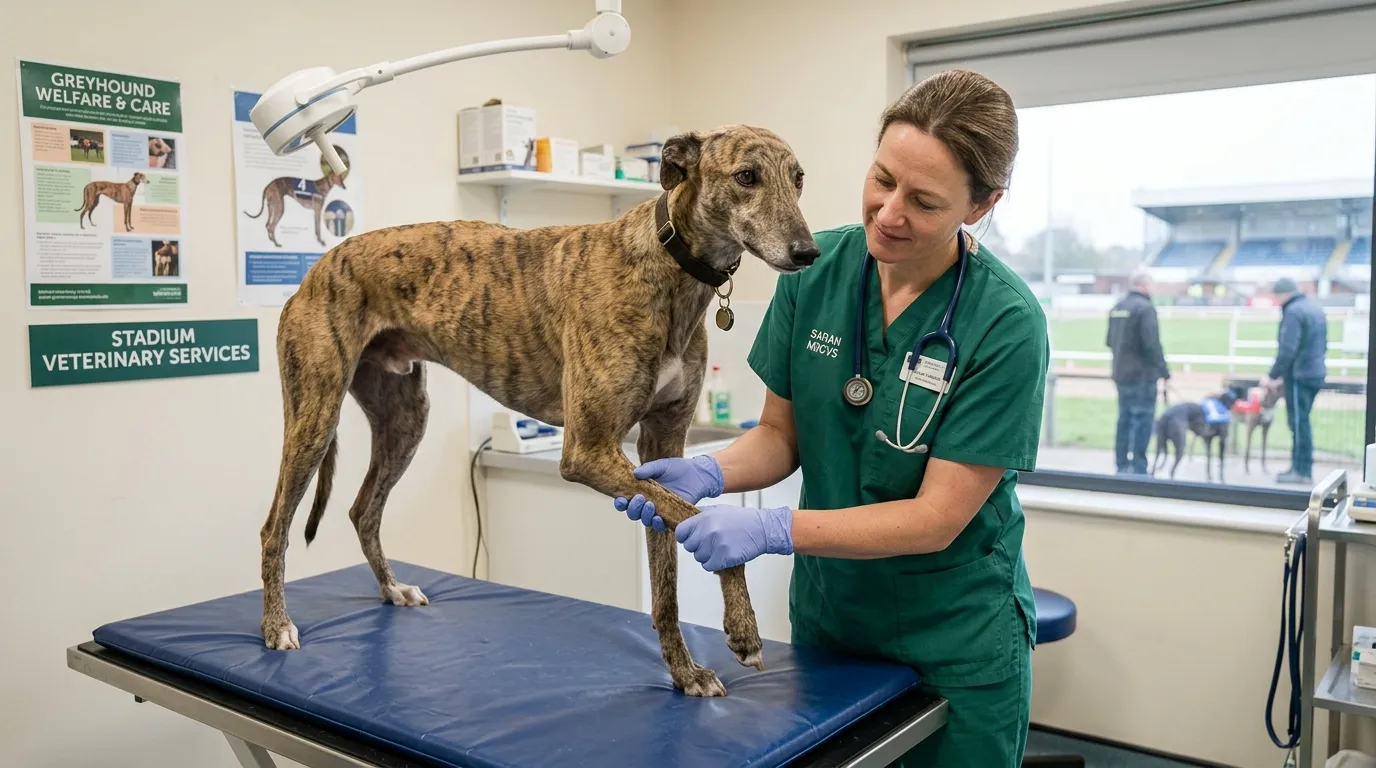
At track level, every GBGB-licensed stadium must have an independent veterinary surgeon present at all race meetings. The vet checks every greyhound before racing — at kennelling and again before the dog enters the traps — and provides emergency care if a dog is injured during a race. Post-race veterinary inspections are mandatory for any dog showing signs of distress. The vet’s authority to withdraw a dog from racing, impose rest periods, or recommend euthanasia on welfare grounds overrides any commercial consideration.
Trainer’s kennels, where greyhounds are housed between races, are subject to annual inspections by independent auditors under the UKAS-accredited scheme, plus a separate annual veterinary inspection. The standards cover kennel dimensions, hygiene, feeding, exercise provision and record-keeping. Non-compliance leads to disciplinary action, which can include fines, licence suspension, or the removal of dogs from the trainer’s care.
The system is not without its critics. The Scottish Animal Welfare Commission concluded in 2023 that where gambling and commercial activity are involved, the risks of poor welfare outweigh the likely positive aspects of the sport. The RSPCA, Dogs Trust and Blue Cross — members of the Cut the Chase coalition — argue that self-regulation by an industry body whose members have commercial interests in racing creates inherent conflicts of interest. The GBGB disputes this characterisation, pointing to the UKAS accreditation as evidence of independent oversight and to the improving data trends as proof that the system works.
The debate is unlikely to be settled by data alone. The welfare numbers are moving in the right direction on every metric the GBGB publishes. Whether that direction of travel is fast enough, and whether the residual risk is acceptable for a sport whose primary purpose is entertainment and gambling, is ultimately a political and ethical question rather than a statistical one. What the data provides is a factual foundation for that debate — and on that foundation, the arguments from both sides are more honest than they were before the numbers were published.
The wider context is set out in our Newcastle dog results guide.
What happens after racing is in adopting a retired greyhound.
