

Two Nations Moving to Outlaw Greyhound Racing While England’s Tracks Plan a Centenary
The greyhound racing ban movement in the United Kingdom has shifted from campaigning to legislating. Wales is advancing the Prohibition of Greyhound Racing (Wales) Bill through the Senedd. Scotland passed the general principles of the Greyhound Racing (Offences) (Scotland) Bill at Stage 1 in January 2026. England, where all eighteen GBGB-licensed stadiums operate, has no equivalent legislation planned. The result is a constitutional patchwork: a sport that may be criminal in two of the UK’s four nations while remaining legal and commercially active in the other two.
The timing is pointed. British greyhound racing marks its centenary in 2026 — one hundred years since the first modern oval-track race at Belle Vue in Manchester. The industry is planning celebrations. Two of the UK’s devolved governments are planning prohibition. The collision between heritage and abolition defines the political landscape around greyhound racing right now, and the outcome will reshape the sport’s geography, economics and public perception for decades.
The Prohibition of Greyhound Racing (Wales) Bill
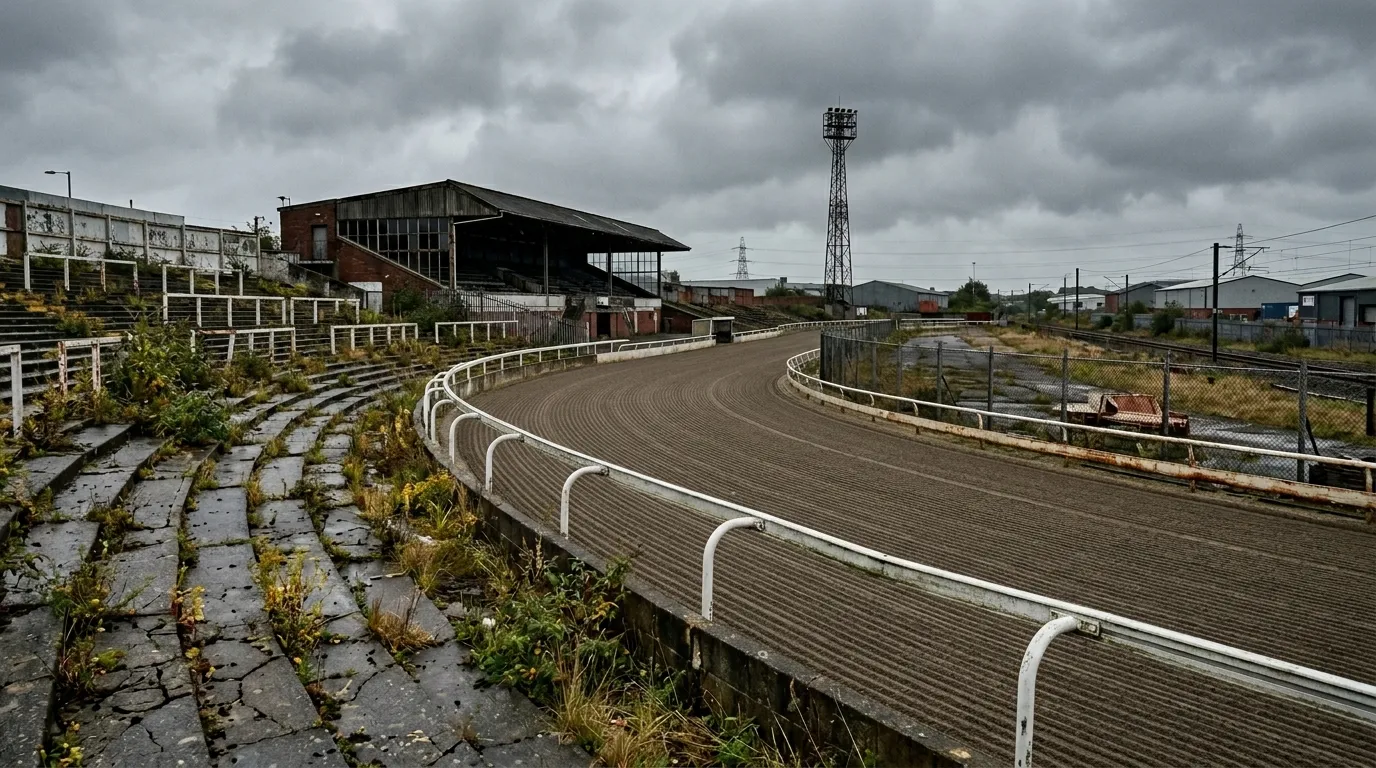
Wales has one GBGB-licensed greyhound track: the Valley Greyhound Stadium in Ystrad Mynach, near Caerphilly. The Prohibition of Greyhound Racing (Wales) Bill, introduced by Deputy First Minister Huw Irranca-Davies, would make it an offence to operate a stadium for greyhound racing in Wales and an offence to organise greyhound racing within the country.
The bill’s general principles were approved by the Senedd in December 2025, with 36 of 50 members voting in favour, three abstaining and eleven voting against. That margin — a comfortable majority — makes final passage near-certain barring an unexpected collapse of support at the remaining legislative stages. The bill progressed to Stage 2 for detailed scrutiny and amendment, and the Welsh Government has signalled its intention to implement the ban as soon as practically possible.
The legislative journey began with a petition. In September 2021, Hope Rescue launched a petition in the Senedd to ban greyhound racing in Wales. It received over 35,000 signatures, making it one of the most-signed petitions in Senedd history. A subsequent government consultation on a national model for animal welfare saw nearly two-thirds of responses support ending greyhound racing. That level of public engagement gave the Welsh Government the political cover to move from consultation to legislation.
Polling data reinforces the mandate. Surveys conducted by Panelbase in 2022 and 2023, commissioned by GREY2K USA Worldwide, found that 57 per cent of Welsh citizens supported an end to greyhound racing. The GBGB has contested the framing of these polls and argued that the Valley track operates to the same regulated standards as any English venue. The regulator’s submission to the Senedd in October 2025 stated that 15.5 per cent of greyhounds registered with GBGB were from British-bred litters, up from 13.1 per cent in 2021, and emphasised that welfare standards at the Valley were consistent with national averages.
The practical impact of the Welsh ban is geographically contained — one track closes — but the symbolic impact is not. Wales becomes the first UK nation to outlaw greyhound racing by statute, establishing a precedent that campaigners in England will inevitably cite.
The Greyhound Racing (Offences) (Scotland) Bill
Scotland’s path to prohibition follows a different route. The Greyhound Racing (Offences) (Scotland) Bill is a Members’ Bill introduced by Green MSP Mark Ruskell in April 2025, with cross-party support and the backing of the Scottish Government through Agriculture Minister Jim Fairlie.
The bill would make it illegal to race a greyhound on an oval racetrack in Scotland. Conviction could lead to a fine or imprisonment. The bill passed Stage 1 on 29 January 2026, with a majority of MSPs agreeing to its general principles. It now proceeds to Stage 2 for amendment and detailed scrutiny, with the Greens pushing for passage before the Scottish Parliament dissolves in April ahead of the May election.
The immediate practical effect is limited. Scotland’s last licensed greyhound track, Shawfield Stadium in Rutherglen, closed in 2020. The only remaining venue, Thornton Stadium in Kirkcaldy — an independent, unregulated track — suspended operations in March 2025. No organised greyhound racing currently takes place in Scotland. The GBGB described the bill as a waste of parliamentary time, arguing that legislators should not be banning something that does not occur.
Mark Ruskell framed the bill differently: “Greyhounds are beautiful, gentle creatures, but hundreds are killed and thousands injured every year in the UK due to this cruel ‘sport’. That’s why only a tiny handful of countries still allow it.” The Greens argue that legislation is necessary to prevent the sport from returning — that a ban in statute carries a weight that voluntary cessation does not. Without legislation, a new operator could open a track in Scotland tomorrow.
Polling in Scotland mirrors Wales. Sixty per cent of Scots surveyed by Panelbase supported an end to dog racing, and a petition to ban the sport received over 28,000 signatures — one of the most-signed petitions in Scottish parliamentary history. The Unbound the Greyhound coalition, comprising nine animal welfare organisations, has campaigned extensively to support the bill.
What the Bans Mean for English Racing
England is not Wales or Scotland. The UK Government has stated that it has no plans to ban greyhound racing in England, and considers the sport to be well regulated. That position reflects both the economic scale of English greyhound racing — eighteen licensed stadiums, hundreds of thousands of starts per year, over a billion pounds in annual betting turnover — and the political reality that the sport’s footprint in England is large enough to generate constituency-level employment and leisure spending that MPs are reluctant to legislate away.
The direct economic impact of the Welsh and Scottish bans on English tracks is negligible. One Welsh track closes; Scotland had no active racing. The indirect impact is harder to quantify but potentially significant. The legislative precedent matters. If Wales can ban greyhound racing through its devolved parliament, and Scotland follows, the argumentative infrastructure for a ban is built. Campaign groups — the RSPCA, Dogs Trust, Blue Cross, the League Against Cruel Sports — are explicit that their goal is a UK-wide ban. Wales and Scotland are stepping stones, not destinations.
There is also a practical border question. If greyhound racing is outlawed in Wales but legal in England, what prevents trainers and dogs from simply crossing into the adjacent English counties? In theory, nothing — the Welsh bill criminalises operating a track and organising races in Wales, not the ownership or training of greyhounds. A Welsh-based trainer could, legally, continue to race dogs at English stadiums. The bill’s sponsors acknowledge this but argue that the legislation addresses the venue-level harm rather than attempting to regulate individual movement across a border that has no physical checkpoint.
For English tracks like Newcastle, the bans create a communication challenge as much as a legal one. Media coverage of the Welsh and Scottish bills frames greyhound racing as a sport under existential threat, which can affect public perception even in areas where the local track is thriving. Arena Racing Company’s response has been to invest in the product — improving facilities, increasing prize money, marketing events like the All England Cup — and to let attendance figures make the counterargument. Newcastle’s eighty-five per cent year-on-year increase in footfall on All England Cup finals night is the kind of data point that speaks louder than a parliamentary debate in Cardiff.
The regulatory response is also evolving. The GBGB’s welfare data publications, its Greyhound Commitment manifesto and its long-term strategy document — “A Good Life for Every Greyhound” — are explicitly designed to demonstrate that licensed racing in England operates at a higher welfare standard than the industry’s critics acknowledge. Whether that demonstration is persuasive enough to forestall English legislation depends on whether the improving data trends continue, and on whether the political appetite for a ban materialises in Westminster. For now, England’s greyhound tracks race on — legally, commercially and, in Newcastle’s case, to growing crowds.
The wider context is set out in our Newcastle dog results guide.
