

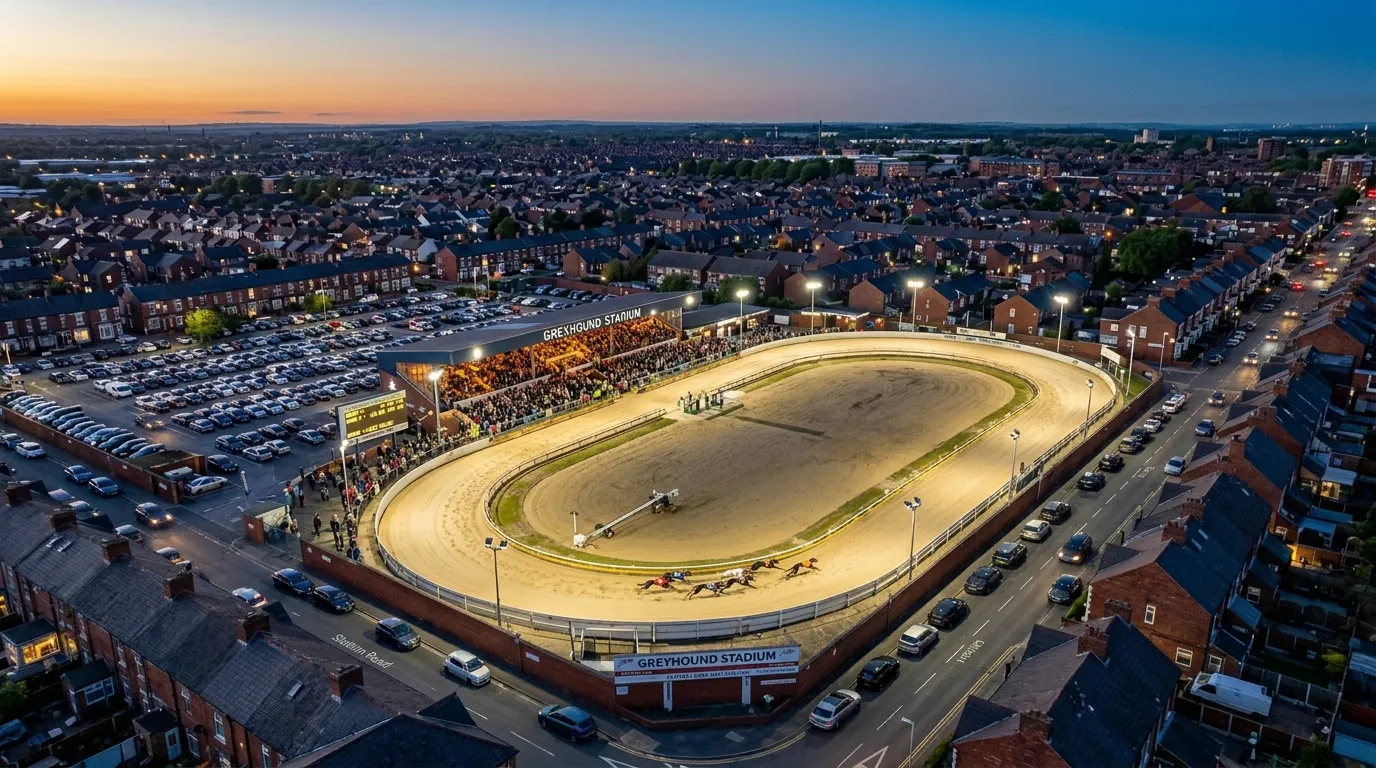
Britain’s Second-Largest Spectator Racing Sport by Fixture Count
The UK greyhound racing industry operates at a scale that surprises people who think the sport faded away in the 1960s. Eighteen GBGB-licensed stadiums stage thousands of meetings per year, generating 355,682 individual starts in 2024 alone. Approximately 500 licensed trainers manage the preparation and welfare of around 6,000 greyhounds registered for racing annually, supported by 3,000 kennel staff and 700 racecourse officials. The ownership base — some 15,000 registered greyhound owners — funds the animal side of the operation, while betting turnover approaching £1.5 billion funds the commercial side.
Those numbers describe a sport that is smaller than it was at its mid-century peak, when more than seventy million spectators a year passed through stadium turnstiles, but substantially larger than casual observers assume. Greyhound racing runs more fixtures per week than any other racing sport in Britain, and it generates the second-highest volume of betting-shop content after horse racing. The GBGB registered 5,899 new greyhounds in 2023 — a 19 per cent decline from 2019, reflecting a contracting but still active breeding pipeline.
Understanding the industry’s structure — who regulates it, who funds it, and how the money flows — is essential context for anyone using greyhound results as more than casual entertainment.
The Numbers: Tracks, Dogs, Trainers and Runs
The licensed racing sector in Britain consists of eighteen stadiums regulated by the Greyhound Board of Great Britain. These span from Newcastle in the north to Brighton and Hove on the south coast, with clusters in the Midlands and London. Each track holds a GBGB licence that subjects it to annual inspections, welfare audits and stewarding oversight. The licence count has declined steadily over decades — Britain once had seventy-seven or more licensed tracks — and the closures of Wimbledon, Hall Green and most recently Crayford have each represented a contraction of the sport’s geographic footprint.
The eighteen remaining stadiums are not equal in scale or ambition. Some operate primarily as BAGS venues — staging afternoon meetings for the benefit of betting shops — with modest facilities and limited on-course attendance. Others, like Nottingham and Newcastle, combine BAGS racing with evening meetings, hospitality operations and Category One events that attract national-calibre entries. The tier structure is informal but real: the top-tier tracks generate more prize money, attract better dogs and invest more heavily in facilities, while lower-tier venues serve a functional role in the betting ecosystem without the same event profile.
The dog population is predominantly Irish in origin. Over 80 per cent of greyhounds racing in Britain are imported from Ireland, where the breeding infrastructure is more extensive. British-bred greyhounds accounted for 15.5 per cent of GBGB registrations in 2024, up from 13.1 per cent in 2021, reflecting a deliberate push by the GBGB to increase domestic breeding. The importation pipeline connects Britain to Ireland’s greyhound economy, and any disruption to that supply — through Irish welfare reforms, export restrictions or changes in breeding volume — has a direct effect on field sizes at British tracks.
The total prize pool across British greyhound racing stands at £15.7 million. The English Greyhound Derby, the sport’s most prestigious race, carries a winner’s purse of £175,000. At the other end of the scale, graded races at BAGS meetings pay a few hundred pounds per race. The prize money gradient influences where trainers choose to enter their dogs and shapes the competitive landscape at each track.
Licensed vs Independent: How Racing Is Organised
The distinction between licensed and independent greyhound racing is fundamental to understanding the sport’s regulatory landscape.
Licensed racing operates under GBGB jurisdiction. The eighteen licensed stadiums comply with the Rules of Racing — a comprehensive code covering track standards, kennel conditions, veterinary provision, doping controls, grading, retirement obligations and data reporting. All registered greyhounds are microchipped, vaccinated, weighed before every race and subject to random drug testing. The regulatory framework is accredited by UKAS, the United Kingdom Accreditation Service, which provides external validation that the GBGB’s standards are being applied consistently. DEFRA oversees the statutory framework through the Welfare of Racing Greyhounds Regulations 2010.
Independent racing — historically known as “flapping” — existed outside this system. Independent tracks had no central governing body, no mandatory injury reporting, no retirement scheme and no requirement for veterinary presence beyond what local authority licensing demanded. The last active independent track in Britain was Thornton Stadium in Kirkcaldy, Scotland, which suspended operations in March 2025. Northern Ireland’s two tracks operate under the Irish Coursing Club rather than the GBGB, creating a separate jurisdictional arrangement.
The collapse of independent racing has simplified the regulatory picture. Virtually all competitive greyhound racing in Britain now operates under GBGB rules, which means the data published by the regulator — injury rates, retirement figures, track inspections — covers the entire active sport rather than just a subset. This was not the case a decade ago, when a significant volume of racing took place outside regulatory oversight and generated no public welfare data.
The Economics of Greyhound Racing
The financial engine of British greyhound racing runs on betting revenue. Total wagering on the sport — combining off-course betting shops, on-course tote pools and online platforms — was estimated at £1.5 billion in the twelve months to March 2023, according to Gambling Commission data. Betting-shop turnover specifically accounted for £794 million in the year to March 2024. These figures have been declining: greyhound betting turnover fell 12.9 per cent over three years in nominal terms, with the inflation-adjusted decline closer to 23 per cent.
The revenue flows from punters to bookmakers to the sport through two channels. Media rights payments — the fees bookmakers pay for the right to screen and take bets on greyhound races — provide direct income to track operators. The Bookmakers Afternoon Greyhound Service, which funds the majority of daytime fixtures, is the mechanism through which this exchange operates. Arena Racing Company’s long-term media rights deal with Entain, effective from January 2024, is the most prominent example of this commercial relationship.
The second channel is the British Greyhound Racing Fund, a voluntary levy paid by bookmakers. BGRF income supports prize money, welfare initiatives and the regulatory infrastructure. Unlike horse racing, which benefits from a statutory levy on bookmaker profits, greyhound racing relies on voluntary contributions — a distinction the GBGB has repeatedly highlighted as a structural disadvantage. GBGB Chief Executive Mark Bird used the 2024 data release to renew the call for a statutory levy, arguing that additional funding would enhance veterinary provision, homing efforts and research programmes.
At stadium level, the economics depend on a combination of media rights income, on-course betting revenue, admission and hospitality sales, and sponsorship. Tracks that attract strong on-course attendance — Newcastle’s All England Cup finals night, Nottingham’s Saturday evenings, Central Park’s Kent Derby — generate proportionally more from gate receipts and food and drink sales. Tracks that rely primarily on BAGS income are more exposed to the decline in betting-shop footfall that has accompanied the broader migration of gambling activity online.
The employment footprint is concentrated but meaningful. The sport directly supports approximately 500 trainers, 3,000 kennel staff and 700 racecourse officials, with thousands more employed in related roles across bookmaking, media production, hospitality and veterinary services. In areas like Byker in Newcastle, where the stadium has been a fixture since 1928, the economic contribution extends beyond direct employment to the surrounding businesses — pubs, taxi firms and takeaways — that benefit from racenight traffic. That local economic argument has historically been one of the sport’s most effective defences against calls for prohibition in England, where constituency-level impact carries weight with MPs.
Welfare funding sits at the centre of the industry’s most pressing financial challenge. The improving welfare data — record-low injury rates, near-elimination of economic euthanasia, rising rehoming percentages — has been achieved partly through increased spending on veterinary provision, homing centres and research. That spending depends on revenue that is simultaneously contracting. Mark Bird’s call for a statutory levy reflects a recognition that the voluntary funding model cannot sustain the welfare investment indefinitely if betting turnover continues to decline. The sport’s ability to maintain its welfare trajectory while its commercial base shrinks is the central tension in British greyhound racing’s financial outlook.
The industry’s financial trajectory is one of managed contraction. Fewer tracks, fewer dogs, declining betting volumes — but improving welfare metrics, growing attendance at feature events, and continued investment from operators like ARC who see a viable if smaller future for the sport. Whether that future is small enough to be sustainable and large enough to be commercially interesting is the question that the next decade will answer.
The wider context is set out in our Newcastle dog results guide.
