

Every Racecard, Every Vet Check and Every Retirement Form Routes Through GBGB
The Greyhound Board of Great Britain sits at the centre of British greyhound racing’s regulatory architecture. Every licensed stadium, every registered trainer, every competing greyhound and every official result passes through its systems. The GBGB writes the Rules of Racing, licenses the tracks, accredits the trainers, registers the dogs, publishes the welfare data and disciplines anyone who falls short of the standards. If you have ever looked at a Newcastle racecard and wondered who decided which dog runs from which trap in which grade, the answer routes back to the GBGB — either directly through its rules or indirectly through the racing managers it oversees.
The organisation regulates eighteen licensed stadiums across England and Wales, covering the sport from Newcastle in the north to Brighton and Hove on the south coast. That figure was higher — Britain once had more than seventy-seven licensed tracks — but the contraction of the sport has concentrated the regulatory workload onto a smaller number of venues operating at a higher standard. In 2024, 15.5 per cent of greyhounds registered with the GBGB were from British-bred litters, up from 13.1 per cent in 2021 — a figure that reflects the regulator’s deliberate push to increase domestic breeding and reduce reliance on Irish imports.
GBGB’s Role, Structure and Funding
The GBGB is the successor to the National Greyhound Racing Club, which governed the sport from 1928. It operates as the independent regulator of licensed greyhound racing, responsible for both the integrity of the sport and the welfare of the dogs. The board comprises representatives from the racing industry, independent members and welfare specialists, though critics — including the Scottish Animal Welfare Commission — have questioned whether the governance structure adequately insulates welfare decisions from commercial pressures.
Funding comes from two main sources: licence fees paid by the eighteen licensed stadiums, and a share of the British Greyhound Racing Fund income. The licence fees cover the cost of maintaining the regulatory infrastructure — stipendiary stewards, registration systems, data management, inspections — while the BGRF contribution supports welfare programmes, prize money and the Greyhound Retirement Scheme. The GBGB does not receive direct government funding, and the absence of a statutory betting levy (unlike horse racing’s Horserace Betting Levy) means its income depends on the willingness of the betting industry to contribute voluntarily.
That funding constraint shapes what the GBGB can do. Publishing independently verified injury and retirement data, running the Greyhound Commitment welfare programme, funding veterinary research and overseeing the retirement bond scheme all cost money. The regulator has been transparent about the tension between its ambitions and its resources — GBGB Chief Executive Mark Bird has repeatedly called for a statutory levy to secure more predictable and equitable funding from bookmakers who profit from greyhound betting but are not legally required to contribute to the sport’s costs.
Track and Kennel Standards
Every GBGB-licensed stadium must meet a set of facility standards that cover the racing surface, kennel facilities, veterinary provision, timing equipment, safety barriers and spectator areas. These standards are codified in the Rules of Racing and are assessed through an annual certification inspection conducted by GBGB stipendiary stewards. The inspection process is accredited by UKAS — the United Kingdom Accreditation Service — which provides the external validation that the standards are being applied consistently across all eighteen venues.
At track level, the standards require an independent veterinary surgeon to be present at every race meeting. The vet checks every greyhound at kennelling — when the dog arrives at the track before racing — and again before the dog enters the traps. Post-race, any greyhound showing signs of injury or distress is examined immediately. The vet has the authority to withdraw a dog from racing, impose mandatory rest periods, or recommend euthanasia on welfare grounds. That authority supersedes the wishes of the owner, the trainer and the track operator — a critical safeguard that distinguishes licensed racing from the unregulated independent sector that has now largely ceased to exist.
Trainer’s kennels — where greyhounds live between race days — are subject to a separate inspection regime. Every licensed trainer must pass an annual inspection by independent auditors under the UKAS-accredited scheme, plus an annual veterinary inspection of their premises. The standards cover minimum kennel dimensions, hygiene, ventilation, temperature control, exercise provision, feeding arrangements and record-keeping. The GBGB publishes the minimum standards in its Rules of Racing, though the enforcement rigour has historically been a point of contention. Welfare organisations have cited cases where trainers found in breach of kennel standards received fines rather than licence revocations, and have argued that the penalty framework does not always match the severity of the offence.
The Welfare of Racing Greyhounds Regulations 2010, the statutory instrument administered by DEFRA, provides the legal underpinning. These regulations impose minimum welfare requirements on licensed tracks and were reviewed through a Post Implementation Review process that led to the GBGB’s commitment to publish annual injury and retirement data from 2018 onwards. The regulations do not extend to trainer’s kennels directly — a gap that the GBGB fills through its own licensing regime but that has been criticised as a structural weakness in the statutory framework.
Stewarding, Inquiries and Discipline
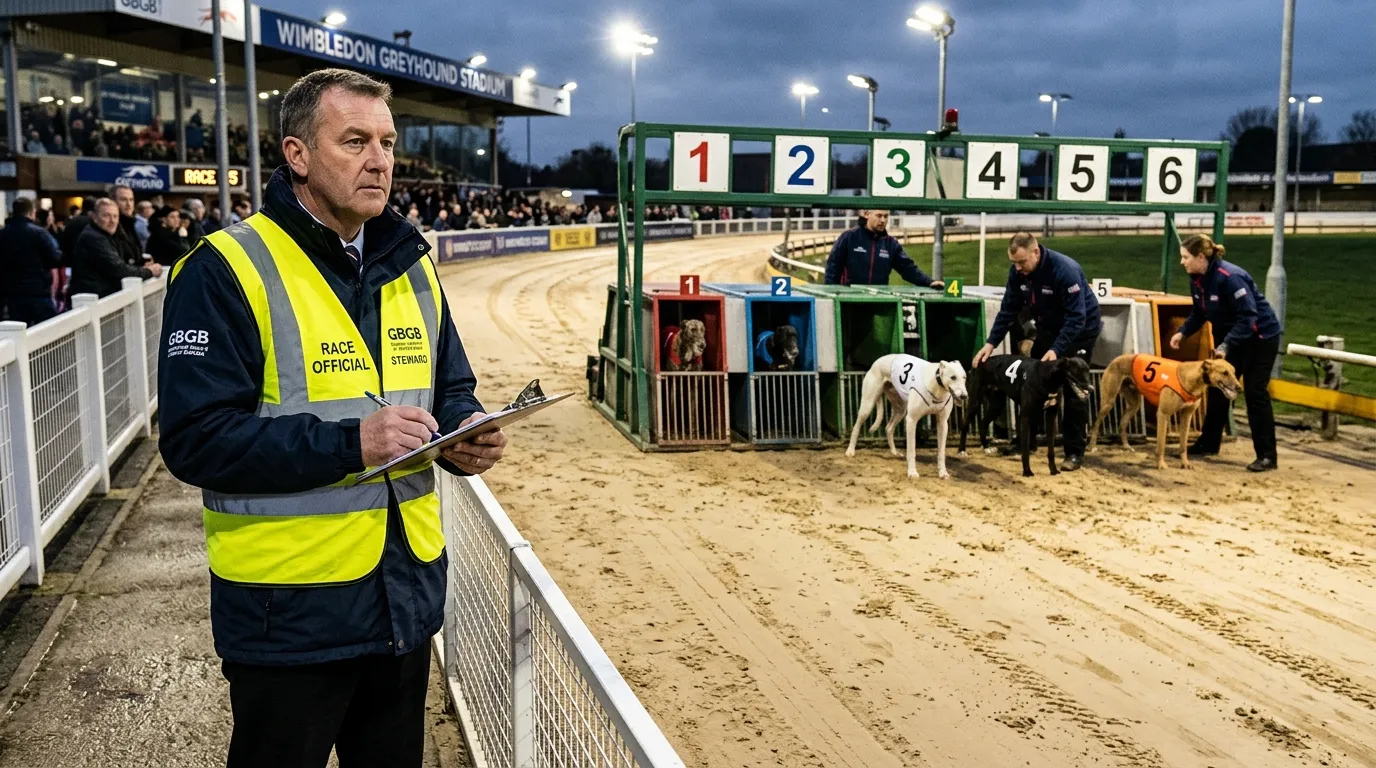
Race-day integrity at GBGB-licensed stadiums is maintained by stipendiary stewards — paid officials who oversee every meeting and have the authority to investigate incidents, interview participants and impose sanctions. Stewards monitor the running of each race, review evidence from the timing system and track cameras, and assess any interference or irregularity that might affect the result.
A stewards’ inquiry can be called during or after a race when the officials identify a potential issue — crowding that may have affected the finishing order, a suspected false start, or an irregularity in a dog’s behaviour that might suggest interference with its preparation. The inquiry process involves reviewing the evidence, hearing from the trainer or handler, and making a determination. If the stewards find a breach of the rules, they can amend the official result, impose fines, suspend licences, or refer the matter to the GBGB’s Disciplinary Committee for more serious sanctions.
Doping controls are a routine element of the integrity regime. Random samples are taken from greyhounds at meetings across all licensed tracks, and the analysis is conducted by an independent laboratory. The GBGB’s anti-doping rules prohibit any substance that could enhance or impair performance, and the penalties for positive tests include trainer suspensions, prize-money forfeiture and disqualification of results. The testing frequency and detection methods are not publicly detailed — deliberately, to maintain the deterrent effect — but the GBGB reports on the outcomes of disciplinary cases in its annual publications.
The Scottish Animal Welfare Commission’s 2023 report noted that where gambling and commercial activity are involved, “the risks of poor welfare outweigh the likely positive aspects” of the sport — a conclusion directed at the fundamental compatibility of animal welfare with commercial racing rather than at the specific failures of the regulatory system. The GBGB disputes this framing, pointing to its UKAS accreditation and improving welfare data as evidence that regulation is working. The disagreement is not primarily about the mechanics of stewarding and discipline — both sides acknowledge that the GBGB’s operational processes have improved — but about whether any regulatory framework can adequately protect animals in a sport where the commercial incentive is to race them at speed around an oval track. That is a question the regulator cannot answer alone, and it is the question that the legislative debates in Wales and Scotland are attempting to resolve through democratic rather than regulatory means.
The wider context is set out in our Newcastle dog results guide.
