

Grading Is the Invisible Hand That Shapes Every Result at Newcastle
The greyhound grading system in the UK determines which dogs race against each other, and that single decision — made by the racing manager at each track before the racecard is published — has more influence on the outcome than any amount of form analysis after the fact. A fast dog placed in a weak grade will win easily. The same dog, elevated one grade too high, will struggle against opponents whose recent times are half a second quicker. The grade is the frame; the race is the picture.
At Newcastle, grading follows the standard GBGB framework used across all eighteen licensed stadiums, but the specifics — the time bands for each grade, the number of dogs available in each bracket, the racing manager’s preferences — are local. Understanding how the system works at a structural level, and how seeding allocates dogs to traps within each race, gives you a reading of the racecard that most casual bettors overlook entirely.
A1 to A11 and What They Mean
The letter-and-number grading system classifies greyhounds by their recent racing performance. The letter denotes the type of race — “A” for standard middle-distance races between 380 and 500 metres, which covers the vast majority of cards at Newcastle — and the number denotes the quality level within that category. A1 is the top grade; A11 or lower represents the bottom of the graded ladder.
A dog’s grade is determined by its recent times over the relevant distance at that track. A greyhound that consistently runs 28.50 over 480 metres at Newcastle will be graded higher than one running 29.20 over the same trip. The racing manager reviews times, finishing positions and recent form to place each dog in a grade where it should be competitive — fast enough to have a chance but not so outclassed that the race becomes a procession. The aim is competitive balance, and when the grading works well, six dogs cross the first bend within a length of each other.
Grade changes happen regularly. A dog that wins convincingly may be moved up a grade for its next race. One that finishes last in successive outings may be dropped down. These adjustments are the racing manager’s primary tool for maintaining competitive fields, and they create the form patterns that experienced punters learn to read. A dog that has just been moved up a grade is, by definition, facing better opposition than in its last race. Its recent form — a string of wins, perhaps — is about to be tested against a higher standard, and the result may look very different. Conversely, a dog dropping down a grade after a losing streak is meeting weaker opposition, and the form book’s recent negatives may not reflect its true ability at the lower level.
Sprint races over 290 metres, staying races over 640 metres and longer trips each have their own grading ladders, sometimes denoted with different letter prefixes. The principle is identical — grouping dogs by recent performance to produce balanced fields — but the population of sprinters and stayers is smaller than the middle-distance pool, which means the grades are thinner and the fields can be less competitive at the extremes.
Seeding: Railer, Middle and Wide Runner
Once the grade determines the six dogs that will contest a race, the seeding system determines which trap each dog runs from. This is not random. The GBGB requires racing managers to seed greyhounds based on their running style — specifically, their tendency to race on the inside rail, in the middle of the track, or wide on the bends.
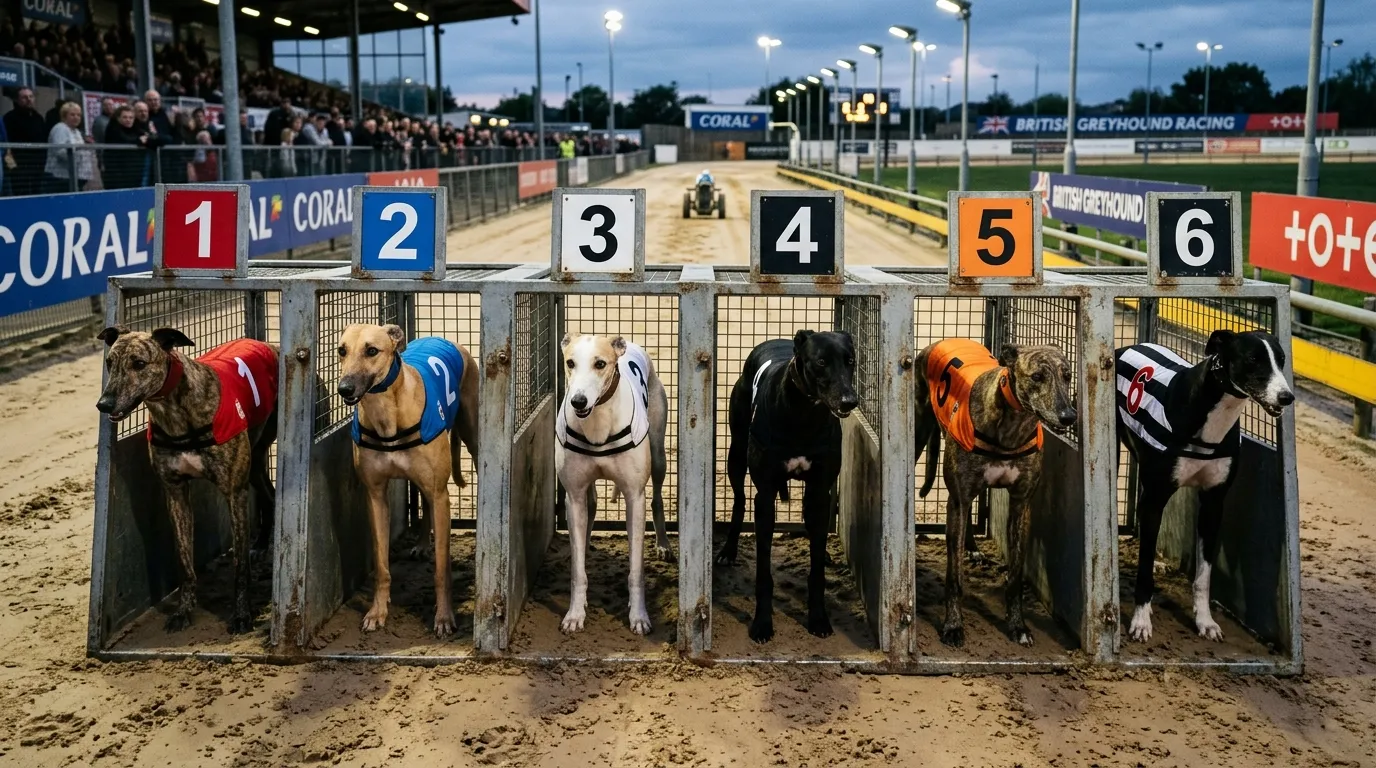
Railers are dogs that naturally hug the inside of the track. They are seeded into traps one and two, where their inclination to run close to the rail gives them the shortest path around the bends. Middle runners, who hold a course between the rail and the outside, are placed in traps three and four. Wide runners, who swing out on the bends and cover more ground, are assigned traps five and six, where their wide running line is accommodated without them cutting across dogs on the inside.
The seeding system exists primarily for safety — it reduces the risk of collisions caused by dogs crossing running lines — but it has significant consequences for betting. Across UK tracks, trap one shows a win rate of approximately eighteen to nineteen per cent against a theoretical expectation of 16.6 per cent. That edge is partly explained by the seeding system: the dogs in trap one are placed there because they are railers, and railers have a structural advantage on any oval track because they take the shortest route. The inside rail protects their flank, and if they break quickly from the traps, they reach the first bend with a clear line through the turn.
At Newcastle, trap two has historically produced more winners than any other box — a result that reflects both the seeding of competent railers into the blue jacket and the specific geometry of Newcastle’s first bend, where the 130-metre run from the 480-metre start gives trap two a balance of clean room and a short angle to the rail. The data does not mean you should blindly back trap two in every race. It means that when form analysis leaves you undecided between two dogs of similar ability, the one seeded into a favourable trap deserves the marginal edge.
Open Races and Category One Events
Open races sit outside the graded system. Instead of racing against local dogs of similar ability, the field in an open race is composed of entries from trainers across the country, competing for significantly higher prize money. Category One events — the highest classification under GBGB regulations — must carry a minimum prize fund of twelve thousand five hundred pounds, and the best competitions offer substantially more. The total prize pool across British greyhound racing stands at £15.7 million, and a meaningful share of that total flows through open-race purses.
At Newcastle, the All England Cup is the flagship Category One event. It draws entries from leading kennels in the south and Midlands alongside the stadium’s local trainers, producing fields where the quality gap between the best and worst runner is often larger than in a graded race. The grading system does not apply — every entry competes on merit, with the heats, semi-finals and final determining advancement through the competition rather than through grade-based placement.
For bettors, open races present a different analytical challenge. The form lines are drawn from multiple tracks with different dimensions, surfaces and hare types, which makes direct time comparison unreliable. A dog that runs 28.40 at Nottingham is not necessarily faster than one that runs 28.60 at Newcastle, because the tracks differ in circumference, bend radius and surface speed. Trial data — the time a visiting dog records in a non-competitive run at Newcastle before the competition — becomes the bridge between external form and local performance. Reading open-race form is a skill that graded racing does not fully prepare you for, and it is where the deepest edges in greyhound betting tend to be found.
The wider context is set out in our Newcastle dog results guide.
