

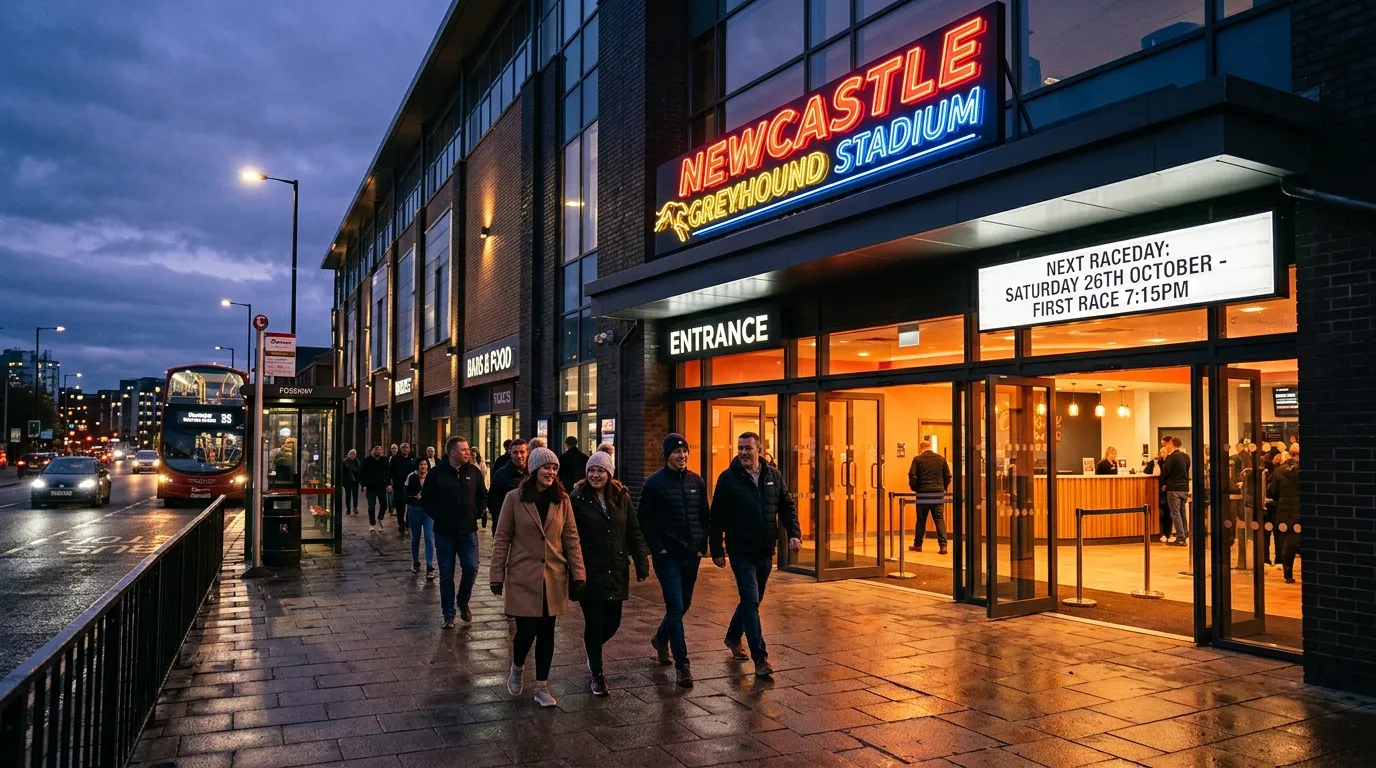
Newcastle’s Five-Day Racing Week Explained
Newcastle greyhound fixtures run across five days each week, every week of the year. That consistency is one of the stadium’s defining characteristics — and one of its advantages for bettors, racegoers and form students alike. Unlike many tracks that operate on a two- or three-day cycle, Newcastle offers enough racing volume to generate meaningful form data and enough variety in meeting types to keep the cards interesting.
The current schedule covers Tuesday mornings, Wednesday and Friday afternoons, Thursday evenings, and Saturday with both an afternoon and an evening meeting. The stadium’s owner, Arena Racing Company, has built the fixture list around two distinct audiences: the betting-shop market served by the Bookmakers Afternoon Greyhound Service during daytime meetings, and the on-course crowd that fills the terracing and restaurant on Thursday and Saturday evenings. Sarah Newman, Marketing and Communications Manager at Arena Racing Company, put it plainly: “Competition for the leisure pound has never been higher, so to grow our footfall in 2025 is a great achievement. We know greyhound racing is a fantastic and cost-effective night out for people of all ages.”
The distinction between meeting types matters because it affects race quality, field composition and even how results are distributed. Understanding the fixture calendar is the first step to using Newcastle’s results data effectively.
Tuesday to Saturday — What Runs When
Tuesday mornings open the week. First race is typically at 10:45, and the card runs twelve races through to early afternoon. This is a BAGS meeting — the races exist primarily for the benefit of licensed bookmakers who screen them in betting shops and through online platforms. The audience is overwhelmingly off-course, and the atmosphere at the stadium is quiet compared to evening meetings. For punters, Tuesday mornings are useful because they generate fresh form data at the start of the week, and because the graded fields tend to be competitive without the presence of open-race entrants from visiting kennels.
Wednesday and Friday afternoons follow a similar pattern. First race is around 14:00, with twelve races completing the card by approximately 16:30. These are also BAGS sessions, broadcast through SIS to bookmakers nationwide. The racing is graded — meaning dogs are matched against others of similar ability based on recent form and times — and distances typically cover the 480-metre standard along with sprints at 290 metres and longer events at 640 metres. The circumference of the Newcastle track is 415 metres, and the run to the first bend is approximately 130 metres for 480-metre races, which favours dogs with early pace from the inside traps.
Thursday evening is the centrepiece of Newcastle’s weekly calendar. Doors open in the late afternoon, with the first race at 18:30 and the card running through to around 21:30. Thursday evenings draw a larger on-course crowd than any daytime meeting, and the race quality reflects this — graded races are often stronger, and open-race heats or feature events are scheduled here when the calendar allows. Full broadcast coverage on Sky Sports Racing ensures that results are available in real time across every major platform.
Saturday splits into two meetings. The afternoon session is a BAGS card starting around 14:00, functionally identical to Wednesday and Friday. The evening meeting, beginning later with doors from 18:15, is the social flagship — the meeting most likely to attract groups, parties and first-time visitors alongside regulars. Saturday evening cards sometimes carry higher-profile races and promotional events, and the atmosphere is noticeably different from the workmanlike afternoon session that preceded it.
BAGS Meetings vs Open-Race Cards
The difference between a BAGS meeting and an open-race card is fundamental, and it shapes every aspect of the racing — from the quality of the dogs to the size of the prize money to the way you should approach form analysis.
BAGS meetings are the workhorses of British greyhound racing. They account for the majority of fixtures at Newcastle and at every other GBGB-licensed stadium. The Bookmakers Afternoon Greyhound Service is funded by bookmakers who pay for the right to screen and take bets on the races. Prize money at BAGS meetings is modest — typically a few hundred pounds per race. The fields are composed of locally trained dogs graded by the racing manager into bands (A1 being the highest graded class, descending through A2, A3 and so on) based on recent form and times. The racing is competitive within each grade, but it does not attract the calibre of greyhound you see at category one events.
Open-race cards are different. Open races carry significantly higher prize money — category one events must offer a minimum of twelve thousand five hundred pounds — and are open to entries from trainers across the country. When Newcastle hosts the All England Cup or the Northern Puppy Derby, the best greyhounds from southern kennels travel north to compete. The form lines on these cards look different: you see dogs with experience at Nottingham, Romford, Towcester and other tracks mixed in with local Newcastle runners. Analysing form for open races requires a broader dataset and an understanding of how times at different tracks compare.
For bettors, the distinction is practical. BAGS meetings reward familiarity with the local dogs, trainers and track characteristics. Open races reward wider knowledge of the national greyhound scene and the ability to compare form across venues with different track dimensions, surfaces and biases. Both are available at Newcastle; neither is inherently more profitable.
Seasonal Variations and Special Fixtures
The weekly pattern holds steady for most of the year, but a handful of seasonal shifts are worth noting. Bank holiday weekends often see an additional meeting or a rescheduled one. The November fireworks period is a recurring example — Newcastle has previously moved its Thursday evening meeting to a Thursday afternoon to avoid clashing with local firework displays that could disturb the greyhounds. The stadium usually announces these changes through its website and social media channels, though not always with much lead time.
The festive period brings its own adjustments. Boxing Day traditionally carries a feature meeting, and Newcastle’s 2025 event drew one of the largest on-course crowds of the year. New Year fixtures may also run to an altered schedule, with meeting times shifting to accommodate staff availability and public transport hours.
The most significant fixture variations come from the open-race calendar published annually by the GBGB. This calendar determines when category one, two and three events are held at each stadium, and it directly affects the composition of the card on those nights. Newcastle’s marquee event, the All England Cup, runs its heats and final across consecutive Thursday evenings in late autumn. The 2025 All England Cup finals night attracted an eighty-five per cent increase in attendance over the previous year, reflecting the event’s rising profile under ARC’s stewardship.
For anyone planning visits or structuring a form study around the Newcastle calendar, the stadium’s fixture page is the single most reliable source. It lists every upcoming meeting with race times, ticket availability and notes on any schedule changes. Checking it weekly takes thirty seconds and prevents the frustration of arriving at the track — or refreshing a results page — on the wrong day.
The wider context is set out in our Newcastle dog results guide.
Tonight’s card is covered in results tonight.
