

Where to Find Any Newcastle Result from the Last 12 Months
The Newcastle greyhound race archive is not a single database sitting on a single server. It is a patchwork of official records, third-party aggregators and specialist form platforms, each storing a different slice of the same data with different retention periods and different levels of detail. That fragmentation matters. A dog that ran at Newcastle three months ago left a trail across half a dozen platforms, and depending on which one you check, you might see just the finishing position or the full picture — sectional times, bend positions, weight, going adjustment and stewards’ remarks included.
With 355,682 starts logged across GBGB-licensed tracks in 2024 and Newcastle contributing its share across five racing days each week, the volume of archived data is substantial. The challenge is not whether the data exists, but knowing where to retrieve it in the form that is actually useful for research. A finishing position alone tells you almost nothing. A full race record, with the context of trap draw, going, and in-running comments, tells you nearly everything.
Newcastle-based trainer Jimmy Fenwick made the point indirectly when discussing a trial run for his All England Cup contender Wicky Ned: “It was an exceptional trial. Personally, I thought the track was running on the slow side that evening so we agreed to buy him.” That assessment — track running slow, time still impressive — only makes sense when you have the archive data to compare against. Without historical benchmarks, a time is just a number.
The Stadium’s Own Results Archive
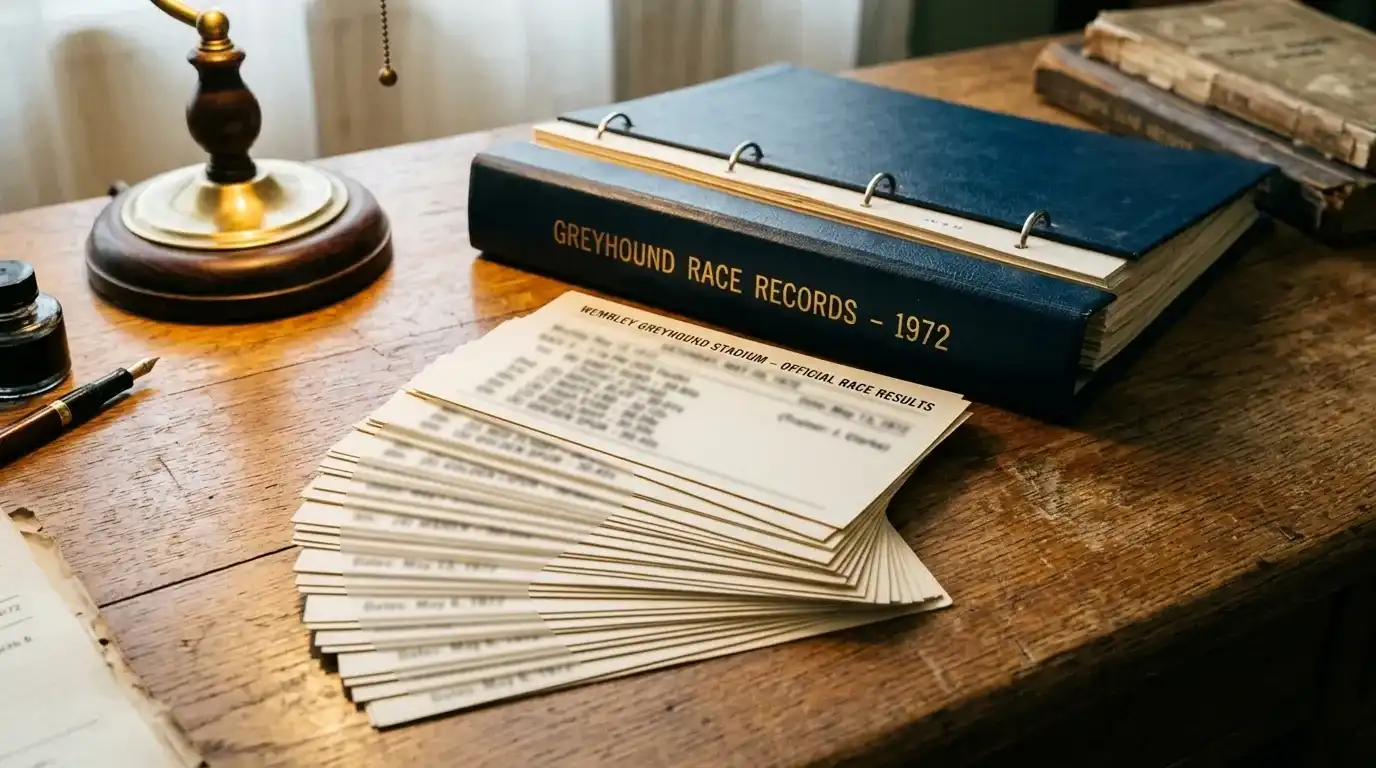
The official Newcastle Greyhound Stadium website publishes results as downloadable PDF cards. These are the most authoritative source — the data comes directly from the track’s racing office and includes everything recorded during the meeting: full finishing order for every race, starting prices, forecast and tricast dividends, weights, sectional times and stewards’ comments.
The current results page shows cards from the past week, with each day’s PDF available for download. Older results are accessible through a link at the bottom of the page, though the archive depth is not explicitly stated and appears to vary. The PDF format is thorough but carries practical limitations. You cannot search by dog name, trainer or distance within a PDF — you have to open the right date’s card first, which means you need to already know when the dog ran. For systematic research across multiple meetings, this approach is slow.
The strength of the official archive is completeness. Every race from every meeting is recorded. There are no gaps, no missing fields, no races omitted because they were low-grade or poorly attended. If it happened on the Newcastle sand, the PDF has it. For verifying a specific result — settling a dispute about a finishing margin, confirming a track record claim, or checking a dog’s weight trend over its last few runs — the official cards are the definitive source.
One practical note: the PDFs are formatted for printing, and the stadium warns that content may fall outside standard page margins. Viewing on a mobile screen can be frustrating. A laptop or tablet is the better tool for working with these files.
Third-Party Archives Compared
Third-party platforms fill the gaps that the official archive leaves — particularly around searchability, data depth and retention period.
Timeform maintains a calendar-based archive that covers Newcastle results going back several years. You select a date, choose Newcastle from the track list, and the full card loads with finishing positions, times, starting prices and Timeform’s own ratings and analyst comments. The search function lets you look up individual greyhounds and pull their complete race history across all tracks, which makes it straightforward to trace a dog’s form without knowing the exact dates it ran. For structured form study, Timeform’s archive is the most efficient tool available.
The Greyhound Recorder, an Australian-run platform, specialises in detailed race data and stores Newcastle results for the past twelve months. The standout feature is sectional times and bend-position data preserved in the archive view — detail that some UK platforms strip or summarise after a few days. If you are tracking how a dog’s early pace has changed over time or monitoring whether a particular trap draw produces consistent bend positions, the Greyhound Recorder holds the data you need. The interface takes some acclimatisation if you are used to UK platforms, and the search defaults sometimes prioritise Australian tracks, but navigating to Newcastle specifically is straightforward once you know where to look.
At The Races archives results alongside its racecard data, letting you compare pre-race information with the actual outcome. The archive depth varies and tends to be shallower than Timeform’s, but the integration between racecard and result on a single page adds a layer of convenience that standalone results services lack. Sporting Life offers a similar archive through its greyhound results section.
The GBGB’s own results portal provides official data for all eighteen licensed tracks in Britain — the current total as of January 2025. The advantage is regulatory authority — if a result is recorded here, it is the version that counts for grading, registration and disciplinary purposes. The disadvantage is functionality. The interface is basic, search options are limited, and the depth of data per race is thinner than what you get from Timeform or the Greyhound Recorder.
Off Track Betting stores Newcastle results under “Newcastle UK Greyhound” with an archive stretching back months. Payouts are shown in dollar equivalents, which reflects the platform’s American user base, but the underlying race data mirrors the official UK feed. It is most useful as a backup when other platforms are slow to update or temporarily unavailable.
Research Strategies with Archive Data
Having access to twelve months of Newcastle results is one thing. Knowing what to do with the data is another. The archive is not useful as a passive record — it becomes valuable when you query it with a specific purpose.
The most common research use is building a form profile for a specific dog. Pull up the animal’s last six to ten runs, filter for Newcastle-specific outings, and look at the progression: is the dog improving (times coming down, finishing positions improving), maintaining a level, or declining? Weight is a secondary indicator — significant changes between runs can signal fitness issues or training adjustments. Sectional times reveal whether the dog’s early pace is consistent or whether it varies depending on trap draw and opposition.
A second use is trap analysis at the track level. By reviewing the results of, say, fifty consecutive 480-metre races at Newcastle, you can calculate how often each trap produced the winner. The data will not predict the next race, but it establishes baseline expectations. If trap two has won twenty per cent of those fifty races and the other traps are clustered around fifteen per cent, that is a bias worth factoring into your assessments — particularly on days when the going is similar to the conditions in the sample.
A third, less common but powerful use is identifying dogs returning from a break. The archive tells you when a dog last raced. If a runner on tonight’s card has not appeared in the results for eight weeks, the archive raises the question: was the absence due to injury, a spell at stud, a kennel change, or simply a rest? The answer often shows up in the racecard’s trial data, but the archive is what flags the absence in the first place.
The practical approach is to pick a primary platform — Timeform for breadth and searchability, the Greyhound Recorder for sectional depth, or the official PDFs for completeness — and use the others as supplementary checks. No single archive holds every data point in the most convenient format, but between them, every Newcastle result from the past year is recoverable.
The wider context is set out in our Newcastle dog results guide.
Today’s card is covered in results today.
