

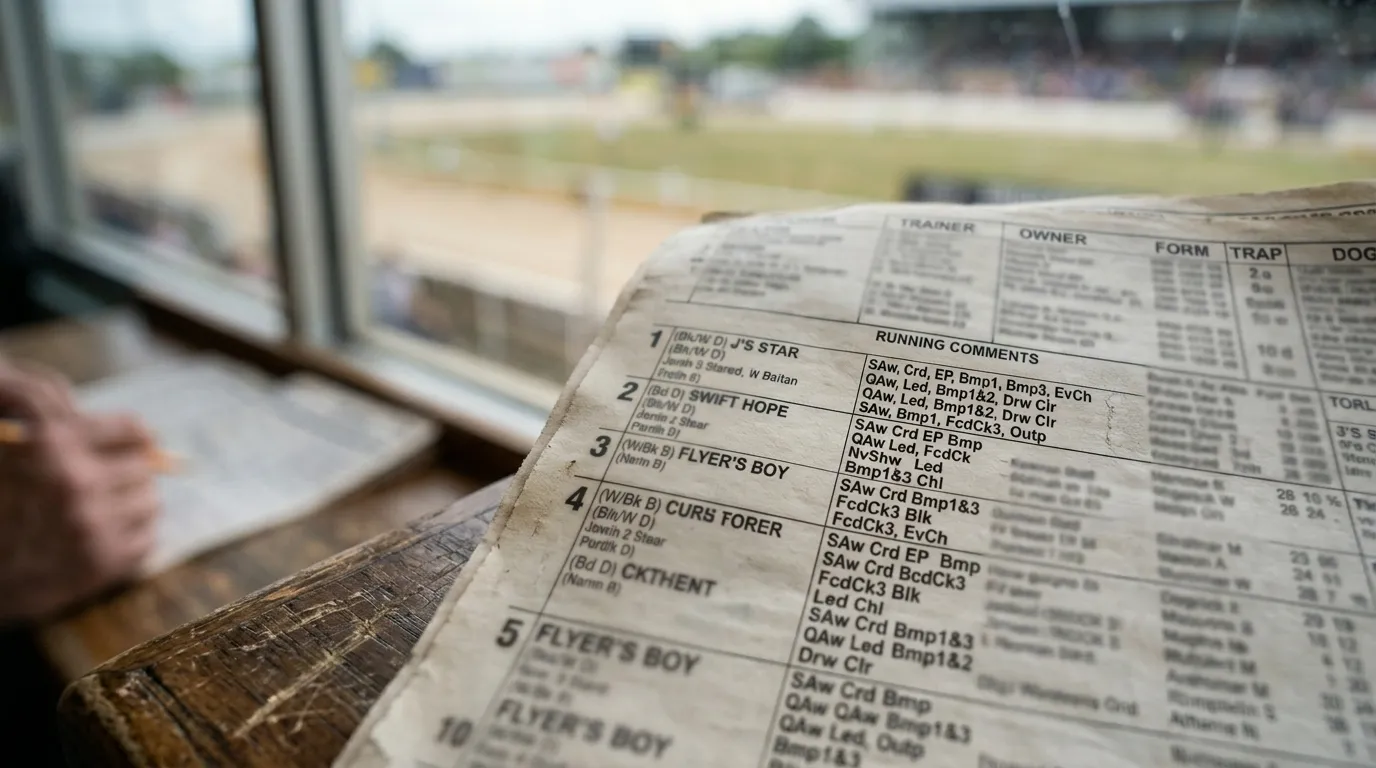
The Shorthand That Decides Your Bets — Decoded
Greyhound racing abbreviations pack the equivalent of a race commentary into two or three characters. They appear in the remarks column of every racecard and results card across all eighteen GBGB-licensed tracks in Britain, and they are one of the most information-dense elements available to anyone studying form. The problem is that nobody explains them at the point of use. You open a racecard, see “Crd2, RnOn” next to a fourth-place finish, and either you know what that means or you do not. There is no tooltip, no footnote, no helpful sidebar.
That opacity matters more than it might seem. In a sport where 3,809 injuries were recorded from 355,682 starts across GBGB-licensed tracks in 2024 — an injury rate of 1.07 per cent — the abbreviations are not just commentary. They are the first layer of safety and integrity data, documenting everything from minor crowding incidents to career-altering collisions. For bettors, they reveal the hidden story behind a finishing position. For the regulator, they form part of the evidence base for stewarding decisions. For anyone trying to assess whether a dog ran to its ability, they are essential reading.
What follows is a working reference — not an exhaustive list of every code ever used (those run to hundreds), but a practical guide to the abbreviations you will encounter most often on Newcastle and other British greyhound racecards.
Running Comments A-Z
Running comments describe what happened to the greyhound during the race. They are recorded by the racing manager at each track, applied in real time as the race unfolds, and attached to the individual dog’s result line. The most common running comments, and what they actually tell you, are these:
SAw — Slow away. The greyhound was slow to leave the traps. This is one of the most frequent abbreviations and one of the most significant for form analysis. A dog that finishes fifth after being slow away may have run a far better race than the position suggests, because it conceded two or three lengths at the start and spent the rest of the race recovering ground. Conversely, a dog that is persistently slow away has a structural problem — either trap shyness, a slow reaction, or a physical issue — that diminishes its prospects regardless of ability.
EP or EPace — Early pace. The dog showed strong speed in the initial phase of the race, from trap to the first bend. This is positive when combined with a good finishing position, and it is important context when evaluating sectional times. A dog with early pace from an inside trap has a natural advantage at Newcastle, where the 130-metre run to the first bend on 480-metre races rewards fast starters on the rail.
Crd — Crowded. The greyhound was squeezed or impeded by adjacent runners, typically at a bend. This is a racing incident, not a fault of the dog, and it should always mitigate a poor finishing position. A “Crd” remark followed by a number — “Crd2” — indicates the crowding occurred at the second bend. If the same dog finishes three lengths behind the winner after being crowded at the second bend, the actual ability gap may be negligible.
Bmp — Bumped. The dog made physical contact with another runner. Less severe than being baulked but still disruptive, particularly at speed. Bumping at the first bend is common when five or six dogs converge on the inside line simultaneously.
Bk or Baulk — Baulked. More severe than bumping — the dog’s running line was significantly impeded, causing it to check, swerve or lose momentum. A baulked dog that still finishes in the first three has demonstrated considerable ability, because the interference cost it measurable ground.
VW — Very wide. The dog ran wide on the bends, covering more ground than rivals on the inside. Running wide is not inherently negative — some greyhounds are natural wide runners seeded in traps five and six for this reason — but it does mean the dog’s time does not directly compare with that of a rail runner who took the shortest route.
RnOn — Ran on. The dog finished strongly in the closing stages. This is an encouraging remark for dogs stepping up in distance, as it suggests stamina reserves that were not fully tested. At Newcastle, where the home straight is long enough to reward closers, “RnOn” in a dog’s recent form is a useful indicator.
Ld — Led. The dog held the lead at some point during the race, usually specified with a positional number — “Ld1” means led at the first bend. “LdRnIn” means led on the run-in to the finish.
Imp — Impeded. Similar to crowded but often used for more specific interference, such as clipping heels or being knocked sideways. The distinction from “Crd” is slight and can vary between racing managers at different tracks.
Fell — The greyhound fell during the race. This is the most serious running comment and usually signals a collision or loss of balance at speed. A fall frequently results in injury, and a dog returning from a fall will typically show a gap in its form followed by one or more trial runs before returning to competitive racing.
CkBmp — Checked and bumped. The dog had to check its stride and simultaneously made contact with another runner. The double disruption typically costs more ground than either event alone.
Blk — Blocked. The dog’s path was obstructed, usually by a tiring runner in front. Less common than crowding at bends, blocking tends to occur on the straights when a front-runner fades and drifts into the path of a dog running on behind.
Positional Abbreviations and Bend Codes
Positional data in greyhound racing uses a numbering system that records where each dog sat in the field at specific points during the race. On a standard racecard, you will see a sequence of numbers separated by hyphens — for example, “2-1-1-1” — representing the dog’s position at each bend.
At Newcastle, 480-metre races have four bends. A sequence of “1-1-1-1” means the dog led from start to finish, holding first place at every checkpoint. “6-5-3-1” tells a different story: the dog was last early, improved through the middle, and hit the front only on the final bend. The pattern reveals running style — front-runner, mid-division tracker, or closer — more clearly than the finishing position alone.
Sprint races over 290 metres at Newcastle have fewer bends, and the positional sequence is shorter accordingly. Longer races over 640 metres or 706 metres involve more bends and produce longer sequences, giving a more granular picture of how the race developed.
The critical positions are the first and last. The first position tells you how the dog breaks — is it quick from the traps or does it take time to find its stride? The last position before the finishing straight tells you where the dog stood when the final push began. At Newcastle, the home straight is long enough that a dog in third or fourth at the final bend can still win if it has superior closing speed. A dog in sixth at the final bend, however, is almost certainly out of contention regardless of finishing pace.
Positional abbreviations sometimes appear alongside bend numbers in the remarks. “Disp1” means the dog disputed the lead at the first bend — it was racing head-to-head with another runner rather than holding a clear advantage. “Mid” indicates the dog raced in the middle of the track rather than on the rail or wide, and “Rls” means it raced on the rails. These descriptions flesh out the bare positional numbers and help you understand not just where the dog was, but how it got there.
Stewards’ Remarks and What They Signal
Stewards’ remarks sit at a higher level than running comments. Where running comments describe what happened during the race, stewards’ remarks record what the officials did about it — or noted for the record.
The most common stewards’ remark is “NR” — non-runner. This means the greyhound was withdrawn before the race started, either through injury discovered at kennelling, a weight discrepancy, or a veterinary decision. A non-runner does not count as a race for grading purposes, but the withdrawal itself is worth noting — particularly if the same dog has been a non-runner at multiple recent meetings, which may signal an underlying fitness issue.
“Vet” or “VetInsp” indicates the greyhound was examined by the track veterinary surgeon, either before or after the race. Post-race veterinary inspections are routine for any dog that shows signs of distress or injury, and the notation does not necessarily mean the dog was hurt. It does mean the vet checked and, depending on the outcome, the dog may face a mandatory rest period before racing again.
“BrtDwn” — brought down. The greyhound was brought down by another runner, typically as a result of a fall or collision. This is more serious than being baulked or crowded, and it almost always triggers a veterinary inspection. A dog that was brought down and subsequently passed fit to race may still carry the psychological effect of the incident into its next outing, making it hesitant at bends or reluctant to race in close quarters.
“StInt” — stewards’ inquiry. The stewards investigated an aspect of the race — typically interference between runners, a suspected false start, or an irregularity in the running. The outcome of the inquiry, if relevant to the result, will be noted separately. Stewards’ inquiries do not always lead to changes in the official result, but they indicate that something unusual occurred.
For form analysis, stewards’ remarks are the context layer. They explain absences (non-runners, veterinary holds), flag incidents that affected the result (brought down, stewards’ inquiry), and signal when a dog’s next appearance may be affected by what happened in a previous race. Ignoring them costs nothing on a single bet. Over fifty bets, it costs you the edge that separated the runners you thought were unlucky from the ones that genuinely underperformed.
The wider context is set out in our Newcastle dog results guide.
Putting them together is the form guide.
