

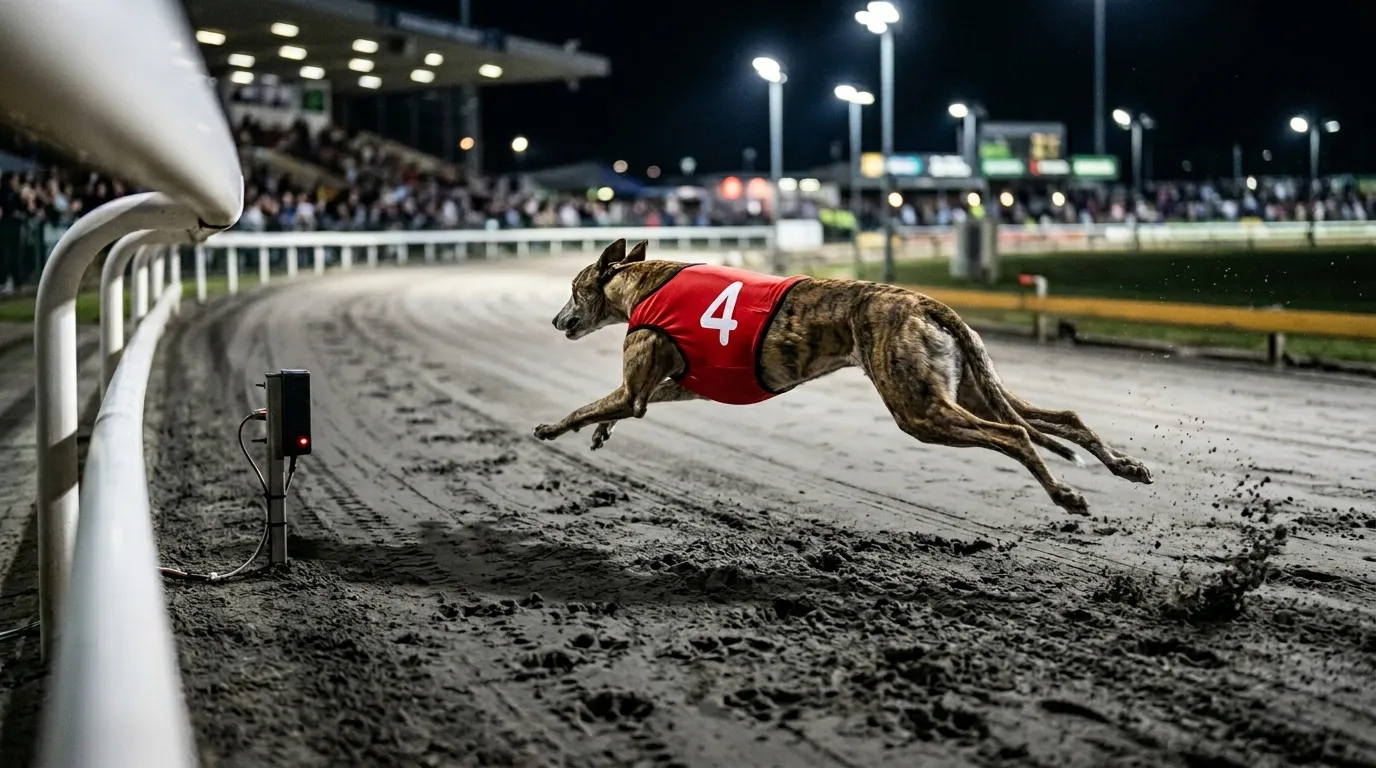
Why the Clock at the First Bend Matters More Than the Finish Time
Sectional times in greyhound racing split a thirty-second race into its component parts, and those parts tell stories that the finishing time conceals. Two dogs can cross the line in an identical 28.70 seconds over 480 metres and have run entirely different races — one leading from the first bend in 4.85 seconds, the other trapped wide, recovering from 5.15 to the bend and closing with a devastating final straight. The finishing time treats them as equals. The sectional times expose them as opposites.
That distinction has practical consequences. At Newcastle, where the run from the traps to the first bend is approximately 130 metres for 480-metre races, the opening sectional defines the shape of the entire race. A fast split from an inside trap typically means an uncontested lead into the bend. A slow split from any trap means traffic, interference and lost ground that may or may not be recoverable over the remaining distance. Understanding sectional times does not make you clairvoyant, but it gives you a structural advantage over anyone who only looks at the final number.
How Sectional Times Are Measured
Greyhound racing in Britain uses electronic timing to record two key data points: the split time and the winning time. The split time — sometimes called the sectional time or first-bend time — records how long it takes the greyhound to travel from the traps to a fixed timing beam near the winning line on the first pass. At Newcastle, this beam is positioned on the home straight, so the split captures the run from the traps, through the first bend, and along the back straight to the timing point. The exact distance covered varies by race distance because the trap positions change depending on where the start is set.
The winning time records the overall elapsed time from the traps to the finish line. It is the headline figure — the one shown in fast results and used in everyday conversation — but it is the less useful of the two for form analysis because it blends early pace, mid-race running and finishing speed into a single number.
The calculated time, or “calc time,” adds another dimension. This figure adjusts the raw winning time for track conditions — the going. If the sand is wet and slow, times will be slower across the board, and the calculated time applies a correction to normalise performances against a standard surface speed. A raw time of 29.10 on a slow track might calculate to 28.75, making it directly comparable with a 28.80 run on a fast surface. Without this adjustment, comparing times across different meetings is misleading. Most serious form platforms, including Timeform and the Greyhound Recorder, display calculated times alongside raw times in their archives.
The timing hardware itself is standardised across GBGB-licensed tracks, but the physical characteristics of each track — circumference, bend radius, distance to the first timing point — mean that split times are not directly comparable between venues. A 4.80-second split at Newcastle does not mean the same thing as a 4.80-second split at Romford or Nottingham, because the distances to the timing beam differ. Sectional analysis works best when confined to a single track, comparing dogs against each other and against the venue’s own benchmarks.
Newcastle Split Benchmarks by Distance
Newcastle’s track layout shapes the sectional profile of every race. The 415-metre circumference is smaller than some competitors — Nottingham, for instance, runs at 430 metres — and the bend radii are correspondingly tighter. This layout amplifies the advantage of early pace, particularly from inside traps, because the first bend arrives quickly and the dog that reaches it first gets the cleanest line through the turn.
Over 480 metres, the standard middle-distance trip, the run to the first bend is approximately 130 metres. Competitive split times at this distance range from about 4.70 seconds for a fast front-runner to 5.20 seconds for a slow-starting closer. A dog consistently breaking 4.85 from traps one or two is a pace threat that forces the rest of the field to react. A dog at 5.10 or above is almost certainly giving up early ground and relying on closing speed to compensate.
At Newcastle, trap two has historically produced more winners than the other boxes, a bias partly explained by the geometry of the first bend: trap two offers a balance of clean running room and a short path to the rail without the congestion risk that trap one sometimes faces from dogs diving inside. The sectional data supports this — trap two runners at Newcastle tend to record marginally faster average splits than runners from traps four, five or six over the same distance, reflecting a smoother passage to the bend rather than superior raw speed.
The 290-metre sprint is a different proposition. The run to the first bend is longer relative to the total distance, and the split time accounts for a larger proportion of the overall race. Fast sectionals in sprints are not just advantageous — they are often decisive. A dog that leads at the first bend in a 290-metre race wins more often than one that leads at the first bend in a 640-metre event, simply because there is less remaining distance for a rival to close the gap.
Over 640 metres and beyond, the relationship inverts. The initial split still matters — a slow start means traffic problems — but the longer distance allows a greater recovery. Dogs with moderate splits but strong stamina can and do win over six bends at Newcastle. The sectional profile you are looking for over longer distances is not necessarily the fastest split but the most sustainable pace — a dog that runs even sectionals throughout rather than blazing the first bend and fading on the final turn.
Applying Sectional Analysis to Selections
The simplest application of sectional analysis is identifying dogs whose finishing positions understate their performance. A runner that recorded a 4.80 split from trap five — faster than the winner from trap one — but finished third after being crowded at the second bend is a dog that ran better than the result shows. If that dog reappears on a Newcastle card drawn in trap one or two, the sectional evidence suggests it has the early pace to take advantage of the more favourable draw.
A more layered approach involves comparing a dog’s split consistency across multiple runs. A greyhound that records splits of 4.85, 4.88, 4.82, 4.90, 4.87 and 4.84 over six recent 480-metre runs is a reliably fast starter — you can predict its early pace with reasonable confidence. A dog whose splits vary from 4.75 to 5.15 across the same number of runs is unpredictable out of the traps. The consistent dog is a safer inclusion in forecasts and tricasts where you need to project finishing order; the erratic one is a risk that may or may not pay off.
Sectional times also reveal the impact of trap draw at Newcastle specifically. By comparing a dog’s splits from different traps, you can see whether it runs faster from the inside or outside. Some greyhounds perform better from trap one, where the rail provides a guiding boundary. Others are more comfortable from trap six, where they have room to stride out without being squeezed. The sectional data quantifies this preference rather than leaving it to anecdotal observation.
The limitation is sample size. A dog with three runs at Newcastle provides a thin dataset. One with twenty runs gives you a robust picture. For open-race visitors from other tracks, you often have no Newcastle-specific sectionals at all, and must rely on trial times — single-run data recorded in non-competitive conditions that may or may not reflect race-day performance. Sectional analysis is most powerful for locally trained dogs with long form lines at the venue, and least useful for newcomers whose track characteristics are unknown.
The best use of sectional times is not as a standalone selection tool but as a filter layered on top of finishing positions and racecard remarks. It answers the question that results alone leave open: did this dog run as well as its position suggests, or does the split time tell a different story?
The wider context is set out in our Newcastle dog results guide.
