

Most Newcastle Races Run for an Audience You Never See — in Betting Shops Nationwide
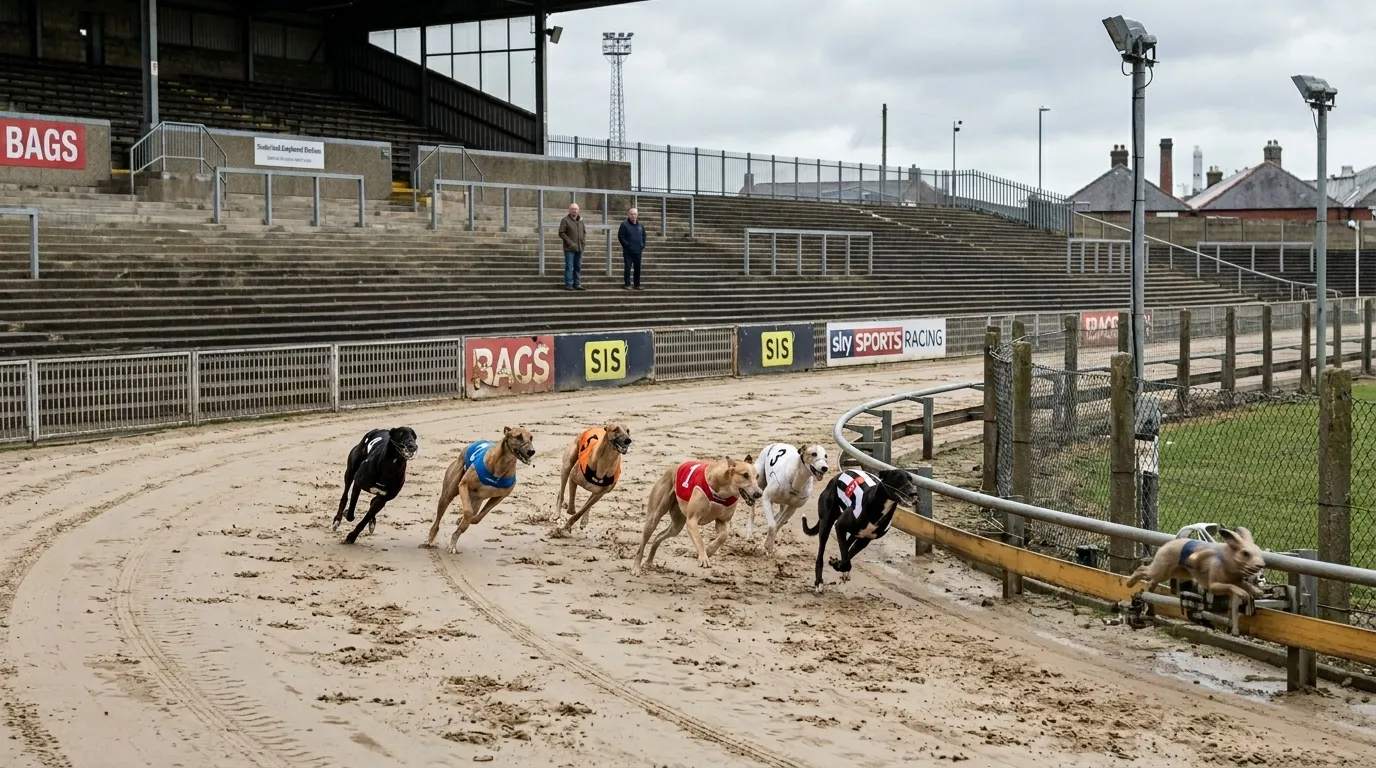
BAGS racing — the Bookmakers Afternoon Greyhound Service — is the commercial backbone of British greyhound racing, and yet most people who bet on it have only the vaguest idea of what the acronym means or how the system works. At Newcastle, the majority of weekly fixtures are BAGS meetings: Tuesday mornings, Wednesday afternoons, Friday afternoons and Saturday afternoons. These races are not staged primarily for the small on-course audience at the Fossway stadium. They are staged for the betting shops. The customers watching on screens in Ladbrokes branches from Truro to Inverness are the real audience, and the money they wager is the real revenue stream.
The scale of that revenue stream is substantial. Betting-shop turnover on greyhound racing reached £794 million in the year to March 2024. Total greyhound betting turnover — combining shops, on-course pools and online platforms — was estimated at £1.5 billion in the twelve months to March 2023. BAGS meetings generate the majority of that volume, because they run during shop hours when punters are physically present and looking for something to bet on between horse races.
Understanding BAGS is understanding the economic engine that keeps Newcastle and every other GBGB-licensed track operational. Without it, the sport’s fixture list would collapse to evening and weekend meetings that, on their own, cannot sustain the infrastructure of eighteen stadiums, five hundred trainers and six thousand racing greyhounds.
What BAGS Is and How It Funds the Sport
BAGS was established to give licensed bookmakers a steady supply of racing content during business hours. Before its creation, afternoons in betting shops were dead time between horse racing fixtures — long gaps with nothing to bet on and no reason for customers to stay. Greyhound racing, with its short races and quick turnarounds, filled that gap perfectly. A twelve-race greyhound card takes roughly two and a half hours to complete, with a new race starting every twelve to fifteen minutes. For a betting shop, that is two and a half hours of continuous customer engagement.
The funding mechanism is direct. Bookmakers pay media rights fees to the track operators for the right to screen BAGS meetings and take bets on them. These fees are the primary revenue source for daytime racing at Newcastle and every other BAGS venue. The SIS — Satellite Information Services — distributes the live video feed to betting shops nationwide, and the races are also available through online bookmaker platforms that have inherited the BAGS model in digital form.
The relationship is symbiotic but asymmetric. The tracks need the bookmakers’ money to fund daytime operations. The bookmakers need the tracks’ content to keep shop customers engaged. But the bookmakers have more leverage, because they can substitute greyhound content with virtual racing, foreign horse racing or other betting products. The tracks cannot substitute their funding source as easily. This power dynamic explains why prize money at BAGS meetings is modest — the bookmakers are paying for content, not for spectacle, and they pay what the market allows rather than what the sport might wish.
The British Greyhound Racing Fund, funded by voluntary contributions from bookmakers, supplements media rights income and supports prize money, welfare programmes and regulatory costs. The voluntary nature of the levy — unlike horse racing’s statutory levy — has been a persistent source of tension between the sport and the betting industry. Not all bookmakers pay the voluntary levy, and those that do contribute varying amounts. The GBGB has repeatedly called for a statutory levy to level the playing field and secure more predictable funding for the sport’s welfare and regulatory obligations.
Newcastle’s BAGS Schedule
Newcastle’s BAGS meetings slot into a national timetable that distributes greyhound content across the day so that betting shops always have a meeting to screen. The coordination is managed centrally, and Newcastle’s position in the schedule reflects its time zone, track availability and the need to avoid clashing with meetings at other GBGB stadiums.
Tuesday mornings open the week with a first race at 10:45 — one of the earliest starts on the national BAGS calendar. Wednesday and Friday afternoons follow the standard pattern with first race around 14:00. Saturday afternoon runs concurrently with Saturday morning and early-afternoon meetings at other tracks, providing continuous coverage through the busiest betting-shop day of the week.
The card at a BAGS meeting is twelve races, run over the standard range of distances available at Newcastle: 290 metres, 480 metres, 500 metres, 640 metres, 706 metres and 895 metres, though not every distance appears on every card. The 480-metre trip dominates, as it does across British greyhound racing, and the race grades are determined by the racing manager based on the pool of available runners from Newcastle’s contract trainers.
One detail that shapes the BAGS experience at the track: because the primary audience is off-course, the on-course atmosphere at BAGS meetings is minimal. The terracing is quiet, the bars are lightly staffed, and the crowd is small. For punters who want to watch racing in person without the social pressure of a busy evening meeting, BAGS sessions offer a calm, focused environment where you can concentrate on the form and the races without distractions. For anyone expecting a night out, BAGS is the wrong meeting type. That distinction catches out a surprising number of first-time visitors who arrive on a Wednesday afternoon expecting Saturday-night energy.
How BAGS Affects Race Quality and Grading
The volume of BAGS racing has a direct effect on the quality and competitiveness of the fields at Newcastle and every other track. Running three or four BAGS meetings per week requires a deep pool of greyhounds, and the grading system — which places dogs in races based on recent form and times — must accommodate a large number of runners across a wide ability range. The result is a grade structure that descends from A1 at the top to A10 or A11 at the bottom, with each level representing a narrower band of ability.
At the top of the graded ladder, the racing is strong. A1 and A2 dogs at Newcastle are competitive animals running close to their peak ability, and the form figures from these grades are reliable indicators of genuine class. As you descend through the grades, the margins between dogs narrow and the results become less predictable — not because the grading is inaccurate, but because smaller differences in ability are more easily overridden by a slow start, an unfavourable trap draw or minor interference at a bend.
The practical consequence for bettors is that BAGS racing in the lower grades is harder to analyse profitably. The form is more volatile, the margins are thinner, and the effect of random variables — a stumble, a bump, a hare glitch — is proportionally larger. Higher-grade BAGS races offer more readable form and more predictable outcomes, which makes them the more productive betting medium even though the prices are typically shorter. The volume of BAGS racing means there are always races on the card at every grade level; the skill is in selecting the races where the form is meaningful rather than treating every race as an equal opportunity.
BAGS meetings also serve as the development pathway for young greyhounds entering the racing system. A dog new to Newcastle will typically debut in a trial, then be graded into an appropriate band based on its trial time. Its first competitive races will be at BAGS meetings, where the graded fields provide a controlled introduction to racing against opponents of similar ability. The form generated in these early BAGS races becomes the foundation of the dog’s racecard — the data that future bettors will analyse when the same dog appears on a Thursday evening card or an open-race entry.
The wider context is set out in our Newcastle dog results guide.
Where those cards fall is in the fixture list.
