

Two Bet Types That Multiply Small Stakes into Headline Payouts
A forecast and a tricast are the two bet types in greyhound racing that routinely turn a one-pound stake into a double- or triple-digit return. They require you to predict the finishing order — first and second for a forecast, first through third for a tricast — and the prices they pay reflect the difficulty of getting it right. In a six-runner greyhound race, there are thirty possible forecast combinations and 120 possible tricast outcomes. The maths alone explains why the dividends can be substantial even when the first two or three finishers were among the favourites.
Greyhound racing and forecast betting have a symbiotic relationship. The sport generated an estimated £1.5 billion in total betting turnover in the twelve months to March 2023, and a meaningful share of that volume comes from forecast and tricast pools. In betting shops — where greyhound racing accounts for £794 million in annual turnover — these bet types are a staple of the afternoon punter’s routine: small stakes, frequent races, and the periodic thrill of a payout that makes the preceding losses forgettable.
Understanding the mechanics of each bet type, the difference between a straight forecast and its variations, and when each option offers genuine value is the difference between treating these bets as lottery tickets and using them as a structured part of a selection process.
How a Forecast Works — Step by Step
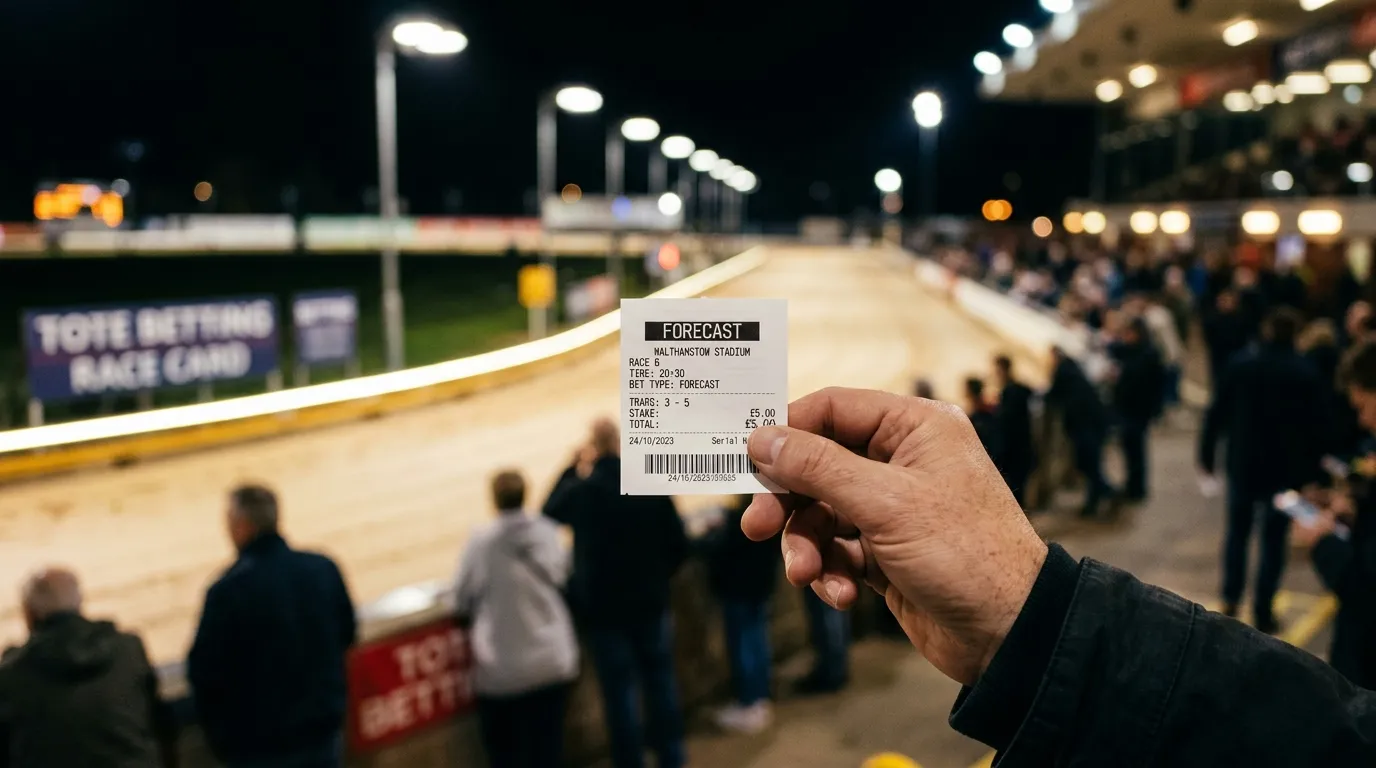
A straight forecast requires you to name the first and second finishers in a race, in the correct order. If you predict that the dog in trap three will win and the dog in trap five will finish second, both must finish in exactly those positions for your bet to pay out. If trap three wins but trap five finishes third, you lose. If trap five wins and trap three finishes second, you also lose. Order matters absolutely.
The dividend is calculated by a formula called the Computer Straight Forecast, known universally as the CSF. This formula takes into account the starting prices of the first and second finishers and produces a payout figure per one-pound unit stake. The CSF is not a fixed return — it varies from race to race depending on the prices. A forecast combining a 2/1 winner with a 5/1 second pays considerably less than one combining a 10/1 winner with an 8/1 second, because the latter outcome was harder to predict and attracted less money from the betting public.
Typical CSF dividends in greyhound racing range widely. A favourite-and-second-favourite combination might pay between three and eight pounds to a one-pound stake. An outsider-outsider combination can pay fifty, eighty or occasionally over a hundred pounds. The average payout sits somewhere in the middle teens, but that average disguises enormous variance — which is precisely why forecasts appeal to punters who want larger returns from small stakes without needing to construct accumulators across multiple races.
One critical detail: the CSF is calculated after the race, not before. You cannot look up what your forecast will pay before the runners pass the post. The starting prices are only finalised at the moment the traps open, and the formula applies those prices to generate the dividend retrospectively. This means you are accepting an unknown payout when you place the bet, which distinguishes forecasts from fixed-odds betting where the price is agreed in advance.
Tricast: Predicting the Top Three in Order
A tricast extends the forecast concept by one additional position: you must name the first, second and third finishers, all in the correct order. In a six-runner race, there are 120 possible permutations (6 x 5 x 4), which means the probability of any single combination occurring by chance alone is less than one per cent. The payouts reflect this difficulty.
The Computer Tricast formula works similarly to the CSF but incorporates the starting price of the third-place finisher as well. Because three runners must finish in the exact predicted order, tricast dividends are typically several times larger than forecast dividends for the same race. A race where the forecast pays twelve pounds might produce a tricast paying forty-five or sixty pounds, depending on the price of the third-place dog.
Tricasts in greyhound racing have a reputation for producing eye-catching returns, and that reputation is deserved. An all-outsider tricast — where the first three finishers were 8/1, 6/1 and 10/1, for instance — can pay several hundred pounds to a one-pound stake. These outcomes are rare, which is precisely why they pay so well, but they occur often enough in a sport where six evenly matched dogs can produce unpredictable results that the tricast pool remains active and liquid at most meetings.
The practical difficulty with tricasts is accuracy. Identifying the winner is hard enough. Identifying the second and third finishers in the correct order requires an additional layer of judgement — or luck — that multiplies the difficulty without a proportional increase in the information available to you. Most successful tricast bettors do not try to find a single correct combination. Instead, they use permutation bets that cover multiple finishing orders, accepting a higher initial stake in exchange for a better chance of hitting the right sequence.
Reverse and Combination Forecasts Explained
A reverse forecast is the simplest variation. Instead of predicting which dog finishes first and which finishes second, you select two dogs and cover both possible orders: A first and B second, or B first and A second. This costs twice the unit stake — because it is effectively two straight forecasts — but doubles your chance of collecting. If your two selections finish first and second in either order, one of the two forecasts pays out.
The payout on a reverse forecast is typically lower than a straight forecast for the winning combination, because the second leg (the losing one) costs you a unit stake that produces no return. Net profit depends on the CSF dividend for the winning combination minus the cost of the losing leg. In most cases, if the CSF is above three or four pounds, the reverse forecast produces a positive return after covering both stakes.
Combination forecasts take the concept further. A combination forecast lets you select three or more dogs and covers every possible first-and-second permutation among them. Selecting three dogs produces six forecast combinations (3 x 2); selecting four produces twelve (4 x 3). The stake is multiplied accordingly — a one-pound combination forecast on three dogs costs six pounds — but you are covered for any finishing order involving your selections in the first two places.
Combination tricasts follow the same logic. Selecting three dogs for a combination tricast covers all six possible first-second-third orderings, costing six units. Selecting four dogs covers twenty-four permutations and costs twenty-four units. The cost escalates rapidly with each additional selection, which imposes a natural discipline: the more dogs you include, the more confident you need to be that at least one permutation will occur at a dividend high enough to cover the total stake.
GBGB Chief Executive Mark Bird, reflecting on the sport’s financial and welfare trajectory, noted in 2025 that “the initiatives we have introduced in recent years are now embedded and are helping to consolidate the significant progress we have made since 2018 across all measures.” That progress includes the regulatory and data infrastructure that underpins fair betting — the integrity of starting prices, the transparency of CSF calculations and the track-level stewarding that ensures results are trustworthy. Forecast and tricast bets depend entirely on the accuracy of the finishing order, which in turn depends on races being run cleanly. The regulatory framework may not be visible on the betting slip, but it is the foundation the slip rests on.
The strategic question with any forecast or tricast variation is always the same: does the expected dividend justify the total stake? A combination tricast on four dogs costs twenty-four pounds. If the likely payout for the winning combination is thirty pounds, the margin is thin and the risk-reward is poor. If the likely payout is two hundred pounds, the twenty-four-pound investment looks different. Estimating likely payouts requires experience — the CSF and Computer Tricast formulae are not published in a form that allows easy pre-race calculation — but reviewing historical dividends for similar types of races at the same track gives a working baseline. Newcastle’s results archive, with its CSF and tricast returns recorded for every race, is the tool for building that baseline.
The wider context is set out in our Newcastle dog results guide.
