

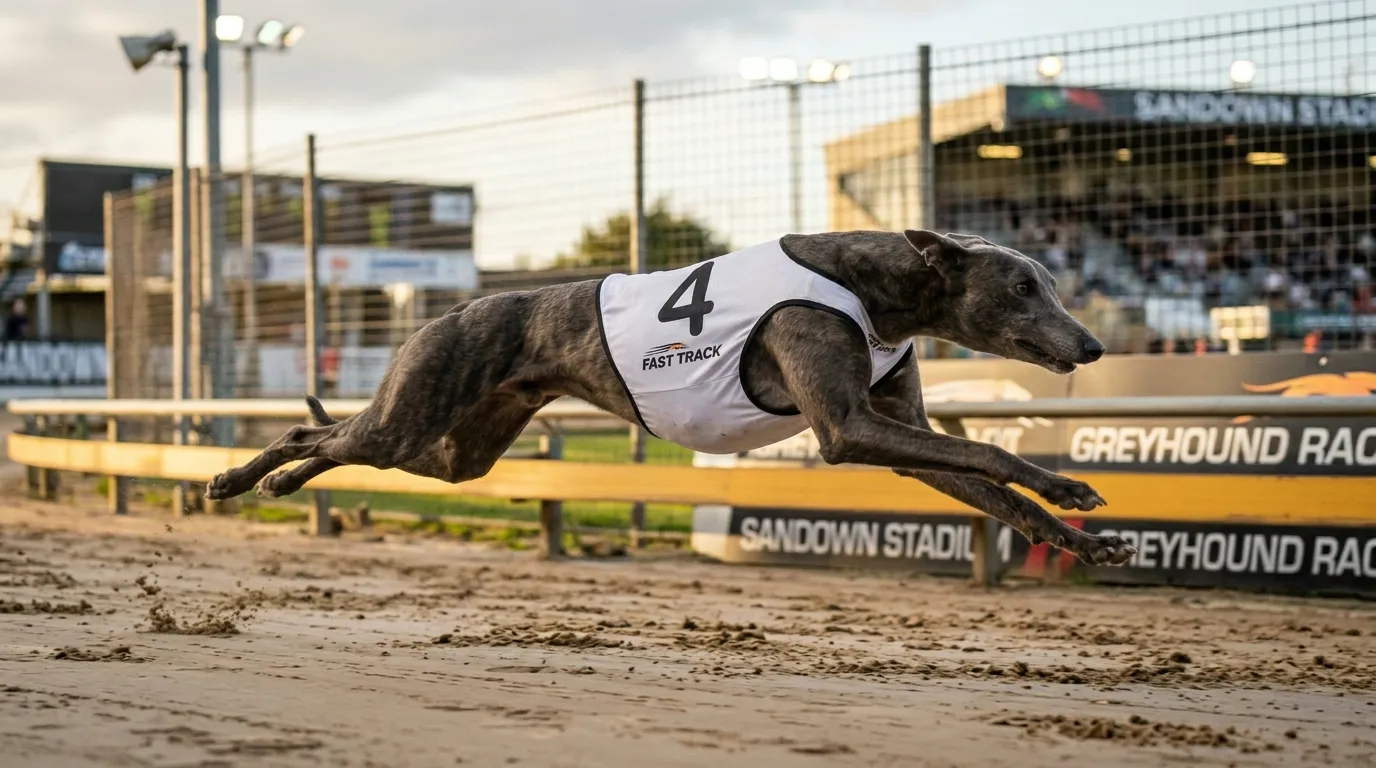
Forty-Plus Miles Per Hour in Under Six Seconds — Why Greyhounds Are Built for Speed
How fast do greyhounds run? The short answer is around forty-five miles per hour at peak velocity, making them the fastest dog breed and one of the fastest land animals over short distances. The longer answer — the one that matters if you are analysing race results — involves acceleration profiles, muscle fibre composition, aerodynamic build and the biomechanical trade-offs that make a greyhound devastating over 290 metres but vulnerable over 895.
A racing greyhound reaches top speed within approximately six seconds of leaving the traps. At Newcastle, where the run to the first bend on a 480-metre race is roughly 130 metres, the dogs are already near peak velocity before they enter the first turn. The split time to the timing point — typically under five seconds for a fast starter — captures this explosive acceleration. Everything that happens after the first bend is a question of how well the animal sustains that speed, navigates tight turns on a 415-metre circuit, and manages the deceleration that fatigue inevitably imposes.
Understanding the physiology behind these numbers changes how you read a racecard. A dog is not a machine with fixed output. It is a biological system whose performance is shaped by anatomy, fitness, weight, age and the accumulation of stress from racing at high speed. The injury rate on GBGB-licensed tracks — 1.07 per cent of starts in 2024, the lowest on record — is a statistical reflection of what happens when those biological limits are tested week after week.
Top Speed and Acceleration Data
Peak greyhound speed is most reliably measured at between forty-three and forty-five miles per hour, though individual dogs in optimal conditions have been clocked marginally higher. For context, that is roughly sixty-five to seventy kilometres per hour — faster than the urban speed limit in most British cities and comparable to the cruising speed of a horse in a flat-out gallop over a short distance.
The acceleration is arguably more impressive than the top speed itself. A greyhound goes from stationary in the traps to over thirty miles per hour within the first two to three seconds, a rate of acceleration that exceeds most production cars in the same time window. The explosive start is powered by the hindquarters — the largest muscle group in the animal’s body — and the greyhound’s unusually high proportion of fast-twitch muscle fibres, which generate maximum force in short bursts.
Deceleration is the counterpart that racecards rarely discuss but that results frequently reflect. A greyhound’s top speed is sustainable for approximately 250 to 300 metres before fatigue begins to erode the pace. Over a 480-metre race at Newcastle, this means the dog is decelerating for the final 150 to 200 metres. Over a 290-metre sprint, the deceleration window is minimal — the race ends before fatigue takes hold, which is why sprint results are more closely correlated with trap speed than with stamina. Over 640 metres and beyond, the deceleration phase dominates, and the race becomes a test of which dog loses speed the least rather than which dog is the fastest at the start.
The practical implication for form analysis is this: sectional times in the early phase of a race are a measure of acceleration and top speed. Finishing times over longer distances are a measure of stamina and fatigue resistance. Two dogs with identical split times but different finishing times over the same distance are physiologically different athletes — the one with the faster finish is sustaining its effort better, and that advantage compounds as the distance increases.
The Anatomy Behind the Speed
The greyhound’s body is an exercise in aerodynamic efficiency. The deep chest houses oversized lungs and a heart that is proportionally larger than in any other dog breed, delivering oxygen to the muscles at a rate that supports explosive and sustained effort. The narrow waist and tucked abdomen reduce drag. The long, lean legs provide a stride length that covers more ground per step than any comparable breed, with a double-suspension gallop — a gait where all four feet leave the ground twice per stride cycle — that maximises speed at the cost of stability.
That double-suspension gallop is the source of both the greyhound’s extraordinary speed and its vulnerability to injury. At full pace, the forces through the limbs are immense. The hock and wrist joints absorb repeated impacts equivalent to several times the dog’s body weight, and the tendons and ligaments that stabilise those joints are under constant strain. Fractures, muscle tears and ligament injuries are the predictable consequences of running at forty-five miles per hour on a tight oval track where centripetal forces add lateral stress to the already-loaded limbs.
Muscle fibre composition varies between individual greyhounds and influences their ideal racing distance. Dogs with a higher proportion of fast-twitch (Type II) fibres generate more explosive power and excel over sprints but fatigue quickly. Dogs with more slow-twitch (Type I) fibres sustain their effort longer and perform better over staying trips. Trainers assess this implicitly through trial runs at different distances, but the underlying physiology explains why some dogs are natural sprinters, others are natural stayers, and very few are genuinely competitive across the full distance range.
Weight is a performance variable that the racecard tracks precisely. Greyhounds are weighed before every race, and any dog whose weight varies by more than one kilogram from its last recorded outing is withdrawn under GBGB rules. A kilogram of additional body mass — roughly two per cent of a typical racing greyhound’s weight — represents extra load that the muscles must accelerate and the joints must support. In a sport where races are decided by margins of hundredths of a second, that kind of weight fluctuation is not trivial. It is one reason experienced form students check the weight column on every racecard and flag significant changes as a potential performance indicator.
How Physiology Shapes Results at Newcastle
Newcastle’s track dimensions interact with greyhound physiology in specific ways that distinguish it from other venues. The 415-metre circumference produces tighter bends than larger tracks like Nottingham, which means the centripetal force through the turns is higher and the stress on the inside legs — particularly the left foreleg, which bears the braking load in left-hand bends — is greater. Dogs with a history of left-forelimb injuries are more vulnerable at Newcastle than at wider circuits, and experienced trainers factor this into their race selection.
The six racing distances at Newcastle — 290, 480, 500, 640, 706 and 895 metres — test different physiological profiles. The 290-metre sprint rewards pure fast-twitch power. The 480 and 500-metre trips require a balance of speed and endurance. The 640, 706 and 895-metre events are stamina tests where the slow-twitch fibres and cardiovascular efficiency become dominant. A dog that wins A1 sprints at Newcastle is a fundamentally different athlete from one that wins A1 staying races at the same track, and their racecards, read correctly, tell you which physiological type you are dealing with.
Temperature affects greyhound physiology directly. Muscle performance is optimal within a specific temperature range, and dogs racing on cold winter evenings at Newcastle may produce slower early sectionals as their muscles take longer to reach operating temperature. Conversely, racing in summer heat increases the risk of overheating, particularly over staying distances where the sustained effort generates significant metabolic heat. The calculated time adjustment on the racecard compensates for track surface conditions but not for the physiological effect of temperature on the dog itself — a subtlety that the form figures do not capture and that trackside observation, or at minimum a weather check, can illuminate.
The intersection of speed, physiology and track characteristics is where the deepest form analysis happens. A dog’s raw time tells you how fast it went. Its split time tells you how it distributed its effort. Its weight, distance record and injury history tell you what its body is capable of sustaining. At Newcastle, where the tight bends and variable surface amplify the differences between physiological types, reading these signals is not optional for anyone who takes the form seriously. It is the difference between seeing a number and understanding what produced it.
The wider context is set out in our Newcastle dog results guide.
What that speed produces is in the track records.
