

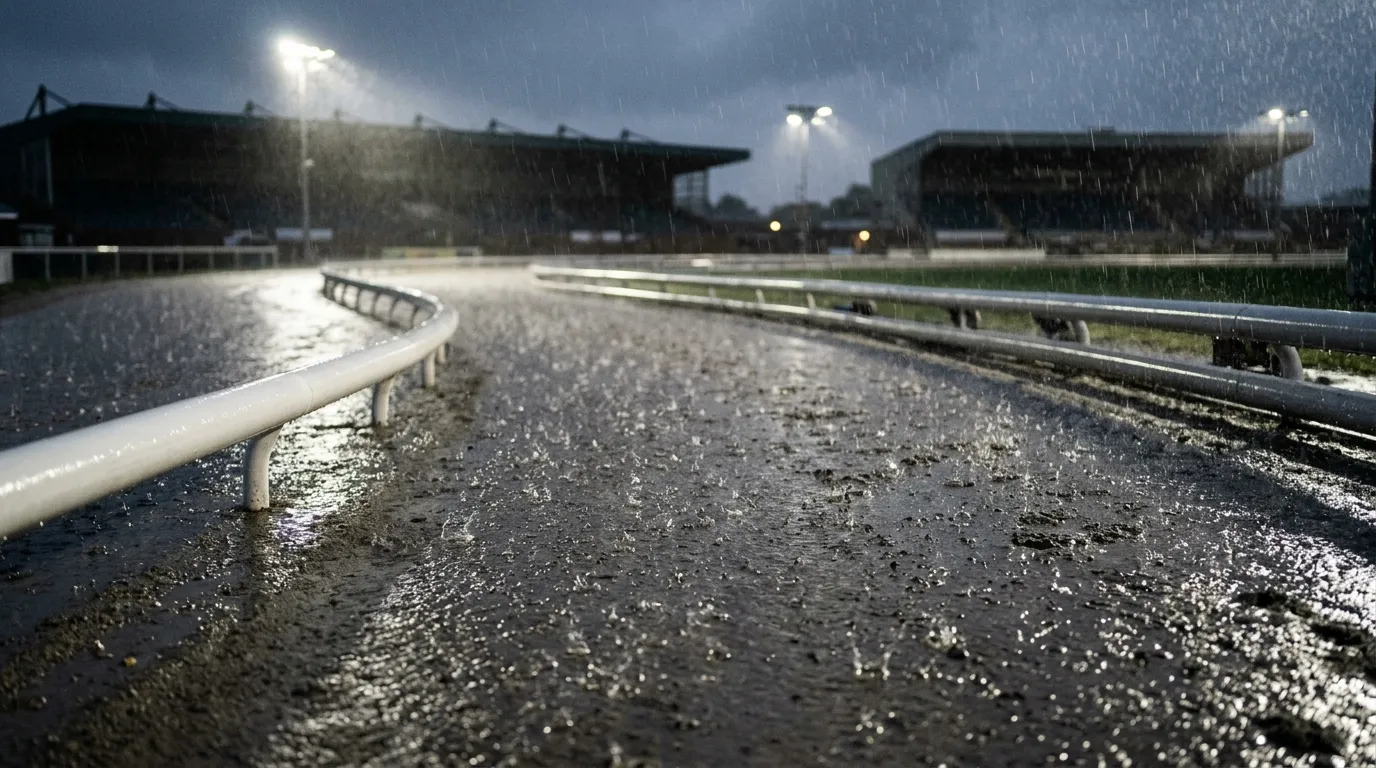
Sand, Rain and Wind Change Everything at Newcastle — Here’s How
The Newcastle dogs going report is not published anywhere as a single, official document. There is no equivalent of the horse racing going stick that produces a standardised measurement before each meeting. Instead, the going at Newcastle is inferred — from the raw times in early races, from the calculated-time adjustments applied by form services, from the weather forecast and, for those at the track, from a visual assessment of the sand surface before racing begins. That absence of an official going declaration is one of the sport’s blind spots, and it catches out punters who assume that a time recorded last Thursday can be directly compared with a time from next Saturday without adjustment.
Newcastle’s 415-metre sand circuit responds to weather with a sensitivity that shapes every race on the card. The Swaffham hare runs on a rail around the outside of the track, and the dogs race on a surface whose speed can shift meaningfully between one meeting and the next — or even between the first and last race of a single evening. Understanding how rain, temperature and wind interact with the sand surface is not optional knowledge for anyone using Newcastle results seriously. It is the difference between comparing like with like and comparing apples with weather systems.
Newcastle’s Sand Surface and Its Properties
The racing surface at Newcastle is sand, as it is at every GBGB-licensed stadium in Britain. Sand replaced grass at most tracks decades ago and offers a more consistent, lower-maintenance surface that drains better and produces fewer injuries from uneven footing. The specific sand composition varies between tracks — grain size, compaction level and drainage characteristics all differ — which is one reason times at Newcastle are not directly comparable with times at, say, Nottingham or Romford even over the same distance.
Newcastle’s sand is maintained by the track’s groundstaff, who prepare the surface before each meeting by watering, harrowing and levelling. The preparation aims to produce a consistent surface across all six lanes, but perfect uniformity is difficult to achieve. The inside lanes, closest to the rail, tend to receive more traffic from greyhounds taking the shortest route through the bends, which compacts the sand differently from the outer lanes. Over the course of a meeting, this differential can develop into a measurable bias, particularly on days when the sand is soft and impressionable.
The drainage properties of the sand determine how quickly the surface recovers from rain. A heavy downpour before a meeting will saturate the top layer, producing a slow, heavy surface that absorbs the dogs’ impact and slows their times. If the rain stops an hour before racing and the drainage is effective, the surface may recover to near-normal speed by the middle of the card. If the rain continues into the meeting, the surface progressively deteriorates and the final races run significantly slower than the first.
One underappreciated factor is the sand’s response to temperature. Cold, hard sand — typical of winter mornings — runs fast because the surface is firm and the dogs get maximum traction. Warm, dry summer sand can also run fast but for different reasons: lower moisture content reduces drag. The slowest conditions tend to be mild, damp evenings where the sand holds moisture without being waterlogged — a grey zone where the surface is neither fast nor dramatically slow, just persistently sluggish. These in-between conditions are the hardest to read from the form figures and the most likely to produce misleading time comparisons.
Weather Patterns and Their Effect on Times
Rain is the dominant variable. A dry surface at Newcastle is typically fast or standard. A wet surface is slow. The gradient between those states is steep — a moderate shower can add two to three tenths of a second to winning times over 480 metres, which is the equivalent of roughly two and a half to three lengths in finishing distance. That margin is enough to reverse the finishing order of a competitive graded race.
Wind has a subtler but measurable effect. Newcastle’s stadium in Byker is reasonably sheltered compared to coastal tracks like Yarmouth, but exposed enough that a strong headwind on the home straight can slow front-runners who have already spent energy leading through the bends. Conversely, a tailwind on the home straight can produce deceptively fast closing sectionals that flatter dogs with a finishing kick. Wind direction relative to the home straight is the detail that matters — and it changes with the weather system, not with the season.
Temperature affects performance through the dogs themselves as well as through the surface. Greyhounds are lean, muscular athletes with minimal body fat and limited tolerance for temperature extremes. On very cold evenings, dogs may be slower to warm up and produce sluggish early sectionals that improve as the meeting progresses and their muscles reach operating temperature. On hot summer afternoons — less common at Newcastle than at southern tracks, but not unknown — overheating can compromise performance, particularly in staying races over 640 metres or longer where sustained effort generates more body heat.
The interaction between weather variables is where prediction becomes difficult. Rain plus cold produces a fast, firm surface with slow dogs — the track is quick but the animals are stiff. Rain plus warmth produces a slow, heavy surface with comfortable dogs — the animals are loose but the track is against them. Dry plus cold is the combination that most consistently produces fast times at Newcastle, which is why winter afternoon meetings on crisp days often see times that surprise form students accustomed to summer benchmarks.
Across British tracks, trap bias can shift measurably with weather. On wet surfaces, inside traps — particularly traps one and two — tend to perform better, partly because the inside lane holds less standing water and partly because front-runners who secure the rail early are less affected by the heavy surface through the bends. At Newcastle, where trap two already holds a historical advantage, wet conditions can amplify that bias further. Dry, fast conditions tend to level the playing field between traps, as the surface offers consistent traction across all lanes. In its analysis of trap bias across UK tracks, The Game Hunter noted that trap one’s general win rate of eighteen to nineteen per cent — above the theoretical 16.6 per cent — is partly driven by wet-weather performance at venues where the rail offers drainage benefits.
Adjusting Selections for Going Conditions
The first adjustment is the simplest: use calculated times, not raw times, when comparing form across different meetings. Calculated times apply a going allowance that normalises the surface speed, producing a figure that reflects the dog’s effort rather than the track’s condition. Most form platforms — Timeform, the Greyhound Recorder, and the official results cards from Newcastle — publish calculated times alongside raw times. If you are only looking at raw times, you are at a structural disadvantage against anyone who uses the adjusted numbers.
The second adjustment involves recognising which dogs benefit from specific conditions. Some greyhounds are demonstrably better on a fast surface — they have the speed to exploit firm ground and the acceleration to take advantage of good traction through the bends. Others prefer slower going, where their stamina and strength carry them past rivals who fade on a heavy surface. The form figures, read over six to ten runs, will often reveal this preference: a dog whose best times cluster on dry Thursdays and whose worst performances fall on wet Saturdays has a clear surface preference that should influence your selections.
The third adjustment is observational. If you are watching live — at the track or via a stream — the early races on a card provide real-time information about the going that no pre-race forecast can match. If the first three races all run two tenths slower than expected, the surface is sluggish and you should recalibrate your expectations for the remainder of the card. If the first three races run faster than expected, conditions have changed since the racecard was compiled — perhaps the sun dried the sand, or the groundstaff watered more lightly — and the dogs with early pace will benefit more than the form suggested.
No going report from any external source replaces this kind of in-meeting observation. The going at Newcastle is a moving target, and treating it as a fixed input is one of the more reliable ways to misread the form.
The wider context is set out in our Newcastle dog results guide.
The draw shifts with it: trap bias data.
