
The Oldest Category One Greyhound Race Still Held at Its Birthplace
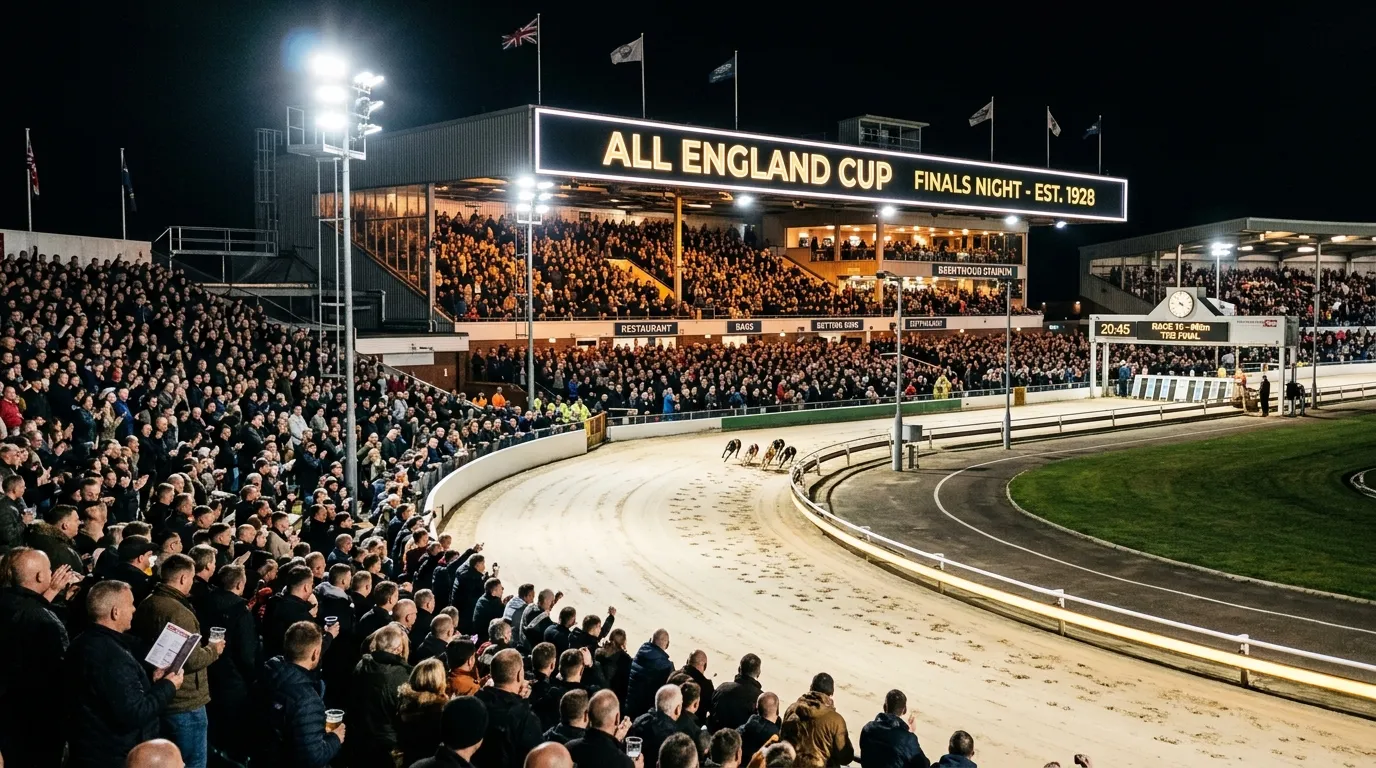
The All England Cup is the defining event in Newcastle’s greyhound racing calendar and one of the longest-running competitions in British dog racing. First staged at Brough Park in 1938, it has survived a world war, multiple changes of stadium ownership, and the broader decline of the sport from a mass-entertainment industry to a niche pursuit — all without leaving the venue where it began. That longevity makes it unusual. Most greyhound competitions of similar vintage have been discontinued, relocated or absorbed into other events. The All England Cup still runs at Newcastle, still draws national-calibre entries, and still generates the biggest crowds of the year at the Fossway stadium.
In 2026, British greyhound racing marks its centenary — one hundred years since the first modern oval-track race at Belle Vue in Manchester. The All England Cup, at eighty-eight years old, has been part of that story for almost its entire span. Its continued presence at Newcastle is not just sporting heritage. It is the economic and promotional centrepiece around which the stadium builds its annual programme.
Race Format, Rounds and Prize Money
The All England Cup is a Category One event under GBGB regulations, the highest classification for open races in British greyhound racing. Category One status requires a minimum prize fund of twelve thousand five hundred pounds, though the All England Cup’s total purse typically exceeds this floor. The competition is open to entries from licensed trainers across Britain, and the field that assembles at Newcastle represents a cross-section of the country’s best middle-distance greyhounds.
The format follows the standard multi-round structure used for major greyhound competitions. Entries are drawn into heats — usually five or six — with six runners per heat racing over 480 metres on Newcastle’s sand surface. The top two finishers from each heat, plus the fastest losers, advance to the semi-finals. The semi-final winners and fastest losers progress to a six-dog final. The entire competition is completed within a fifteen-day window, typically spread across consecutive Thursday evenings in late autumn, with the final forming the centrepiece of a standalone event night.
The total prize pool across British greyhound racing stands at £15.7 million, and the All England Cup’s share of that total reflects its Category One status. For trainers, the financial incentive to enter is significant — the winner’s purse alone can represent a meaningful return on the cost of maintaining a top-class greyhound through a full racing season. For owners, it is a prestige event that elevates the profile of their dog and, by extension, their breeding operation.
The Swaffham hare and the 415-metre circumference at Newcastle give the competition a specific character. The 480-metre trip rewards dogs that combine early pace with the ability to sustain speed through four bends — pure front-runners can be caught on the final straight, and pure closers may not have enough time to make up ground lost at the first bend. The dogs that win the All England Cup tend to be versatile: quick enough to compete for the lead and strong enough to hold off challengers in the closing metres.
Notable Winners Across the Decades
The 1938 inaugural All England Cup signalled Brough Park’s ambition to compete with the southern tracks that dominated the sport’s major events. The prize money — £1,100, a substantial sum at the time — attracted top greyhounds from London and the south, establishing the competition as a respected national event within its first running.
The most storied renewal came in 1946. All four national Derby champions entered: Mondays News (English Derby), Lilac Luck (Irish Derby), Lattin Pearl (Scottish Derby) and Negro’s Lad (Welsh Derby). The hope that all four would make the final did not materialise, but Mondays News and Lattin Pearl met in the decider, with Mondays News taking the title. The 1946 final remains the competition’s most celebrated race and a touchstone in Newcastle greyhound racing history — the night when a stadium in Byker hosted the best dogs from every corner of the British Isles.
Through the 1950s and 1960s, names like Endless Gossip and Just Fame added their own chapters. The competition survived the track’s changes of ownership — from the Greyhound Racing Association’s early involvement through Totalisators and Greyhound Holdings in 1964, Ladbrokes in 1974, and William Hill from 2003 — with each new owner recognising the All England Cup as the stadium’s signature event. No trainer has won the race more often than Charlie Lister, who secured six victories over his career, the last in 2016.
In the Arena Racing Company era, the competition has been rebranded under the Premier Greyhound Racing banner and positioned as one of the headline events in ARC’s national greyhound calendar. The 2022 renewal was won by Mickys Barrett in a time of 28.55 seconds from trap six, trained by Jason Gray — a result that underlined the competition’s ability to attract quality even as the sport’s broader profile has contracted.
The ARC Era and Rising Attendance
Arena Racing Company acquired Newcastle Greyhound Stadium from William Hill in May 2017, taking ownership alongside Sunderland Greyhound Stadium as part of a wider portfolio expansion. The ARC era has brought a deliberate focus on event marketing, hospitality packaging and digital engagement — strategies borrowed from the company’s horse racing operations and adapted for greyhound venues.
The results have been measurable. Sarah Newman, Marketing and Communications Manager at Arena Racing Company, noted in early 2026 that “competition for the leisure pound has never been higher, so to grow our footfall in 2025 is a great achievement.” Across ARC’s greyhound stadia — including Newcastle, Sunderland, Nottingham and Central Park — footfall rose five per cent year-on-year in 2025. Newcastle’s contribution to that growth was disproportionate: the All England Cup finals night saw an eighty-five per cent increase in attendance compared to the previous year’s final.
That figure is not just a percentage in a press release. An eighty-five per cent increase on finals night means the stadium was substantially fuller than it had been for any recent All England Cup, with the atmosphere — the noise, the queues at the tote, the collective tension before the final bend — reflecting a genuine event rather than an ordinary race meeting that happened to carry higher prize money.
The ARC approach to building the All England Cup’s profile includes several practical elements. Hospitality packages are promoted well in advance, with restaurant bookings and trackside deals aimed at groups and corporate clients. The racing is broadcast live on Sky Sports Racing, extending the audience far beyond the physical stadium. Promotional pricing — such as the “Back On Track” initiative that offered twenty-five per cent off admission packages — has been used to fill the venue on supporting cards in the weeks around the final, building momentum for the main event.
In 2022, ARC signed a long-term media rights deal with Entain, effective from January 2024, that gives the betting operator access to Newcastle’s racing content. That deal provides a financial underpinning for the stadium’s operations and, by extension, for the prize money that makes the All England Cup attractive to trainers from across Britain. The relationship between media rights revenue and on-track prize money is the commercial engine that keeps Category One racing viable at a venue this far north.
For racegoers and bettors, the All England Cup represents the highest-quality racing that Newcastle offers in any given year. The fields are stronger than standard graded cards, the times are faster, and the competitive intensity produces results that test even the best-prepared form assessments. It is also, by most accounts, a very good night out — which is ultimately the simplest explanation for why attendance keeps rising.
The wider context is set out in our Newcastle dog results guide.
